



Private cellular keeps coming up when plant, hangar, and shipyard teams plan their connectivity. The practical question is whether a private cellular network fits your site, because the cost pays off only under specific conditions.
Those conditions are a very large footprint, assets in motion, a high device count, or a security requirement that excludes shared infrastructure. Where none of them applies, Wi-Fi or another backhaul option usually does the job for less. Backhaul is the path sensor data takes from the device to the system that uses it. This post covers when private cellular earns its place and how it fits alongside the other options.
What a Private Cellular Network Solves
A private cellular network is a dedicated 4G or 5G network that a company runs on its own site. It gives the site its own coverage instead of depending on a public carrier or the facility’s Wi-Fi. In the United States, many private networks run on CBRS (Citizens Broadband Radio Service). The FCC’s 3.5 GHz band overview describes this shared-access option. A CBRS private network keeps its radios, and its traffic, on premises.
The difference between a private network and a public network is control. A public carrier network serves everyone in the area. A site has little say over coverage, capacity, or where its traffic travels. A private network serves one site, and its owner decides who connects and where the data goes.
That control produces three practical advantages. Coverage holds across large or outdoor areas without dropped handoffs (the moment a device passes from one radio to the next). Each radio can serve a high density of devices. The radio layer can also stay entirely on premises when security or data sovereignty requires it. Data sovereignty means the data stays under the owner’s control.
A private cellular network carries data, but sensors still have to capture it, and something still has to turn it into a view operators can act on. That capture layer sits on top of whatever backhaul the site runs.
Where Private Cellular Earns Its Keep
The strongest private 5G use cases in industrial settings share at least one of four conditions.
- Large outdoor or multi-building footprints. Yards, hangars, and campuses can exceed the practical range of enterprise Wi-Fi, while a cellular radio covers more ground.
- Assets in motion. For example, tow tractors, carts, and vehicles that cross between buildings and open yards need continuous coverage with no gap at each handoff.
- High device density. One cellular radio can serve far more endpoints than a typical Wi-Fi access point. That matters when many sensors report from the same area.
- Security or data-sovereignty requirements. Some programs require the radio layer to stay entirely on premises. Thinaer works in classified and defense-industrial environments, is DISA (Defense Information Systems Agency) approved, and supports on-premises, air-gapped, and GovCloud deployments.
These conditions often stack. A large aerospace or defense campus can meet several at once, because big footprints tend to come with moving vehicles and strict security requirements. However, a single condition can still justify private cellular for one zone while the rest of the site stays on the infrastructure it already has.
Private 5G vs. Wi-Fi: Different Zones Need Different Answers
Wi-Fi remains the right answer in many places. A dense indoor production floor with good coverage and mostly stationary equipment gains little from a private cellular network. Wi-Fi covers it for less. That said, Wi-Fi gets harder to maintain across open yards, where each access point covers a limited area and needs power and a wired connection.
Other backhaul fits other jobs. Wired Ethernet suits gateways that can be hard-wired, and public cellular suits isolated assets outside any facility network. Low-power sensors spread across a big outdoor area fit LPWAN (low-power wide-area network) options. LoRaWAN (Long Range Wide Area Network) is the common example, and our LPWAN comparison covers that choice.
A single campus often contains all of these situations at once. A production floor, an outdoor yard, and a secure bay can each need something different. As a result, one connectivity standard across the whole site forces a compromise somewhere. Thinaer starts from the environment instead. It carries wired Ethernet, Wi-Fi, cellular (4G/5G), private 5G (CBRS), and LoRaWAN, and routes all of them through one platform. Our post on real-time location systems without vendor lock-in applies the same logic to location technology.
“A production floor, an outdoor yard, and a secure bay can each need something different.”
What a Mixed-Backhaul Site Looks Like in Practice
Consider a hypothetical defense manufacturer with three kinds of space on one campus.
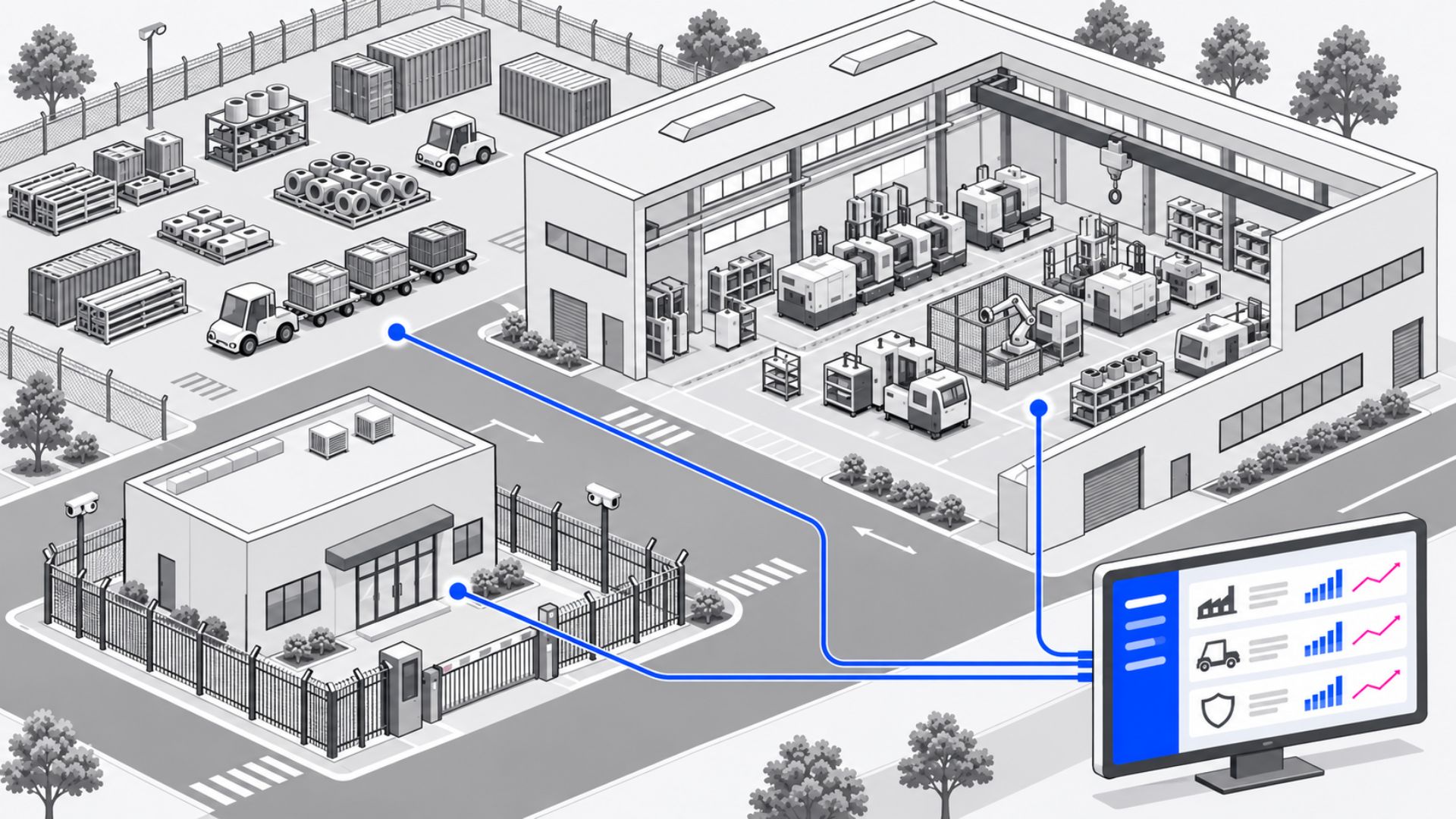
The outdoor laydown yard covers a wide area and sees vehicles moving all day, which makes it a candidate for private cellular. Static, low-power assets in the same yard, such as stored materials, might fit LoRaWAN instead. In contrast, the production floor has dense equipment and solid Wi-Fi coverage, so Wi-Fi or wired gateways handle it. The secure bay carries a data-sovereignty requirement. The customer’s own security rules decide which backhaul runs there, and Thinaer works inside that boundary.
All three zones feed the same pipeline into Sonar, Thinaer’s operational visibility application, so operators see one live picture instead of three. Sensing technology and backhaul are separate choices, so the radio that locates an asset in a zone leaves the backhaul decision open. Specifically, Thinaer deploys sensors and gateways onto whatever backhaul the customer has or is installing. Designing and running the cellular network stays with the customer or their network partner. Thinaer’s deployments span 150,000+ sensors, 33 locations, and 12M+ square feet. The technology changes from site to site. The platform stays the same.
Questions to Ask Before Choosing a Private Cellular Network
Four questions help decide whether a private cellular network belongs in your plan.
- How many devices need to connect, and how dense is that count in each zone?
- Are assets moving continuously across a large area, or mostly staying put?
- Does existing Wi-Fi cover the site adequately, or are there real dead zones?
- Does a security or data-sovereignty requirement rule out shared infrastructure?
Answers that describe a dense, mobile, or security-bound zone point toward private cellular. Answers that describe a covered, static, open zone point toward the infrastructure already in place. Because zones differ, answer each question zone by zone instead of once for the whole campus.
| Question | Points toward private cellular | Points toward other backhaul |
|---|---|---|
| Device density | Many devices packed into one zone | Modest device counts spread thin |
| Asset movement | Continuous movement across a large area | Mostly stationary assets |
| Wi-Fi coverage | Real dead zones that Wi-Fi cannot cover | Adequate coverage already in place |
| Security or sovereignty | A requirement that rules out shared infrastructure | No such requirement |
If the answers point to private cellular, the next step is a network design conversation with a carrier or integrator who builds these networks. Thinaer joins after that decision and deploys onto the result. In addition, knowing the four answers up front gives that partner what it needs to scope the design.
Start With the Environment
Private cellular is a strong answer to a specific set of problems. Where those problems do not exist, Wi-Fi, wired, or LoRaWAN backhaul usually does the job. A campus that contains both kinds of zone ends up with a mix of backhaul.
Whatever carries the data, the goal stays the same: structured, AI-ready data from every zone. The models already running in your operation then have something to work with. For a plant, hangar, or yard, Thinaer can assess the environment and deploy the right sensor mix on the backhaul that fits. Your environment decides.