



Physical AI Starts in the Shipyard
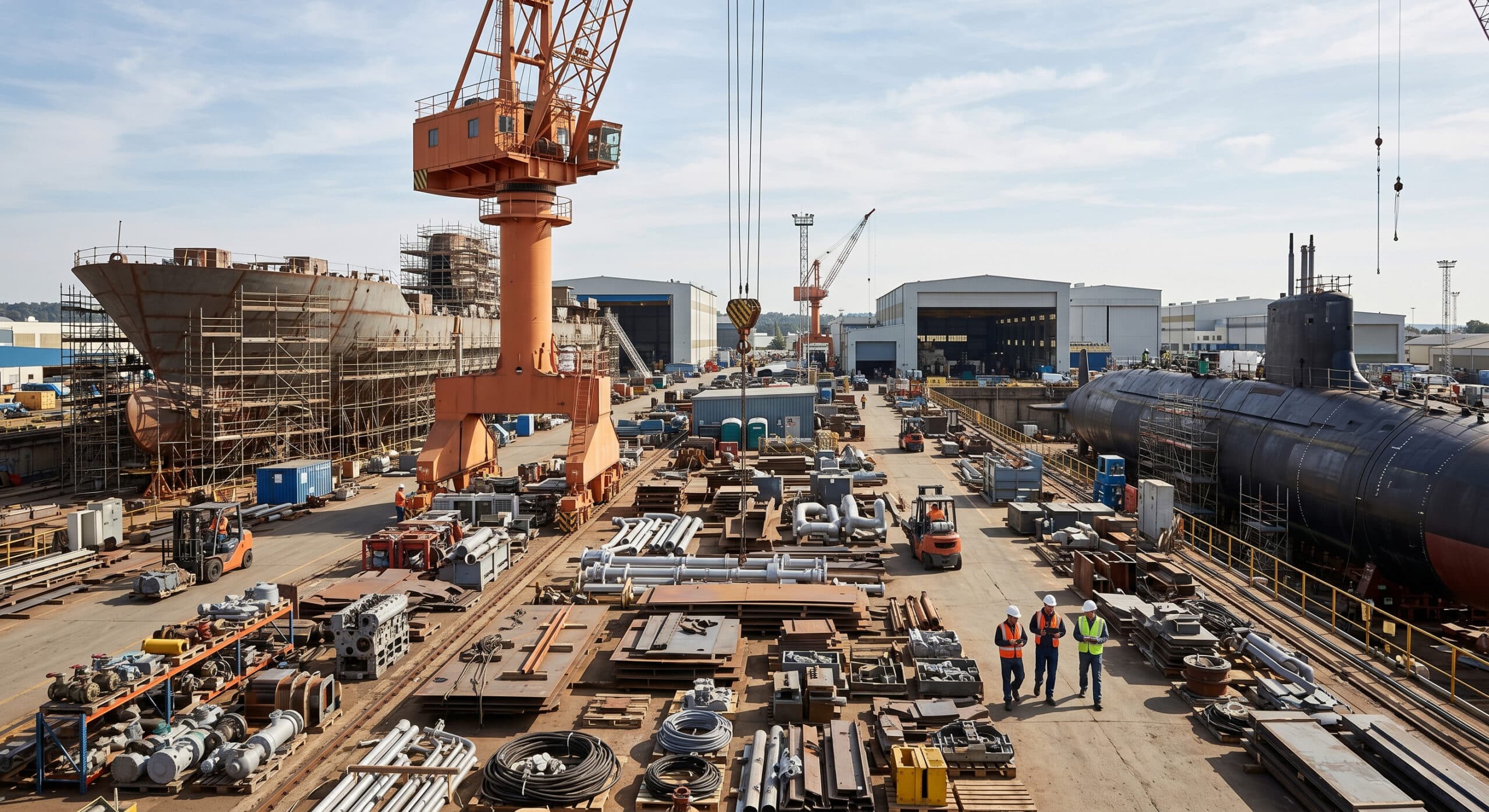
A shipyard moves thousands of assets, tools, and material packages across millions of square feet of steel. Thinaer captures what the yard has never given up, structures it, and delivers it to the systems your teams already use.
Production Targets Are Rising
Shipyard visibility is not.
A shipyard is one of the hardest physical environments to capture. Steel density changes radio behavior from one compartment to the next. Assets move between drydock, outfitting, blast and paint, and staging on no fixed schedule. Material arrives months before it is installed.
Most of what happens in between lives in spreadsheets, handheld radios, and people’s memory. Crews spend shifts looking for things the yard already owns, and planners make calls on data that was accurate last Tuesday.
That is not a reporting problem. It is a capture problem, and it is why AI programs stall the moment they leave the office and reach the waterfront. The model is not the missing piece. The data from the floor is.
Five Things Shipyard Teams Told Us Before We Built Anything
These came from shipbuilders, not from a whiteboard. They shaped how we approach shipyard asset tracking on every deployment.

One technology will not cover one yard
Coverage that works in open staging fails inside a double bottom tank. A single radio choice forces you to accept blind spots somewhere.

Steel density varies by location
Radio behavior has to be designed around the structure that is actually there, not assumed from a datasheet.

Thousands of parts behave differently than dozens
A pilot that works on fifty tags tells you very little about fifty thousand. Scale has to be proven at scale.

Legacy systems stay
Anything that requires replacing the ERP, MES, or maintenance system will not get deployed. Integration is the requirement, not the upsell.

Security posture decides the vendor
If it cannot live inside your identity management and your accreditation boundary, it is not a candidate. This is usually settled before anyone looks at a feature list, which is why our architecture starts there.
Four Data Sets the Shipyard Has Never Handed Over
Every radio, every backhaul, matched to the shipyard zone it has to survive. The environment decides the mix, not the vendor.
Asset and Tool Location
Cranes, welders, calibrated tooling, and test equipment located live, so crews stop spending shifts searching for what the yard already owns.
BLE / UWB / RFID / GPS
Material and WIP
Chain of custody from receipt through ship installation, including staging dwell time and the units that quietly went missing between zones.
Passive and Active Tags
Environmental Conditions
Temperature, humidity, and cure conditions monitored continuously in blast, paint, and controlled storage, with alerts when a range is breached.
Continuous Monitoring
Machine Utilization
Runtime, idle time, and anomaly signals pulled from equipment that was never built to report, with no machine replacement required.
Retrofit Sensing
Capture. Learn. Act.
Shipyard data capture, structured and handed off. We are the capture layer. We do not make AI. We make AI work, including the AI you have already chosen.
Stage 1
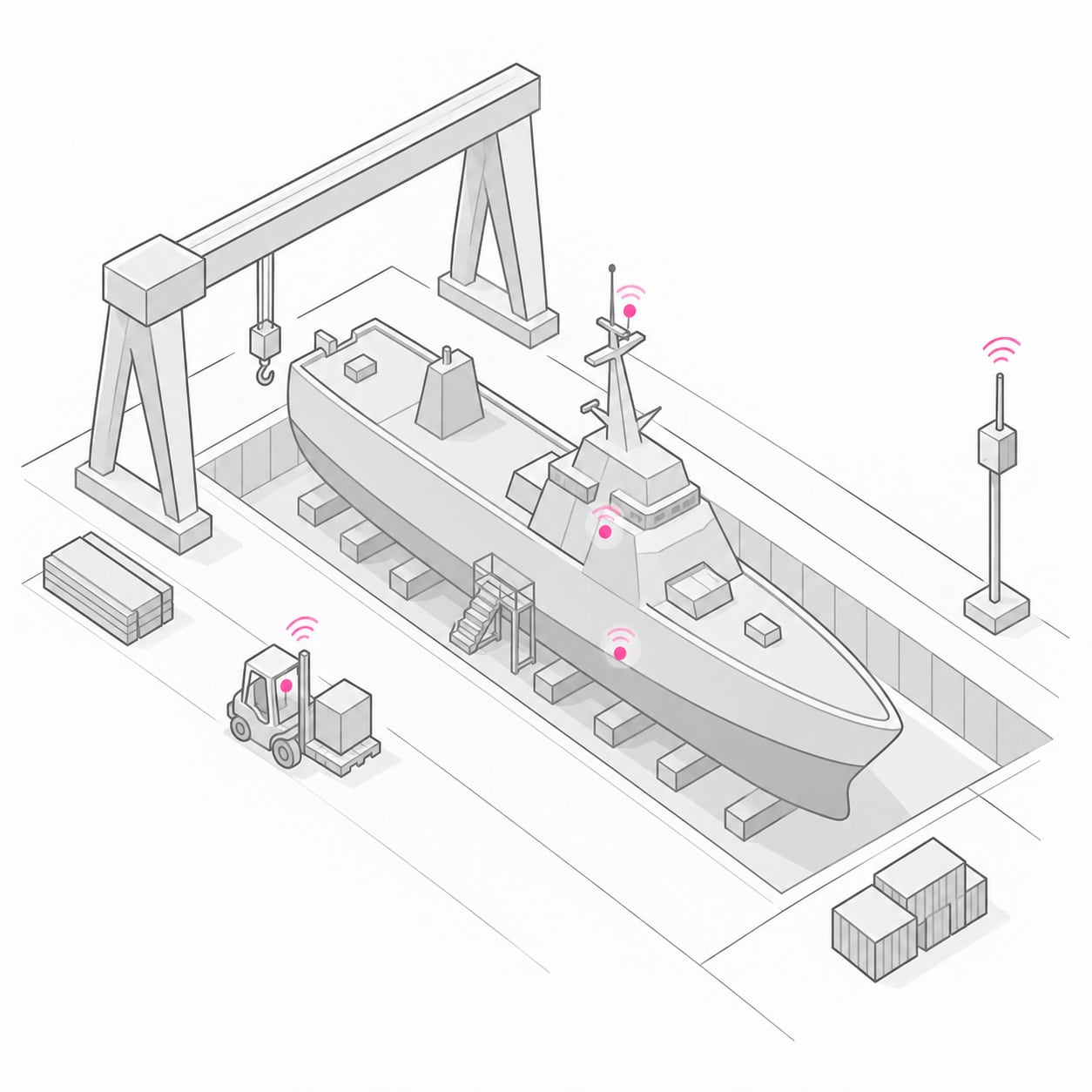
Capture
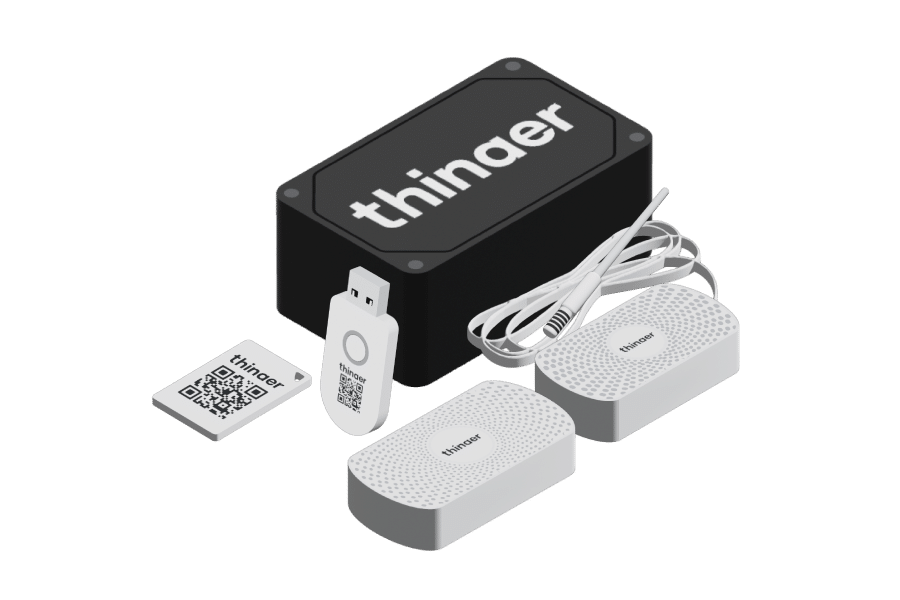
Sensors and gateways matched zone by zone to the structure of your yard. Sonar visualizes it live on day one: where assets are, what is dwelling, what fell out of range.
Sonar Lives Here
Stage 2
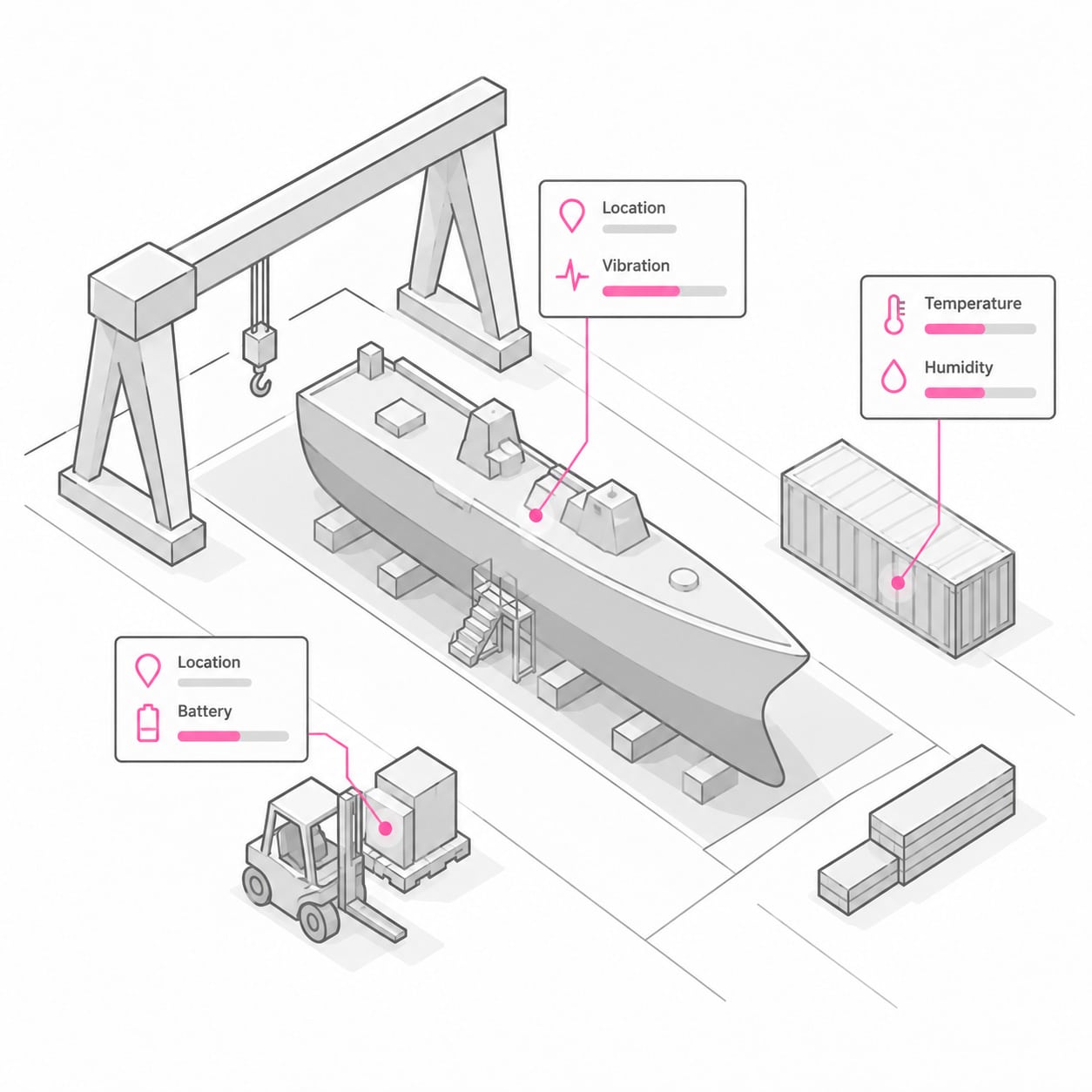
Learn
Structured, timestamped, API-ready data lands inside your cloud, under your identity management, inside your accreditation boundary. Complete and accurate enough to train on.
Your Environment
Stage 3
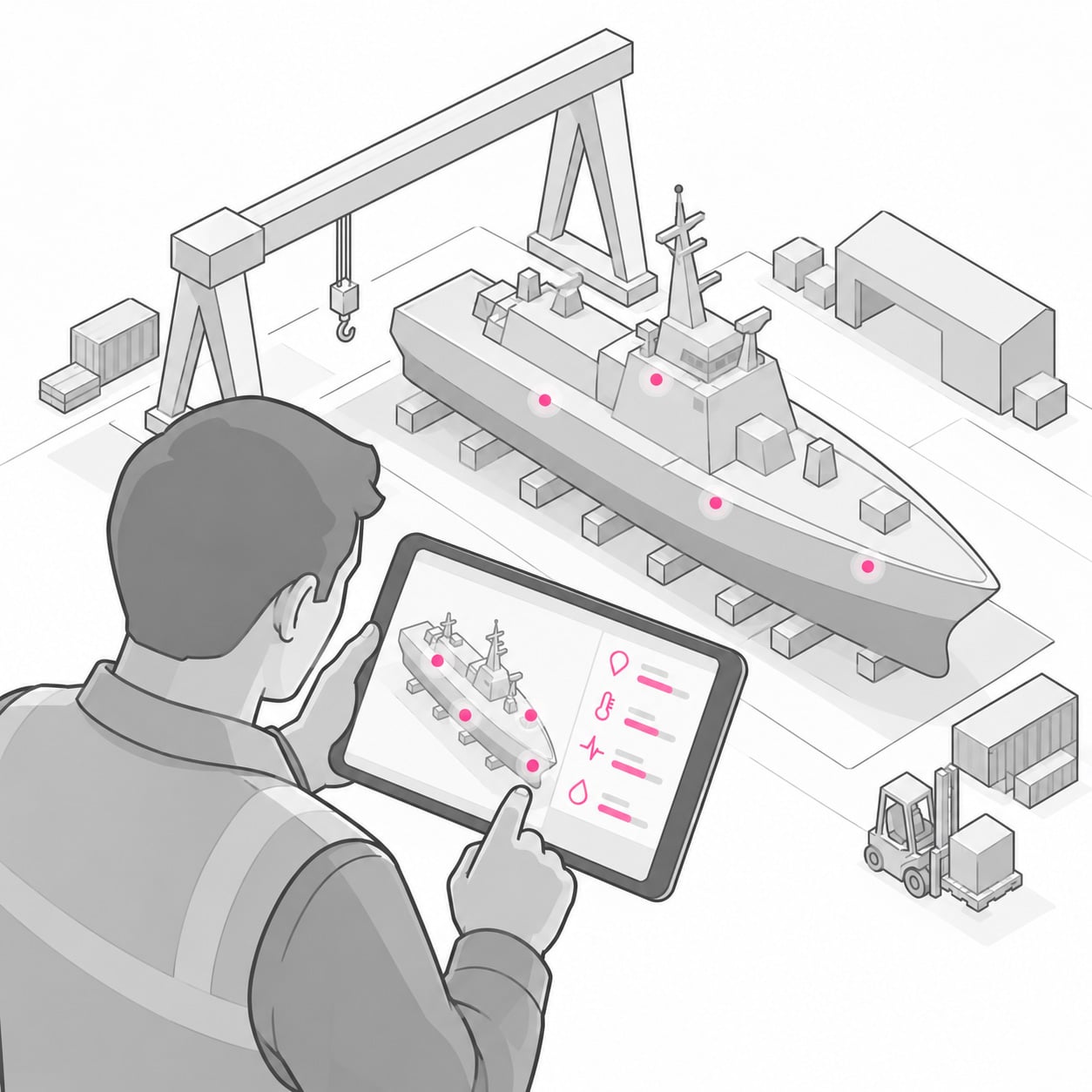
Act
Feeds into your BI, MES, ERP, and maintenance systems, and into whatever model you choose. Any cloud, any model. Your team stops guessing.
Your Systems
What Changes Across the Shipyard
Continuous Chain of Custody
Receipt, staging, kitting, and ship installation, recorded rather than reconstructed.
Search Time Replaced by a Map
Crews look at Sonar instead of walking the yard and calling on the radio.
Automated Dwell and Zone Alerts
Material that sits too long, or leaves a zone it should not, raises its own flag.
Equipment Utilization Made Visible
Runtime and idle time on existing machines, without capital replacement.
Environmental Compliance Evidenced
Continuous records for blast, paint, and cure conditions instead of manual rounds.
API-First Feeds Into Existing Systems
Data goes where your teams already work. No rip and replace.
The pilot has to survive the compartment where nothing has ever reported. Everything else is easy.
Tiered Shipyard Deployment, Sized to Your Yard and Your Crew
You decide how much of the work is ours. All three tiers land on the same platform and the same data model.
Tier 1
Full Service
Our team surveys the yard, designs coverage around the steel, installs, validates, and hands over a running system.
Tier 2
On-Site Program Management
Your crews install. Our program manager runs the design, the schedule, and the acceptance testing on site.
Tier 3
Remote Assist
You own execution. We provide the design package, the configuration, and remote support through validation.
Insights in days, not months. Coverage expands by zone and by asset class as the program earns its next phase, so the first area is producing data while the next is still being surveyed.
Built for the Accreditation Boundary You Already Live Inside
Protecting your data is not a compliance checkbox for us. In a naval shipyard or a DIB facility, it decides the architecture.
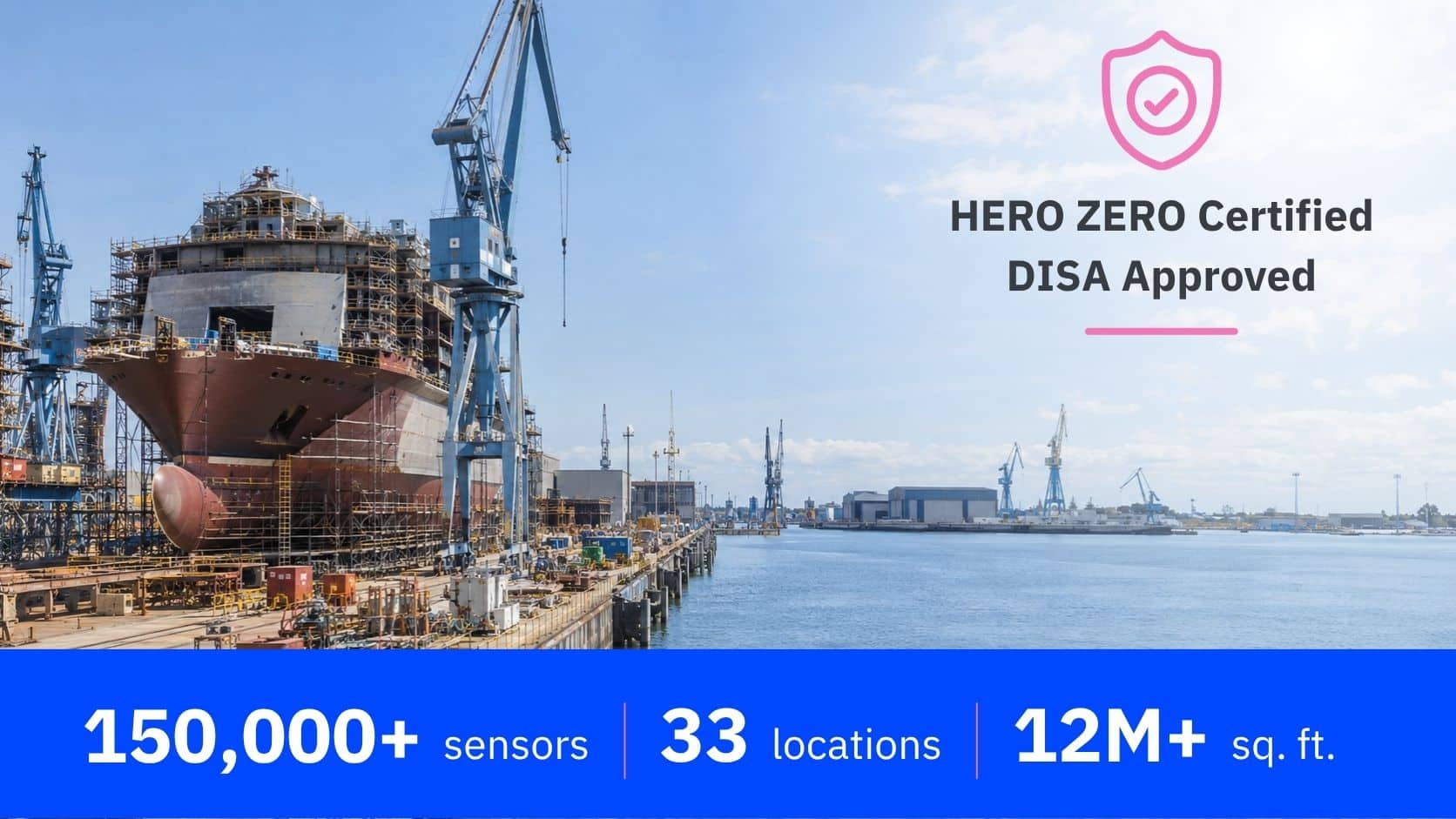
Hero Zero Certified
DISA Approved
Patent Pending, Classified Environments
De-Identified at the Source
Sensors collect and transmit fully de-identified data packets. Nothing leaves the device already tied to a person, a hull, or a program.
Association Happens Behind Your Firewall
Data stays anonymous in transit and is only associated with identifiable systems once it is inside your network.
Customer-Owned Cloud and Identity
The platform deploys into your environment, under your identity management, inside your compliance regime. Government cloud and IL5-aligned deployments supported.
Coverage Where Others Stop
Patent pending approaches for classified areas, so the restricted spaces are part of the picture rather than a permanent gap in it.
Shipyard Questions, Straight Answers
How rugged are the sensors?
They are built for shipyard conditions: temperature extremes, wash-down, vibration, and heavy metal interference. We also select the sensing technology per zone rather than forcing one device into every environment, which is usually what causes the field failures customers have seen elsewhere.
Can Thinaer work with our existing ERP, MES, and maintenance systems?
Yes, and that is the intended pattern. We are the capture layer, not a replacement for your systems of record for transactions. Structured data is delivered by API into the platforms your teams already use, including SAP and comparable enterprise systems.
Will this survive in a classified area?
Classified-area coverage is where most platforms stop. Our approach there is patent pending, and it is designed so the restricted spaces are included in the operating picture rather than written off. Specifics are covered under the appropriate agreements, and we will tell you plainly what is and is not in scope for your facility.
What happens if we need help implementing?
Choose the deployment tier that fits your crew. Full service, on-site program management, or remote assist. Every tier includes coverage design against your actual yard layout, validation testing, and support through acceptance.
What will not work?
We will say so. Some environments need more infrastructure than a first phase can justify, and some accuracy expectations are set by consumer products rather than industrial ones. We scope to what the environment can actually deliver, then expand.
Trusted by Global Leaders











Not the open staging yard. The compartment where nothing has ever reported. That is the conversation worth having, and it is the fastest way to find out whether we belong in your program.
Let’s talk.
Talk to our shipbuilding team, and we’ll walk the floor with you, scope a phased deployment, and show you what Sonar sees in the compartments other platforms have never reached.