



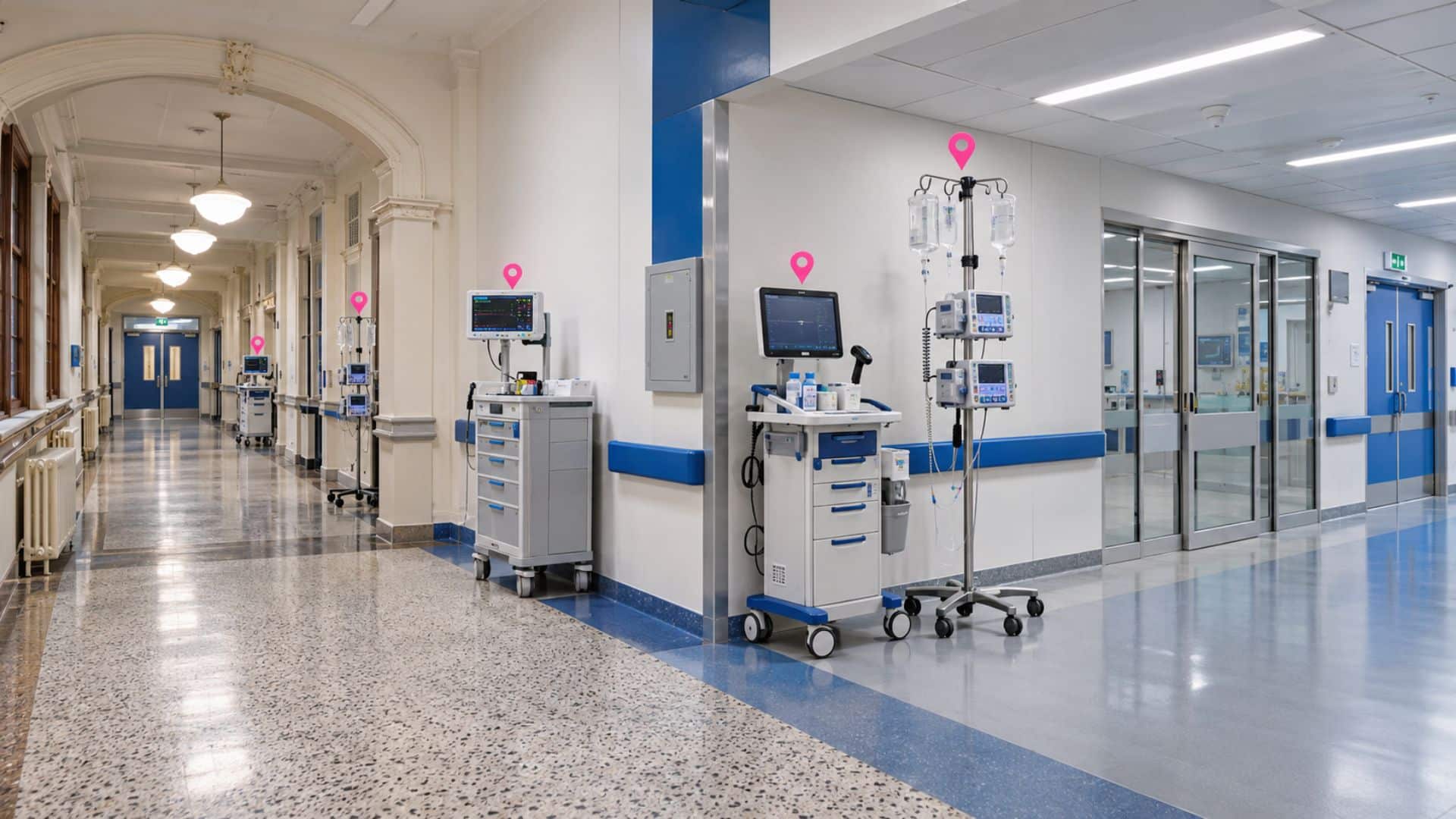
RTLS healthcare tools show clinical engineering and IT teams where every device is right now. That matters more this year. The FDA’s Quality Management System Regulation (QMSR) has been in effect since February 2, 2026. Hospital teams now work under it alongside Section 524B, the HIPAA Security Rule, and EUDAMED. Each of those assumes you already know which devices you own and where they sit. Most hospital networks can’t say that with confidence.
This post covers what a real-time location system (RTLS) does in a hospital. It also explains why RTLS is the starting point for the device audit your team should already be running. RTLS isn’t the compliance work itself. Thinaer doesn’t write SBOMs, manage encryption, or file paperwork. We show you the device estate that work depends on.
Why 2026 Changed the Stakes for Device Visibility
Many of these rules land on device makers first. Hospitals inherit the consequences through procurement, patching, and audits.
- The FDA’s Quality Management System Regulation took effect on February 2, 2026. It incorporates ISO 13485:2016, and FDA’s updated cybersecurity guidance now ties manufacturers’ secure product development to that quality system.
- Section 524B of the FD&C Act requires makers of cyber devices to provide a software bill of materials (SBOM) with premarket submissions.
- The HIPAA Security Rule still lists encryption as “addressable,” not mandatory. A January 2025 proposed rule would tighten that, but it isn’t final.
- Four modules of EUDAMED, the European medical device database, became mandatory on May 28, 2026. That puts device traceability, built on unique device identifiers (UDIs), on firmer footing for manufacturers and importers. Organizations with EU operations or suppliers feel the effect.
Every one of them starts with “know what you have.” You can’t audit a device you can’t find. You can’t segment a network around devices you haven’t counted.
Four 2026 Obligations, One Shared Prerequisite
QMSR
In effect since February 2, 2026
Section 524B
SBOMs for cyber devices
HIPAA Security Rule
Encryption addressable; proposed rule pending
EUDAMED
Four modules mandatory since May 28, 2026
▼
Know what you have
Every device, located in real time
What RTLS Healthcare Actually Solves
A real-time location system puts small tags or sensors on equipment. Receivers around the building pick up those signals. Software turns them into a live map.
In a hospital, that means you see where biomedical equipment, infusion pumps, and mobile devices are at any moment. It works across floors, wings, and legacy network segments. Sensors can also report condition, such as storage-room temperature, and show how long a device has sat idle.
Accuracy depends on the technology. Bluetooth Low Energy (BLE) gives room- or zone-level location, typically within 3 to 10 feet. Ultra-wideband (UWB) delivers sub-foot precision where a department needs it. Sonar, Thinaer’s operational visibility application, puts all of it on one live map with search, alerts, and time-out tracking. Across Thinaer deployments, Sonar triggered more than 10 million events in 2025.
RTLS healthcare tools don’t read network traffic or scan devices for vulnerabilities. They answer a different question: where is this device, and how long has it been there? Device audits depend on the answer.
The Single-Technology Trap in Healthcare RTLS
Most RTLS vendors build their product around one radio. Some are BLE-first. Others are RFID-first. The customer then bends the building to fit the technology.
| Single-Radio RTLS | Environment-First (Thinaer) | |
|---|---|---|
| Starting Point | Picks one radio, then fits the building to it | Assesses the environment, then picks the technology |
| Mixed Hospital Footprint | Gaps where that radio underperforms | The right mix for each space |
| Platform | Changes when the building or use case changes | One platform across every wing |
| Your Data | Often stays inside the vendor's system | Customer-owned, delivered by MQTT and REST |
A hospital can’t bend that way. It has new wings next to decades-old wiring, shielded imaging rooms next to open corridors, and a device fleet from dozens of manufacturers. A single-radio plan leaves gaps in exactly the places where equipment is hardest to find.
Thinaer takes the opposite approach: your environment decides. We carry BLE, RFID, UWB, GPS, LoRaWAN, and Wi-Fi HaLow, across more than 40 sensor types. We assess the space, deploy the right mix, and run it all through one platform. The technology can change from wing to wing while the platform stays the same.
The gap matters for compliance too. An inventory that covers only the new wing has holes, and devices you can’t patch are the ones you most need to account for.
Medical Device Inventory Management as a Compliance Starting Point
Compliance work depends on an accurate device inventory, and a spreadsheet that was right last quarter doesn’t count. Three tasks show why.
- Network segmentation is a standard compensating control for legacy devices that can’t be patched. It only works if you know exactly which devices sit on which virtual local area network (VLAN). IT’s network tools supply the network side. RTLS supplies the physical side: where each device is and which department has it.
- SBOM procurement checklists compare a vendor’s software list against what you own. That comparison only works if you know which units in your hospital run that software.
- Audit trails and vulnerability response matter most when a manufacturer flags a vulnerable model, because someone has to find every unit. Real-time location turns a floor-by-floor hunt into a search.
Thinaer is the layer that makes that inventory real-time and physical. We aren’t compliance software, and your team keeps ownership of the program and its filings. We make sure the inventory it works from is accurate today, not last quarter.
“You can’t audit a device you can’t find.”
Hospital Equipment Tracking Software in Practice
Hospitals use equipment tracking for three everyday jobs. Staff find mobile equipment by searching a map instead of walking the unit, which puts more time at the bedside and less into hunting for pumps. Utilization data shows which devices sit idle, so you can redeploy them before buying more. Sensors report temperature and humidity in cold chain and sterile storage and alert you when readings leave range.
You can start with one high-friction category, such as infusion pumps. Prove the value in a single department, then expand to other equipment and other floors. The same platform covers each new use case, so growth doesn’t mean starting over.
For a deeper look, read our guide to medical equipment tracking software. You can also see how real-time location services in healthcare are changing hospital operations.
What to Ask Before You Deploy an RTLS Solution
Bring these three questions to any vendor conversation.
- Does it work in your actual mix of environments? Ask for proof beyond new construction, including older wings, shielded rooms, and mixed fleets. Thinaer has deployed 150,000+ sensors across 33 locations and more than 12 million square feet.
- Does it lock your data in? Your location data should feed the maintenance and operational systems you already run instead of sitting in a closed system. Thinaer delivers data through MQTT and REST APIs, and you own it. We don’t replace your CMMS.
- Can it scale with your fleet? Start with one use case in one department and add more without a rip and replace. Thinaer has tiered deployment: full service, on-site project management, or remote assist.
A good vendor answers all three with specifics; treat a vague answer as a reason to keep asking.
FAQ
What Is RTLS in Hospitals?
RTLS is a real-time location system. In a hospital, it tracks the live location of equipment, and sometimes its condition, using tags or sensors and a live map. Clinical engineering, nursing, and IT teams use it to find devices fast, see utilization, and keep an accurate inventory.
How Does RTLS Work?
Tags or sensors attach to equipment. Receivers placed around the facility pick up their signals. Software places each item on a map. The sensing technology depends on the space. BLE gives room-level location at 3 to 10 feet. UWB gives sub-foot precision. GPS covers outdoor areas, such as loading docks.
How to Manage Medical Inventory?
Start with a complete count of mobile and high-value devices, and tag them. Define zones such as storage, departments, and biomedical shops. Track utilization to find idle units. Then connect location data to your maintenance system so service history stays current. Our post on healthcare logistics and operational visibility covers more.
Does RTLS Help With Medical Device Compliance?
RTLS supports medical device compliance by giving clinical engineering and IT teams accurate, real-time visibility into where devices are. That’s the starting point for tasks like network segmentation and device audits. It doesn’t replace a compliance program, generate SBOMs, or manage encryption. It gives the teams doing that work an accurate picture of the device estate to work from.
Start With What You Can See
The compliance deadlines have already landed, and they raise the value of knowing right now where every device is. That same real-time data also feeds whatever analytics or AI tools your health system runs. The models are here. The data has been the missing piece.
If you’re starting this quarter, three steps are enough. Count the devices you have. Locate them in real time. Then share that picture with the teams doing the compliance work.
Want to see it in a healthcare environment? See Sonar in action and find out how real-time visibility works across your device estate.