



Most Azure customers aren’t short on AI and analytics horsepower. Power BI, Azure IoT Hub, Azure AI — the tooling is there. What’s usually missing is the thing feeding it: real operational data from the physical floor, in a structured form those tools can actually use. That’s the gap Azure Physical AI closes. Thinaer doesn’t compete with Azure’s stack. It captures the data that stack was built to run on.
This isn’t a hypothetical pairing. Industrial organizations are adopting Azure’s AI and analytics tools faster than they’re solving the data problem underneath them, and that gap is exactly where most operational AI initiatives stall before they ever reach production.
Two Ends of the Same Pipeline
Azure’s AI and analytics tools are genuinely strong at the Learn and Act layers of operations. The modeling, the dashboards, the automated workflows that turn data into decisions. Azure IoT Hub and Power BI are built to ingest and visualize exactly this kind of operational telemetry at scale. However, none of that works without a reliable stream of data coming in first, and that’s precisely where most Azure deployments stall.
Ask an Azure customer “What operational data is flowing into Power BI or Azure IoT Hub today?” The honest answer is often “some of it, from some machines, updated when someone remembers.” Spreadsheets, manual checkpoints, and siloed point sensors don’t disappear just because a customer has adopted a sophisticated cloud platform. The AI and analytics layer is ready. The physical layer underneath it usually isn’t.
That’s the two-ends-of-the-pipeline problem. Azure owns the analytical end. Thinaer owns the capture end — the sensors, gateways, and structured data streams that turn a factory floor, hangar, or shipyard into something Azure’s tools can reason over. Neither end works in isolation. The organizations getting the most out of Azure Physical AI are the ones treating capture as a first-class part of the architecture, not an afterthought bolted on once the models are already licensed.
What Thinaer Captures, What Azure Physical AI Does With It
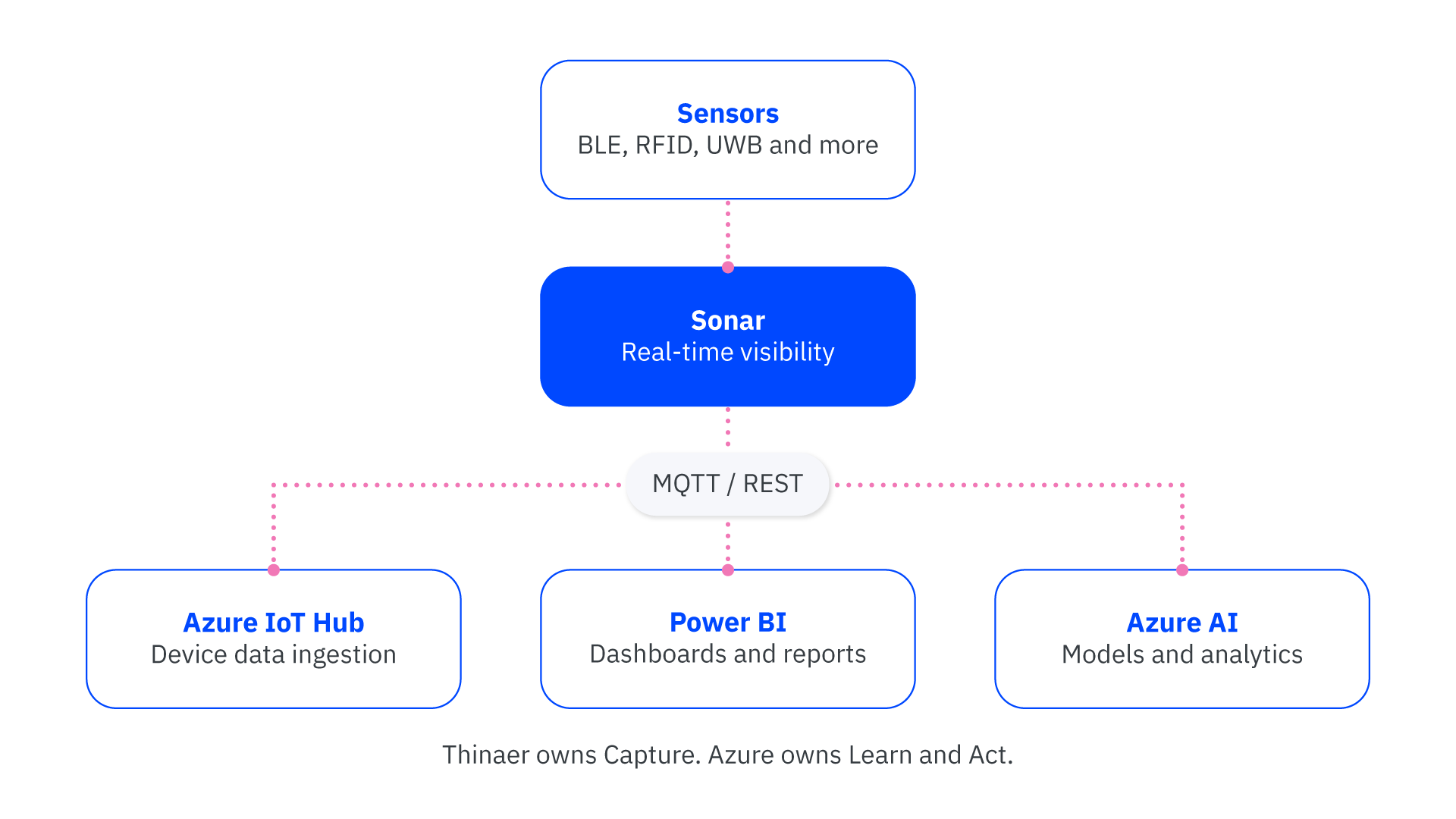
In practice, the pipeline looks concrete, not abstract. Sensors deployed across a facility — BLE, RFID, UWB, or whatever mix the environment calls for — capture location, movement, environmental conditions, and machine utilization. That raw signal flows into Sonar, Thinaer’s operational visibility application, for real-time maps, alerts, and dashboards from day one.
From there, the same structured data delivers out via MQTT and REST APIs into named Azure surfaces.
- Azure IoT Hub for device and telemetry ingestion
- Power BI for operational dashboards and reporting
- Azure AI for models that need grounded, current data rather than a batch export from last week
This is the same open-delivery pattern Thinaer already runs for Sonar’s listing in the Azure Marketplace — nothing proprietary sits between the sensor and the Azure tool consuming it.
For more on how Thinaer’s data delivery integrates cleanly with existing Azure infrastructure, see IT/OT Convergence: How the Capture Layer Actually Works. The short version: Thinaer owns Capture, Azure owns Learn and Act. The Capture → Learn → Act framework is what keeps the two in sequence instead of in competition.
Consider what this looks like for a manufacturer already running Power BI. Before Thinaer, the dashboard reflects whatever was last entered into an MES checkpoint — accurate at the moment someone typed it, stale the moment production moved on. After Thinaer, the same dashboard updates continuously, because the data feeding it comes from sensors on the floor instead of a person walking a clipboard. Nothing about the Power BI report changes. What changes is whether the numbers on it are still true by the time someone reads them.
Why This Isn’t Just Another Marketplace Listing
A generic connector moves data from point A to point B and calls it done. That’s not what’s happening here. Thinaer’s environment-agnostic capture — BLE where room-level accuracy is enough, UWB where sub-foot precision matters, RFID at high-volume checkpoints, all through one platform. That’s why the data reaching Azure is already structured and contextualized before it lands, not a raw telemetry dump someone has to clean up downstream.
A temperature reading or a location ping means little on its own. It becomes useful the moment it’s tied to a specific asset, a specific zone, and a specific process context. That contextualization happens at capture, not after the fact in an Azure data pipeline someone has to build and maintain. As a result, Power BI dashboards reflect what’s actually happening on the floor right now, and Azure AI models get grounded, current inputs instead of stale or incomplete signals.
This distinction matters more as industrial organizations move past pilot projects. Industrial AI adoption across the Azure ecosystem is accelerating. The projects that scale past a proof-of-concept tend to share one trait: a capture layer built before the AI strategy, not bolted on after it. A connector that only moves raw telemetry doesn’t survive that transition. A capture layer that contextualizes data at the source does.
GovCloud and Azure Government
For defense and aerospace customers running Azure Government, the same architecture applies inside that boundary. Thinaer deploys within the customer’s own Azure Government environment — not alongside it — so structured operational data stays inside the security perimeter the customer already controls. Maintenance teams still get real-time asset visibility through Sonar. The same data still flows to whatever AI or analytics tool the program runs, whether that’s Azure AI or a locally deployed model, without sensitive data ever leaving the boundary. Thinaer’s broader GovCloud and air-gapped deployment options cover this in more depth; the point here is simply that “Azure” doesn’t mean commercial-only. The same capture-first sequence holds in Azure Government, too.
One Capture Layer, Any Cloud
None of this makes Thinaer an Azure-exclusive tool, and that’s intentional. The same capture layer that feeds Azure IoT Hub and Power BI today can feed AWS Bedrock, ChatGPT Enterprise, or an on-premises model tomorrow. All without touching the sensor deployment underneath. That’s the difference between a partnership and lock-in.
This matters even inside an Azure-specific piece of content, because it’s the actual reason Azure customers should trust the integration. A capture layer that only worked with one cloud vendor would be making the same bet the customer is trying to avoid. Betting the operational data foundation on a single provider’s roadmap. Thinaer’s environment-first design means the customer’s Azure investment stays fully usable, and nothing about the underlying data pipeline needs to change if that investment evolves.
Your environment decides the sensing technology. Your data ownership decides the cloud. Azure is a strong choice — not the only one Thinaer supports.
For Azure customers specifically, that means adopting Thinaer doesn’t require betting the operational data layer on any single vendor relationship — including this one. The capture layer stays constant. The cloud, the model, and the analytics tool on top of it stay the customer’s choice.
Bringing Your Own Azure Environment Into Focus
Azure has the AI and analytics tools operations teams need. What most Azure deployments are missing is the structured, real-time operational data to point those tools at. That’s the gap Thinaer’s capture layer closes. Feeding Azure IoT Hub, Power BI, and Azure AI with data that’s contextualized before it ever reaches the cloud, whether that’s a commercial Azure tenant or Azure Government.
See Sonar’s listing in the Azure Marketplace to see how your Azure environment could look with a capture layer underneath it.