



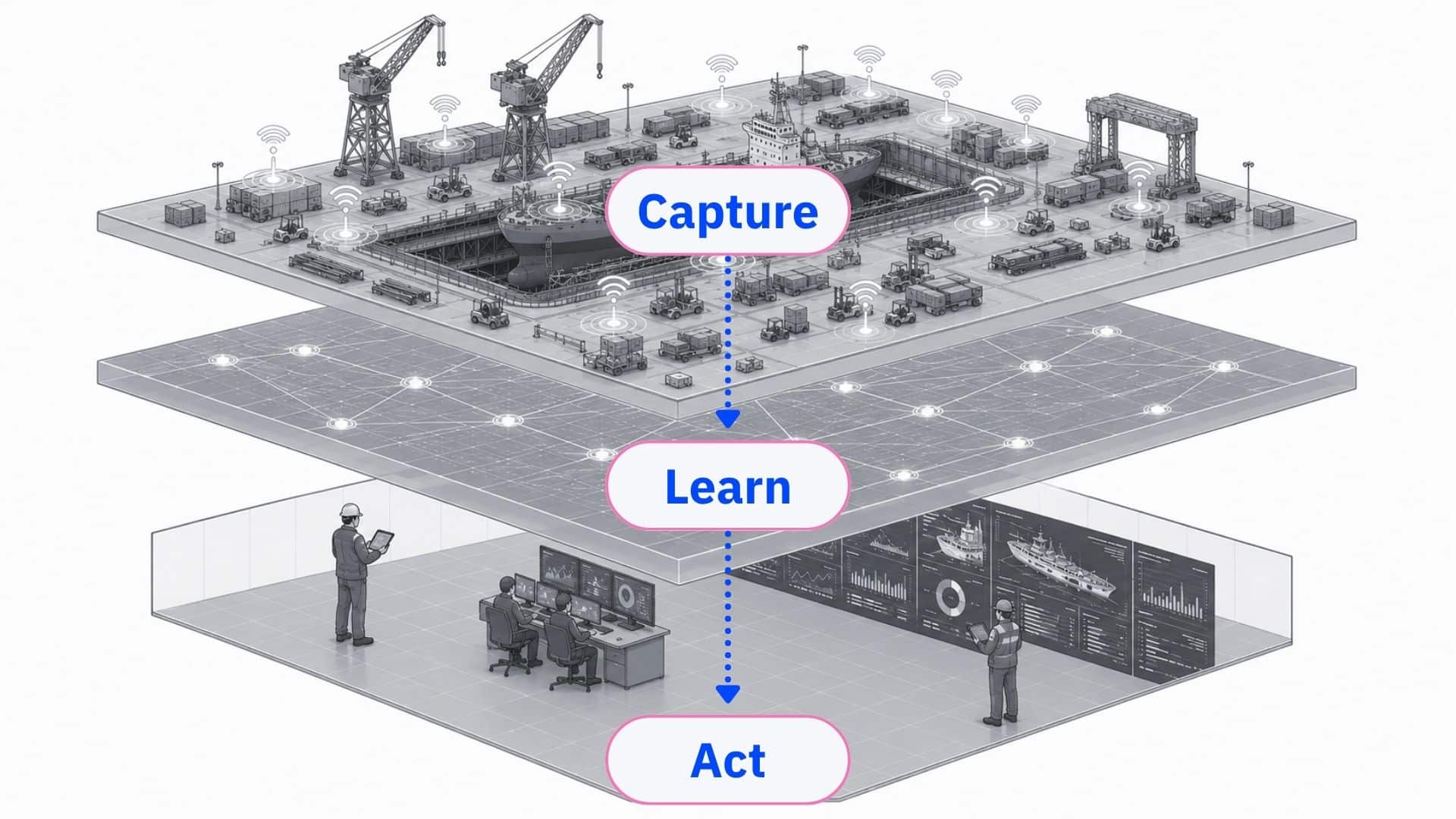
Every wave of enterprise technology has had a foundational architecture. For cloud, it was virtualization. For analytics, it was the data warehouse. For the current wave of AI in physical operations, the architecture has a name: Capture, Learn, Act. This is the Physical AI framework — and understanding it changes how you think about your AI investment.
Most organizations pursuing AI in operations have been solving the wrong layer of the problem. Therefore, before anyone debates which model to use or which cloud to run it on, it’s worth being precise about what Physical AI is, why the framework exists, and what each layer actually requires.
Why Physical AI Exists as a Category
Artificial intelligence in its current form is exceptionally good at reasoning over digital content: documents, code, structured databases, images, and text at scale. However, factories, shipyards, defense hangars, and hospital wings don’t produce digital content on their own. They produce physical events — a torque wrench moving between stations, a curing oven cycling through temperature ranges, a work package stalled at a bottleneck, a piece of equipment drawing unusual current.
Physical AI is the term for artificial intelligence that operates on real-time data from these kinds of environments. Specifically, it describes a complete system — not just a model or a sensor network or a dashboard, but all three working in sequence. That sequence is what the Capture → Learn → Act architecture describes.
The category exists because the challenge is real and distinct. Pointing a large language model at stale ERP records doesn’t give you Physical AI. Neither does installing sensors with no connection to an analytical layer. The framework captures what actually has to be true for AI to produce reliable decisions in operational environments.
The Capture Layer: Where It All Starts
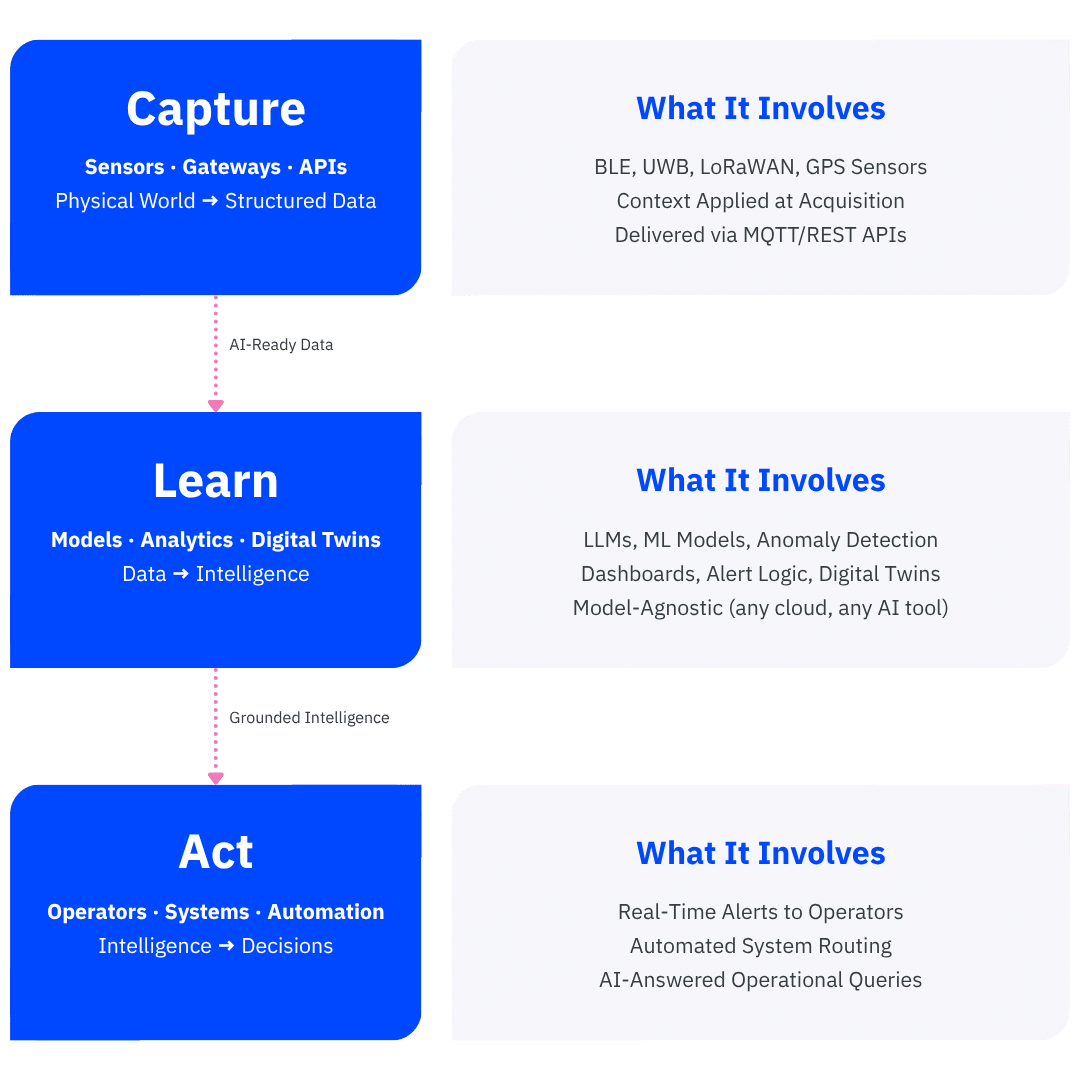
Capture is the first layer of the Physical AI architecture, and it’s the one most frequently underbuilt. In this context, capture means deploying sensors, networks, and software that continuously transform physical operations into structured, machine-readable data.
That last word matters: structured. Raw sensor telemetry is not useful by itself. A temperature reading is meaningful only when it’s associated with a specific asset, at a specific location, within a specific process context, at a specific timestamp. Capture isn’t just data collection — it’s data contextualization at the moment of acquisition.
For this reason, effective capture infrastructure typically involves several sensing technologies working in parallel. Location tracking may rely on Bluetooth Low Energy (BLE) or Ultra-Wideband (UWB). Environmental monitoring covers temperature, humidity, and pressure. Equipment status uses current sensing and vibration. The right mix depends on the environment, not on what a vendor happens to sell.
The physical world doesn’t generate clean data on its own. The capture layer is what makes it legible to everything above it.
Without a well-built capture layer, the rest of the Physical AI framework doesn’t have material to work with. This is why so many operational AI deployments produce strong demos and weak results in production: the model layer gets built before the data foundation exists. Capture is not a prerequisite to check off quickly — it’s the investment that determines the ceiling of everything downstream.
The Learn Layer: What the AI Actually Does
The Learn layer is the one the industry talks about most. In the Physical AI framework, Learn refers to all the AI and analytical processing that runs on top of structured operational data — machine learning models, large language models, digital twins, anomaly detection engines, and any other AI tooling that reasons over the data stream.
A few things are worth noting about where Learn sits in the sequence.
First, the model is almost never the bottleneck. In practice, organizations that struggle with operational AI do so because the data feeding the model is incomplete, delayed, or unstructured — not because the model itself is inadequate. This is the failure mode that the Physical AI framework is designed to prevent. Capture first, then Learn.
Second, the Learn layer is intentionally model-agnostic. In a well-designed Physical AI architecture, the capture layer delivers structured data through standard interfaces — typically MQTT for real-time streaming and REST APIs for queried access — so that any AI tool can consume it. As a result, organizations aren’t locked into a specific model vendor, and they can swap or layer AI tooling as the landscape evolves.
Third, the Learn layer is broader than most people assume. It includes not just sophisticated AI models but also the operational dashboards, alert logic, and visualization platforms that help human operators understand what the data means in real time. In many deployments, significant value comes from the simpler, more immediate layer of this stack — anomaly detection, threshold alerts, utilization tracking — before any LLM enters the loop.
The Act Layer: Where Value Is Realized
Act is the output layer of the Physical AI framework. It’s the point at which the intelligence generated by Learn becomes a decision or an action — whether taken by a human operator, an automated system, or an autonomous agent.
What Act looks like in practice varies widely. In some deployments, it’s a maintenance technician receiving a real-time alert that a piece of equipment is trending toward failure, giving them time to intervene before an unplanned outage. In others, it’s an autonomous system rerouting a work package because the AI has detected a bottleneck forming at a downstream station. In still others, it’s a shift manager asking a plain-language question about facility status and getting a grounded, accurate answer because the AI has access to live operational data.
The common thread is this: Act produces value only when it’s grounded in current reality. Therefore, an action triggered by stale or incomplete data isn’t Physical AI — it’s guesswork with extra steps. The quality of Act is a direct function of the quality of Capture. That relationship runs through the entire stack.
Why the Order Is Non-Negotiable
The Physical AI framework isn’t just a list of components — it’s a sequence, and the sequence is load-bearing. Specifically, you cannot Learn effectively without first Capturing, and you cannot Act reliably without Learning from grounded data.
This sounds obvious. In practice, it’s where most operational AI initiatives go wrong.
The industry’s instinct, understandably, is to start with the most visible layer: the model. Organizations license an LLM, build a data lake, and engage data scientists — and then discover that the operational data they need doesn’t exist at the resolution or latency that AI requires. The model is fine. The foundation isn’t there.
However, the reverse failure also occurs. Some organizations deploy sensors without a clear path to structure and deliver the data. Consequently, they end up with terabytes of raw telemetry that no downstream system can consume. Data volume without data meaning is not a capture layer — it’s a storage problem.
The framework works because it reflects the actual dependency chain. Each layer creates the conditions for the next. Capture makes Learn possible. Learn makes Act reliable. Skipping or underinvesting in any layer doesn’t just weaken that layer — it constrains everything built on top of it.
What the Framework Means for Technology Investment
Understanding the Physical AI architecture has practical implications for how organizations should sequence their investments.
For example, before evaluating AI vendors or model platforms, it’s worth auditing the capture layer first. Specifically: what data exists, at what resolution, with what latency, and with what context attached? If the answer is “we have some data in our ERP but it’s updated manually” or “we have sensor data but it’s siloed in a proprietary system,” that’s a signal about where the investment needs to go.
Similarly, the choice of capture infrastructure affects what’s possible at the Learn layer for years. As a result, organizations that lock into proprietary sensor platforms with closed data formats limit their future AI optionality. A well-designed capture layer delivers open, structured data through standard protocols so that the Learn layer can evolve independently — adapting to new models, new tools, and new use cases without requiring infrastructure changes below.
In this sense, the capture layer is not just a technical foundation. It’s a strategic one. The organizations building it thoughtfully now are the ones that will have the most options when the AI landscape inevitably shifts.
A Note on Where Thinaer Fits
Thinaer is a Physical AI capture layer company. We deploy sensors in the environments where capture has historically been hardest — including defense and aerospace facilities with significant RF constraints — and we deliver structured, AI-ready data through open APIs to whatever AI platform, analytics tool, or enterprise system the customer is running. We don’t build models or own the Learn layer. We make the Learn and Act layers possible by solving the Capture problem first. For organizations working through how to build their Physical AI architecture, that’s where the conversation usually starts.