



You’ve probably started hearing the term “Physical AI” show up in conversations about manufacturing, defense, and industrial operations. NVIDIA uses it. Technology analysts use it. And now it’s appearing in vendor materials everywhere.
The problem: most of those uses aren’t actually defining it. They’re borrowing the term to describe things they were already doing — and that conflation makes it harder to understand what Physical AI actually means, and why it matters.
This article gives you a clear, working definition of Physical AI — what it is, what makes it distinct, some concrete examples of it in action, and how it relates to terms you may already know, like AIoT and industrial AI.
Physical AI: The Definition
At its core, Physical AI is artificial intelligence that operates on real-time data from physical, operational environments.
That sounds broad. Here’s what makes it specific:
Physical AI requires three things to function:
- Capture — sensors deployed in the real world collecting data continuously: location, movement, environmental conditions, equipment status, asset behavior
- Learn — AI models that reason over that structured data to identify patterns, predict outcomes, or answer operational questions
- Act — people, systems, or autonomous equipment making decisions based on what the AI surfaces
All three layers are necessary. If any one of them is missing, you don’t have Physical AI — you have a component of it.
The “physical” part of the term is doing a lot of work. It distinguishes AI that processes operational data from the real world (a factory floor, a hospital wing, a shipyard) from AI that operates on digital content — documents, images, text, code. Both are legitimate applications of AI. They’re not the same thing.
What Physical AI Is Not
A few common sources of confusion:
It’s not just robotics. Robots are one example of Physical AI in action (specifically at the “Act” layer), but they’re not the whole category. A system that tells a maintenance technician in real time that a critical tool has been sitting at the wrong station for six hours — that’s also Physical AI. No robots required.
It’s not a synonym for IoT. The Internet of Things (IoT) refers to the connected devices and sensors that collect operational data. That’s the Capture layer. IoT alone doesn’t make Physical AI — you need the AI reasoning on top of it.
It’s not the same as predictive maintenance. Predictive maintenance is one use case. Physical AI is the broader category. Anomaly detection, inventory optimization, real-time compliance monitoring, autonomous workflow routing — these are all examples of it in action.
It’s also not the same as AI models trained on sensor data after the fact. If the model is running on batch uploads from yesterday, that’s analytics. Physical AI implies real-time or near-real-time data flowing from operations directly into AI-enabled decisions.
What It Looks Like in the Real World
The clearest way to understand Physical AI is to see what it looks like when it’s working:
Manufacturing — tool search elimination
A production floor in an aerospace facility has thousands of calibrated tools that must be tracked for FOD (Foreign Object Debris) prevention and compliance. Without Physical AI, technicians search manually. With it in place — sensors on every tool, real-time location in a visibility platform, and AI-powered search — a query like “where is torque wrench 4471?” returns a location in seconds. Shift time lost to search drops to near zero.
Defense — environmental compliance
A defense contractor monitors temperature and humidity in sensitive materials storage. Without Physical AI, compliance is verified through manual rounds and spot checks. With it in place, sensors capture conditions continuously, the system detects exceedances in real time, and alerts trigger automatically — before a quality escape occurs. The AI doesn’t just report; it flags, prioritizes, and routes.
Healthcare — equipment utilization
A hospital system loses hours every shift to nurses searching for infusion pumps, wheelchairs, and surgical tools. Physical AI gives every tagged asset a live location, detects patterns in where equipment gets stranded, and surfaces utilization data that helps administrators right-size their inventory. Less time searching means more time with patients.
Shipyard — work-in-process tracking
A large shipyard wants to know whether work packages are moving through production on schedule. Physical AI gives supervisors a real-time view of where every WIP unit is, how long it’s been at each station, and where bottlenecks are forming — without a single manual scan.
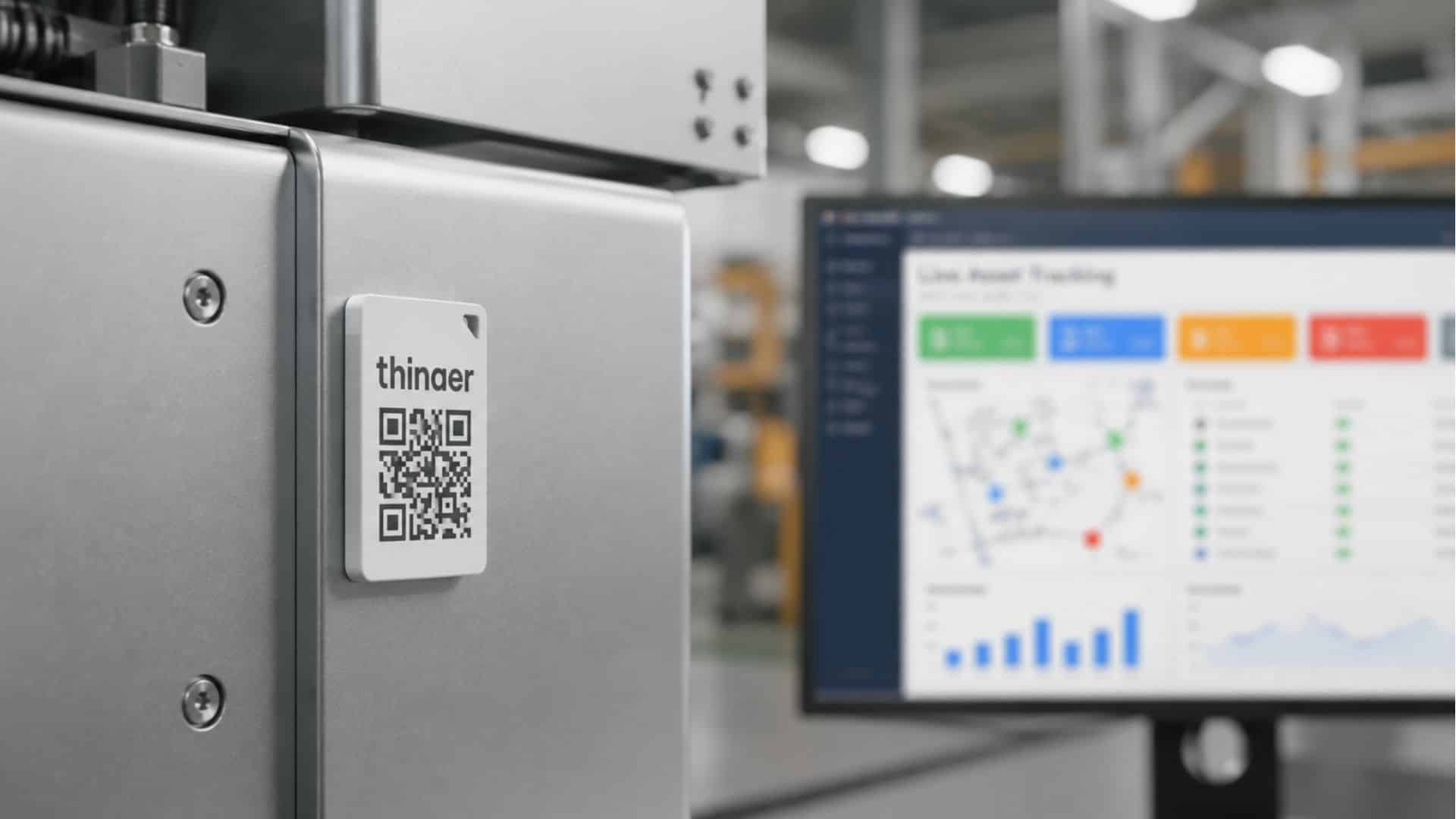
In each of these cases, the pattern is the same: sensors capture operational data, the platform structures it, and AI or human intelligence acts on what it surfaces. Capture → Learn → Act.
Physical AI vs. AIoT: What’s the Difference?
AIoT (Artificial Intelligence of Things) is a term that emerged a few years ago to describe the combination of AI and IoT: using AI to process and act on data collected by connected devices. It’s a useful concept, and it’s largely accurate.
Physical AI is a more recent and more specific framing. Here’s how they relate:
| AIoT | Physical AI | |
|---|---|---|
| Focus | AI + IoT device data | AI + operational data from physical environments |
| Emphasis | The technology combination | The full stack: Capture → Learn → Act |
| Scope | Broad (consumer and industrial) | Operational and industrial environments |
| Data timing | Can include batch or historical | Assumes real-time or near-real-time |
| Maturity | Established term (mid-2010s) | Emerging term (2023–present) |
The two terms aren’t in conflict. AIoT describes the technology combination. Physical AI describes the architecture and the outcome — intelligence operating on live data from the real world.
In practice, when organizations say Physical AI, they usually mean an operational system where real-time data from a physical environment is flowing into AI-enabled decisions at scale. That’s a more meaningful description of what’s happening than “AI plus IoT.” Organizations actively building this out — like Thinaer’s work with Ingram Micro’s AIoT Centre of Excellence — are a useful example of how the two concepts operate together in practice.
How It Relates to Industrial AI
Industrial AI is a broad term for AI applications in industrial settings — manufacturing, energy, logistics, defense. It encompasses machine vision, process optimization, predictive maintenance, quality inspection, demand forecasting, and more.
Physical AI is a subset of industrial AI — specifically the part that depends on real-time operational data captured from physical environments. Not all industrial AI qualifies: an AI model that forecasts demand based on historical sales data is industrial AI but not Physical AI. An AI model that monitors a production line using live sensor data from the floor is both.
The distinction matters when you’re planning infrastructure. Industrial AI is a strategy. Physical AI is the architecture it requires.
Why the Data Foundation Comes First
Here’s where many Physical AI initiatives stall: organizations start with the model. The gap between AI hype and manufacturing reality almost always traces back to this same mistake.
They license an LLM, hire data scientists, and build dashboards — and then discover that the operational data they need doesn’t exist at the resolution AI requires. The model is fine. The data isn’t there.
Physical AI inverts that sequence. Before you can learn or act, you have to capture. Before an AI can answer the question “where is that component?” or “why did Line 3 slow down this morning?”, something has to have captured that data in real time.
Every wave of enterprise technology has had a foundational layer that determined what was possible above it. Cloud needed virtualization. Analytics needed the data warehouse. The answer is a capture layer — the sensors, networks, and APIs that turn physical space into structured, AI-ready data.
That capture layer is what most organizations are still missing. The models are largely ready. The data foundation isn’t.