



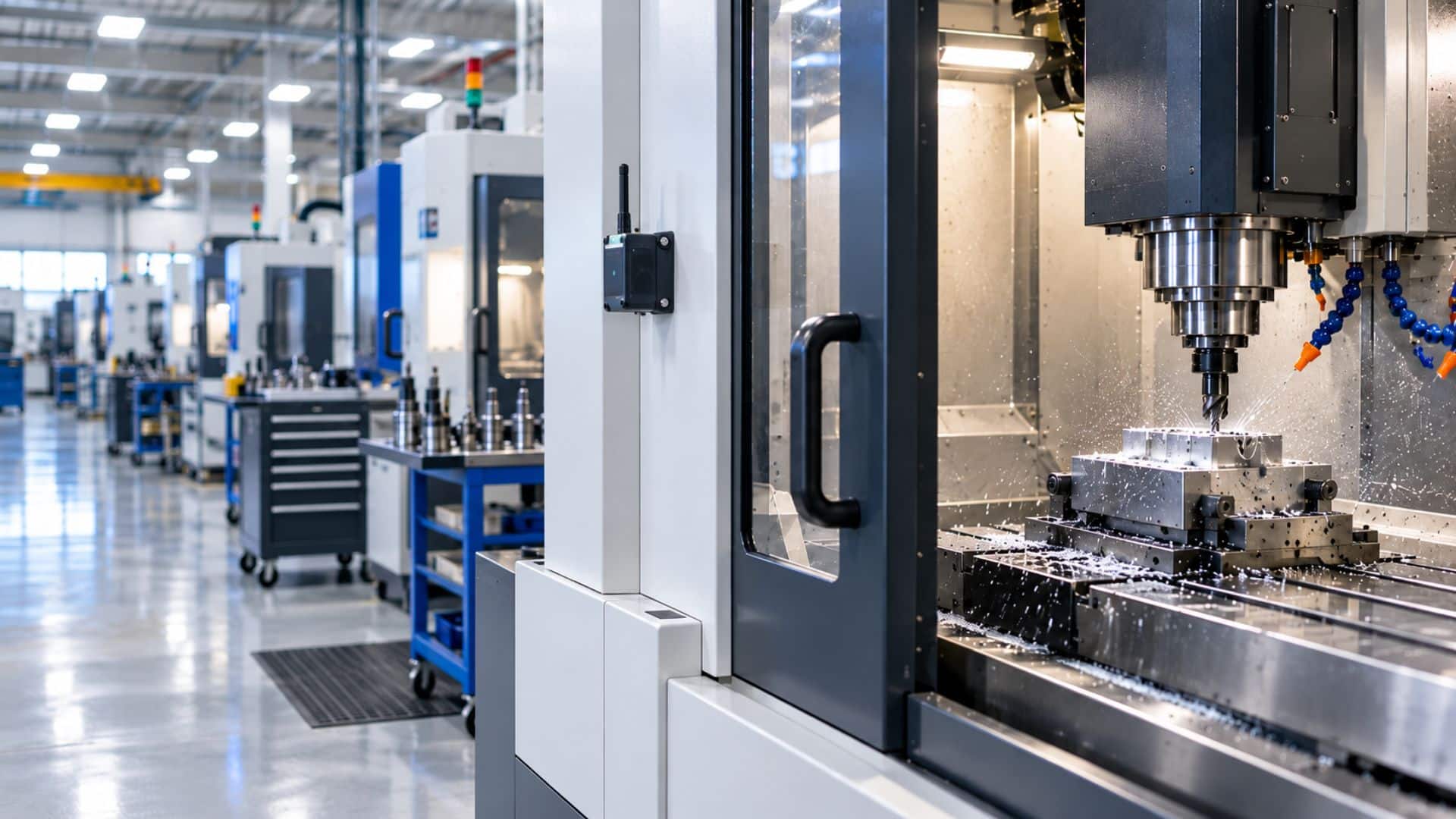
Fixed-calendar maintenance has two failure modes. A machine serviced every 90 days gets pulled offline even when nothing is wrong, which costs production time, parts, and labor. Or the machine fails partway through the interval, between scheduled checks, and nobody knew until it stopped. Both problems share a source: the schedule knows the date and has no idea what condition the machine is in.
What Is Condition-Based Maintenance?
Condition-based maintenance (CBM) works from live equipment data. Sensors on a machine report vibration, temperature, current draw, or run status. When a reading crosses a threshold the maintenance team has set, the system raises an alert and the team schedules service. If readings stay normal, the machine keeps running and nobody touches it.
The machine’s actual condition decides when service happens. Maintenance teams still plan their work and still follow manufacturer guidance. The difference is a second input: evidence from the asset itself.
Where It Sits Among Maintenance Strategies
Four strategies cover most plants, and most plants run a mix of them.
- Reactive maintenance repairs equipment after it fails.
- Preventive maintenance, the fixed-calendar approach, services equipment at set intervals.
- Condition-based maintenance services equipment when measured condition changes.
- Predictive maintenance forecasts failure from historical patterns.
The right strategy for each asset depends on what a failure costs. A conveyor idler can run to failure. A spindle on a bottleneck machine deserves live monitoring.
How It Relates to Predictive Maintenance
People often use the two terms interchangeably, and they describe different things. Condition-based maintenance reacts to current sensor readings. When vibration or temperature crosses a threshold, an alert fires. Predictive maintenance models historical patterns to forecast when a failure is likely, which usually takes specialist analytics and high-frequency data from complex machinery.
This distinction also sets the boundaries of what Thinaer does. Thinaer captures the vibration, temperature, current, and run-status data that condition-based alerts depend on. Thinaer does not build predictive failure models, and it does not capture high-frequency waveform data such as acoustic emission. Teams that run specialist predictive tools can send Thinaer data to them, because the data is open and customer-owned. For a closer look at where predictive programs fall short without real-time visibility, read Predictive Maintenance Is Not Enough.
Calendar-Based vs. Condition-Based Maintenance: What Changes
Calendar-based maintenance triggers service on elapsed time or run hours. Condition-based maintenance triggers it on measured condition. That single change shifts cost, risk, and labor in the ways below.
| Factor | Fixed Calendar | Condition-Based |
|---|---|---|
| What triggers service | A date or a run-hour count | A sensor reading crossing a threshold |
| Over-maintenance cost | Healthy machines are serviced and taken offline on schedule | Service happens when readings call for it |
| Under-maintenance risk | A fault that develops between checks goes unseen until failure | Readings are watched continuously, so a developing fault raises an alert |
| Labor use | Technicians follow the route whether or not machines need work | Technicians go where the alerts point |
| Records | Proof that the task was done | Proof of the task and of the condition that prompted it |
The Cost of Servicing Too Early
Every scheduled service on a healthy machine costs production time and technician hours. It also costs parts that had life left in them. Each time a machine is opened, a technician has to put it back together correctly, which adds the chance of an assembly error. A 90-day interval is a guess about the average asset. Plenty of machines run lighter or cleaner than average, and they receive the same service as the ones that run hardest. Siemens’ True Cost of Downtime report makes the same point: frequent scheduled maintenance keeps machines healthy, but it carries real costs in lines closed unnecessarily and in stocks of expensive spares.
The Risk of Servicing Too Late
The opposite problem can cost more. A bearing that starts to degrade a few weeks after an inspection has nobody watching it until the next scheduled check. If it fails first, the plant takes an unplanned stop, and the repair is often bigger than an early fix would have been. The stop itself is expensive: Siemens’ 2024 True Cost of Downtime report puts an hour of unplanned downtime in a large automotive plant at $2.3 million, about double the 2019 figure. A fixed schedule cannot see a fault coming, because it only checks the calendar.
Where Technician Time Goes
Calendar routes send technicians to every machine on the list. Alerts send them to the machines whose readings changed. That frees hours for work that needs a skilled person, and it keeps people in charge of the decisions. The sensor gives the technician better information, and the technician decides what to do with it.
The same logic applies to tool calibration, where usage-based triggers beat arbitrary intervals. Our post on real-time calibration monitoring covers that parallel.
What Triggers a Condition-Based Alert
Take a CNC machine tagged CNC-014. A vibration sensor on the machine reports readings continuously, along with the machine’s run status: on, off, or idle. During normal production, readings stay in the range the maintenance team recorded for that machine. One day the sensor reports 0.54 g while the status reads ON. Suppose the team set that machine’s vibration threshold below that value.
Sonar raises an alert, and the maintenance team sees it on the dashboard instead of discovering the problem at the next scheduled inspection. Run status matters here. Vibration on a machine that is switched off points to a different problem than the same reading on a machine that is cutting parts.
From there the workflow is ordinary maintenance. A technician inspects CNC-014, finds the cause, and fixes it during a planned stop instead of an emergency one. The work order goes into the computerized maintenance management system (CMMS) the team already uses.
Setting Thresholds That Teams Trust
Thresholds come from each machine’s own baseline, with input from the technicians who know how it behaves. A threshold set too tight produces alerts that the team learns to ignore. A threshold set too loose misses early changes. Most teams adjust thresholds during the first weeks of operation as they learn what normal looks like.
Trend views help here. A reading that climbs slowly over several weeks can stay under the alert threshold and still tell a technician something. Many teams set a lower watch level that flags that drift and a higher action level that opens a work order.
Temperature alerts follow the same pattern. A motor housing that runs hotter than its own baseline raises an alert while the team still has time to inspect it. Thinaer supports vibration, temperature, and current sensing among its 40+ sensor types, so one platform covers the readings most condition-based programs start with.
Common Condition Monitoring Techniques
Condition monitoring is the data-gathering half of condition-based maintenance. Several techniques exist, and each detects different faults. The table shows what each technique finds and where Thinaer’s sensors fit.
| Technique | What It Finds | Where Thinaer Fits |
|---|---|---|
| Vibration analysis | Imbalance, misalignment, bearing wear | Thinaer captures vibration readings for threshold alerts. Detailed waveform and spectrum analysis stays with specialist sensors. |
| Thermography | Overheating from friction or electrical resistance | Thinaer captures temperature readings continuously. Infrared camera surveys complement them. |
| Current analysis | Motor and load problems | Thinaer captures current readings. Signature analysis of the current waveform sits with specialist tools. |
| Oil analysis | Wear particles, contamination, lubricant breakdown | Lab-based and sample-driven, so it complements sensor data. |
| Acoustic monitoring | Leaks, friction, cracking | Needs specialist high-frequency capture, which sits outside Thinaer's sensor set. |
Which Equipment Benefits Most
Condition-based maintenance pays off fastest where three things hold. A failure is expensive, the condition changes in ways a sensor can see, and the current schedule does not match how the machine is used.
CNC machines, motors, pumps, compressors, conveyors, and hoists show vibration and temperature changes as they wear. Machines with variable duty get the least benefit from a fixed interval. Equipment that runs three shifts one month and one shift the next accumulates wear at very different rates. Elapsed time says little about how hard the machine worked.
Low-cost components on non-critical equipment often stay on the calendar. A sensor and a threshold take more attention than they return on a part that is quick to swap.
Where Condition-Based Maintenance Has Limits
Sensors only report what they measure. A fault that shows up in neither vibration nor temperature will not trigger an alert. Some failures develop faster than anyone can respond, such as a sudden electrical fault or a part that breaks under shock load.
Some tasks stay on the calendar regardless: inspections that regulations require, manufacturer-mandated service, and safety checks. Condition data supports those tasks with evidence.
Teams that need to forecast failures weeks ahead on complex rotating machinery need the specialist predictive tools described earlier. Thinaer feeds those tools with operational data from across the floor.
Technician knowledge covers what sensors miss. An operator who hears a new noise or sees a change in surface finish adds information that no sensor in the set captures. The strongest programs treat alerts and operator observations as two inputs to the same decision.
Getting Started With a Condition-Based Rollout
A rollout can start small. This sequence works for most teams.
- Start with critical assets. Pick the machines where an unplanned stop hurts most, such as bottleneck equipment and assets with long repair lead times.
- Establish baselines. Let the sensors record normal operation on each machine, then set thresholds with the technicians who know it.
- Connect alerts to existing workflows. Send alert data to the CMMS and to the channels the maintenance team already watches. Thinaer delivers data through MQTT and REST APIs, so existing systems stay in place.
- Keep the calendar as a safety net. Leave current tasks in place at first, then lengthen intervals on assets where the sensor history supports it.
- Expand. Add equipment in the order that failures cost the most.
A pilot on a handful of critical machines proves the approach on the team’s own equipment before anyone commits to a wider rollout. Thinaer’s environment-first approach decides the sensor and backhaul mix for each facility, so the platform does not change when the next building or machine comes online. Deployment comes in tiers: full service, on-site project management, or remote assist.
How to Tell Whether It Is Working
A short list of measures shows whether the program earns its place. Review them monthly at first, then quarterly once thresholds settle.
- Unplanned downtime hours on monitored assets, compared with the same assets before sensors went in.
- The share of maintenance hours spent on planned work versus emergency repairs.
- The number of scheduled tasks removed or lengthened because the sensor history supported it.
- The share of alerts that led to a real finding when a technician inspected the machine.
The last measure deserves the most attention early on. Alerts that rarely lead to a finding point to thresholds that need adjusting, and a team that keeps getting false alerts will stop trusting the system. Alerts that usually lead to a finding build the trust that lets a team lengthen calendar intervals with confidence.
Day-One Value That Compounds
The first sensors on critical assets deliver value right away. Sonar shows live readings and raises an alert the first time a reading crosses a threshold. Each machine added after that contributes more history, which helps teams set tighter thresholds and decide which fixed intervals to lengthen. The same data feeds whichever analytics or AI tools a team runs, because Thinaer captures the data and the customer owns it.
Condition-based alerts are one piece of operational intelligence. Our guide to operational intelligence covers how the same captured data supports decisions beyond maintenance.
See how Sonar turns sensor readings into maintenance alerts. Talk to the Thinaer team about starting with your most critical assets.