



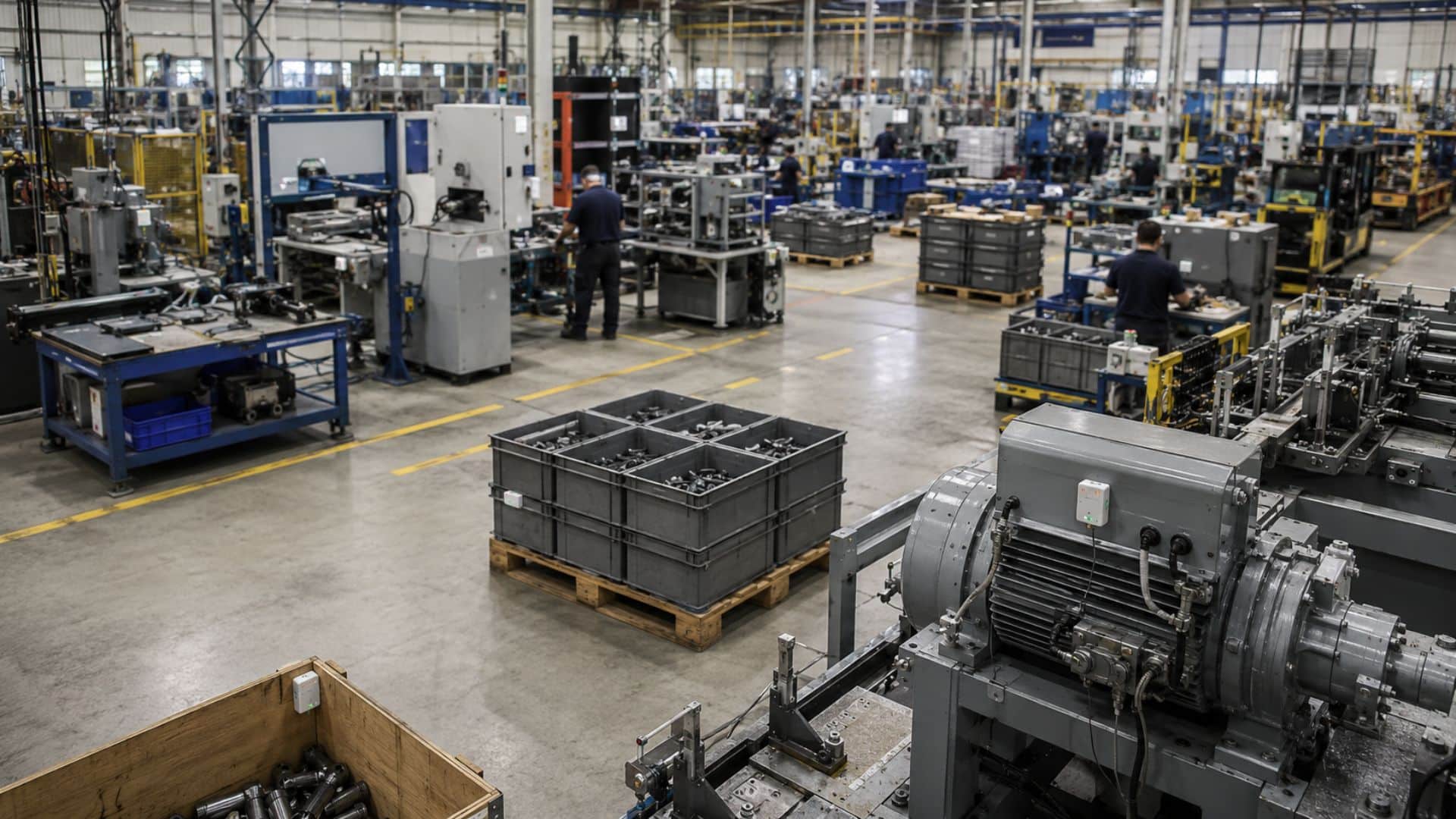
AI models only see what’s digitized. Most operations floors aren’t. Equipment runs without a sensor attached, materials move without anyone logging where, and by the time a report reaches a decision-maker, it describes a shift that ended hours ago.
Operational intelligence is the answer to that gap: the practice of capturing what’s happening in a physical environment in near real time and putting it in front of the people and systems that need to act on it. Not a historical report. Not a quarterly dashboard. A live, structured picture of assets, equipment, and conditions as they actually are right now.
For manufacturing, aerospace, defense, and healthcare operations leaders, that distinction is the difference between reacting to what already went wrong and acting before it does. Here’s what operational intelligence actually requires, and why most organizations don’t have it yet.
What Is Operational Intelligence?
At its core, operational intelligence is the discipline of turning physical operational activity, where assets are, how equipment is running, what conditions surround them, into structured data that’s current enough to act on immediately. Some vendors use the term as shorthand for real-time dashboards. That’s part of it, but it’s not the full operational intelligence definition that matters to leaders running physical environments.
Business intelligence and operational intelligence solve different problems. BI looks backward: it aggregates transactional and historical data, sales figures, financial records, past performance, into reports that inform strategy over weeks or quarters. Operational intelligence looks at right now: whether a tool is where it’s supposed to be at this moment, whether a machine is running or idle, whether an isolation room’s environmental conditions are still within spec. BI tells you what happened. Operational intelligence tells you what’s happening, while there’s still time to change the outcome.
That distinction matters because most industrial and healthcare operations run on the BI model by default, whether they call it that or not: spreadsheets updated at shift change, inventory counts done manually once a week, maintenance logs filled in after the fact. None of that is operational intelligence. It’s history, arriving too late to prevent the problem it describes.
An operational intelligence platform is the system that closes that gap. It’s not a single dashboard or a single sensor type. It’s the combination of continuous data capture, a live visualization layer, and open delivery to whatever tool acts on the data next, whether that’s an operator glancing at a map or a model running in the background. Miss any one piece and the picture stops being current the moment it’s assembled.
What Operational Intelligence Is Not
A few common mix-ups worth clearing up. It’s not just a dashboard, a dashboard is only useful if what feeds it is current and structured; a beautiful interface on top of a weekly spreadsheet export isn’t operational intelligence, it’s a nicer-looking version of the same delay. It’s also not the same as predictive maintenance, which is one application built on top of operational intelligence, not a substitute for it. And it isn’t an AI product on its own. The models that reason over the data are a separate layer; operational intelligence is what makes sure they have something current to reason about.
Why Manual Operations Can’t Keep Up
Manual tracking isn’t a smaller version of operational intelligence. It’s a different category of problem, and it breaks down in three consistent ways.
Data That’s Scattered and Slow
Asset location lives in one spreadsheet, maintenance records in another, and environmental readings, if they’re captured at all, on a clipboard near the equipment. None of it is connected, so nobody gets a single picture without manually reconciling three or four sources first, usually after the problem has already surfaced.
reduction in search time for one Thinaer manufacturing customer, thousands of labor hours redirected to productive work each year
Hours Lost to the Search
Every hour spent locating a missing tool, a mobile asset, or a piece of equipment that’s supposed to be in one place and isn’t is an hour not spent on work that pays, and the stakes keep climbing. Siemens’ 2024 True Cost of Downtime study puts unplanned downtime at up to $150,000 an hour for small and midsize manufacturers, and as high as $2.3 million an hour in automotive, roughly double what it cost in 2019. Across Thinaer’s manufacturing and defense customers, search time is a direct contributor to that number: one customer eliminated 85% of the search time their teams were losing across operations, thousands of labor hours a year redirected back to productive work.
Maintenance That Reacts Instead of Predicts
Without continuous visibility into machine utilization, on, off, or idle, and the conditions surrounding it, maintenance only happens after something breaks or on a fixed calendar that ignores actual wear. Neither approach uses data that’s already available at the machine. It simply isn’t being captured.
This is also where operational intelligence and predictive maintenance get conflated, and it’s worth separating them. Predictive maintenance is a use case: forecasting when a specific machine is likely to fail. Operational intelligence is the foundation underneath it, the continuous, contextualized data feed that makes an accurate forecast possible in the first place. Predictive maintenance without that foundation is only a partial fix, because a model can’t reason about conditions it was never given.
Manual Operations vs. an Operational Intelligence Platform
The difference shows up clearest side by side. Here’s how manual, spreadsheet-driven operations compare to an operational intelligence platform across the five areas that matter most to operations leaders.
| Area | Manual Operations | Operational Intelligence Platform |
| Asset Visibility | Periodic counts and tribal knowledge, “usually near the loading dock” | Real-time location for every tagged asset, updated continuously |
| Maintenance Trigger | Fixed calendar, or a response after failure | Triggered by actual machine utilization and condition data |
| Data Accuracy | Only as good as the last manual entry | Captured automatically at the point of activity |
| Compliance Record |
Reconstructed after the fact from logs and memory | A continuous, timestamped record that supports the compliance posture the organization already maintains |
| Decision Speed |
Hours to days, once someone assembles the picture | Minutes, from a live dashboard |
From Raw Sensor Data to a Live Operational Picture
Getting from an empty floor to full operational intelligence starts with capture: deploying the sensing an environment actually needs, whether that’s BLE for room-level accuracy, UWB where inches matter, or RFID and environmental sensors layered on top. What separates operational intelligence from a pile of disconnected sensor readings is that every reading is tied to a specific asset, a location, and a moment in time, immediately.
That structured stream is what Sonar renders into a live picture operators can use right away: maps, alerts, dashboards, and time-out tracking, live from day one. From there, the same data feeds whatever comes next, an ERP, a maintenance system, or any AI model the organization runs, because it’s already in a form those systems can consume.
None of this requires ripping out what’s already in place. Existing sensors, spreadsheets someone still trusts, a legacy MES, all of it can stay. Operational intelligence fills the gaps around those systems rather than replacing them, so the rollout is additive instead of disruptive.
Thinaer’s Capture → Learn → Act framework goes deeper into how this stage connects to what happens downstream, in analytics, digital twins, and AI.
Industry Applications
Operational intelligence looks different depending on what a floor, hangar, or hospital wing actually needs to know.
Manufacturing
On a production floor, operational intelligence means work-in-process tracking, machine utilization, and environmental monitoring in one feed instead of three disconnected systems. Instead of a supervisor walking the floor to find out why a line slowed down, the data already shows which station is idle and why. Operators stop chasing tools and materials and start catching downtime before it costs a shift.
Aerospace and Defense
For the Defense Industrial Base and aerospace manufacturers, operational intelligence extends into classified visibility and asset accountability, environments most platforms can’t reach at all. Knowing where every tool, component, and asset is, inside spaces with their own security requirements, is what keeps a build on schedule and an audit from turning into a scramble. It’s also what lets a program prove asset accountability on demand instead of reconstructing it after the fact.
Healthcare
In healthcare, operational intelligence covers biomedical asset tracking, isolation-room environmental monitoring, and the kind of continuous data trail that supports a health system’s own compliance program. Finding an infusion pump in seconds instead of twenty minutes changes what an entire shift looks like, and it means clinical staff spend that time on patients instead of on a search.
Physical AI Starts With Capture
None of this works without the first step: getting structured, real-time data out of a physical environment that was never generating it on its own. That’s the gap Thinaer closes. We deploy the sensing each environment needs, Sonar turns it into a live operational picture from day one, and the same data feeds whatever AI, analytics, or business system comes next, any cloud, any model, inside the customer’s own security boundary.
Organizations don’t need to solve every blind spot at once to get value from operational intelligence. Most start with one floor, one facility, or one use case, prove the outcome, and expand from there. The models are ready. The question was always whether the data was. Physical AI starts here.