



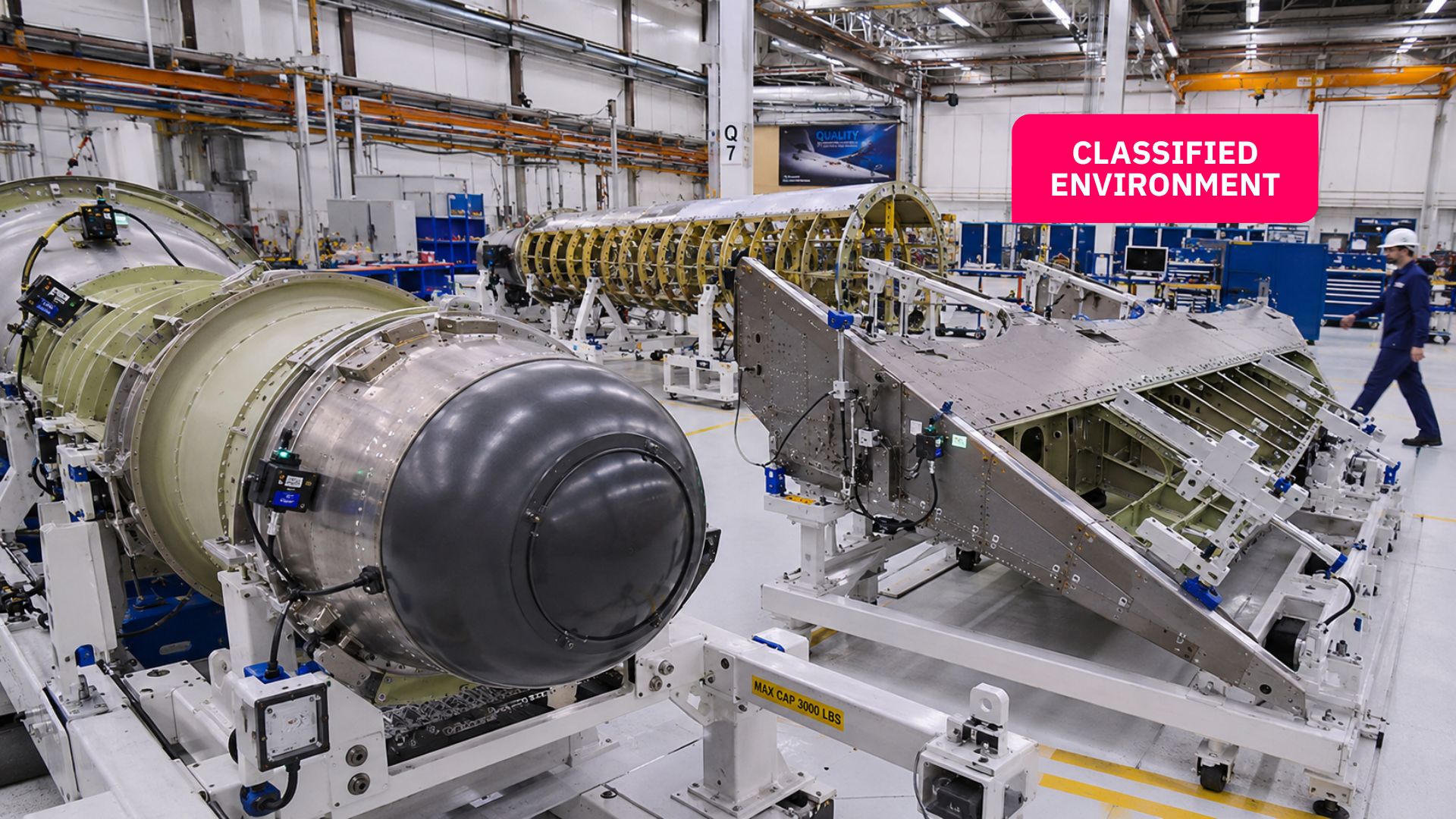
Defense and aerospace leaders keep running into the same wall. The pitch decks promise AI-powered maintenance scheduling, real-time logistics intelligence, and smarter production decisions. The data those models need does not exist yet, not because operations are quiet, but because nobody has captured the physical environment in a form an AI tool can actually use.
This is the data problem. In defense environments, it operates within compliance constraints that dictate what is even allowed in your architecture.
Why Defense Data Pipelines Are Different
Commercial IoT deployments are hard. Defense IoT deployments are hard because they operate within a framework that limits cloud options, restricts where data can travel, and requires cleared personnel to stand up the infrastructure.
A commercial plant can route sensor data to a public cloud and run off-the-shelf analytics. A defense OEM on a classified program cannot. A shipyard tracking work packages across multiple bays may need real-time location data inside HERO ZERO zones where common RF technologies are restricted.
These constraints do not make operational visibility impossible. They make it a different engineering problem. The platform has to honor those constraints by design, not through exception requests that erode your security posture.
Thinaer was built for this. As the first mover in classified areas (patent pending), the platform deploys inside the customer’s environment, behind air gaps, on the customer’s own IAM and cloud, and across DISA-approved infrastructure. Data stays where it belongs.
The Four Stages of a Defense-Grade Telemetry Pipeline
Building a secure path from raw sensors to AI-ready output follows a consistent progression, no matter the facility.
Stage 1: Capture: Sensors that Match the Environment
Every facility is different. Composites’ layup needs temperature and humidity. Tool cribs need RFID. Assembly bays need UWB for precision location. A sprawling campus needs LoRaWAN. An outdoor yard needs GPS.
The common mistake is to pick a sensor technology first and then force it everywhere. A BLE-only deployment leaves gaps. An RFID-only deployment misses real-time location. A single-technology approach creates new blind spots while it tries to close old ones.
Thinaer’s hardware-agnostic capture layer lets the environment decide the technology. BLE, RFID, UWB, LoRaWAN, GPS, wired sensors, all integrated into one platform. With 150,000 sensors deployed across 33 locations and 12 million-plus square feet of defense and manufacturing operations, this is operational practice, not theory.
Stage 2: Structure: Turn Telemetry into Context
A reading of 72.4 degrees is raw telemetry. That same reading, tagged to a specific composites curing station, the work order in progress, the acceptable range for the material being cured, and the timestamp, is structured operational data.
This is where most IoT deployments stall. They collect raw signals and dump them into a data lake, leaving downstream systems (and AI tools) to figure out what the data means. In defense environments running AS9100, NADCAP, and program-specific traceability requirements, unstructured data is a compliance risk, not a starting point.
Thinaer contextualizes automatically. Every reading is bound to its source asset, location, process state, and relevant thresholds. The output is a structured stream any downstream system can consume without rebuilding ETL for each new use case.
Stage 3: Visualize: See Operations Live Through Sonar
Data should be visible to operations before it ever feeds a model. That is how you confirm the pipeline is working and surfacing what matters.
Sonar, Thinaer’s Gartner-recognized application, delivers that visibility from day one of deployment. Live maps show every tracked asset. Geofences trigger automated alerts when assets enter or exit designated zones. Environmental dashboards run conditions across the facility. Trend views surface patterns that inform human decisions today and AI models tomorrow.
This stage carries double weight in defense environments. Operations teams get value on day one, finding tools, tracking work packages, and monitoring conditions without waiting for an AI rollout. And the data flowing through Sonar is the same data that will feed AI tools later, so teams can validate accuracy before trusting it to drive automated decisions.
Stage 4: Deliver: Open APIs That Feed Whatever You Choose
This is where the pipeline pays off. Structured, contextualized, validated data flows through MQTT and REST APIs into whichever analytics, BI, or AI tools the organization picks.
A program-mandated AI stack. A custom machine learning model trained on your operational baseline. The vendor a Tier 1 prime asks you to align with. The data is shaped for any of them. The organization is not locked into a single AI vendor or analytics platform. The capture layer is independent of the intelligence layer.
That separation matters in defense. AI tools evolve fast. The model trained this year may be replaced next year. The operational data pipeline (the sensors, the structure, the delivery path) is the durable foundation. Build it once, feed any tool you choose, now and across whatever comes next.
What AI-Ready Defense Data Looks Like
AI-ready data in defense environments has characteristics that go beyond those of commercial data.
- Provenance and traceability. Every data point traces back to its source sensor, location, and timestamp. In regulated defense manufacturing, the chain of custody is not optional. It is required for compliance and audit readiness.
- Classification alignment. Data generated in classified environments stays inside classified infrastructure. The pipeline cannot route through commercial clouds or third-party processing. Everything happens inside the customer’s security boundary, on their IAM, in their cloud.
- Real-time currency. AI tools making operational calls need current data, not yesterday’s batch. The pipeline delivers continuous streams, not periodic snapshots. A recommendation to reroute a work package because a station is bottlenecked is only useful if the bottleneck data is current.
- Structured consistency. Every data type (location, temperature, humidity, vibration, asset identity, process state) follows a consistent schema that AI tools can parse without custom work for each source. Thinaer normalizes data from all sensor types into one unified format.
The Cost of Waiting
Defense organizations that delay building the operational data pipeline pay twice. Every month without structured data is a month of decisions made on incomplete information. It is also a month of data that does not exist, data that could have been used to train models, establish baselines, and reveal patterns.
The pattern from current deployments tells the story. More than 10 million triggered events captured across Thinaer environments in 2025 alone, fueling documented multi-million-dollar ROI for a leading defense OEM. That return came from operational visibility, knowing where tools were, eliminating search time, catching environmental excursions before they became quality escapes, and tracking work packages in real time. The AI layer multiplies those returns. The foundation has to come first.
Start with the Capture Layer
The path from raw sensor data to AI-powered defense operations runs through a structured pipeline. Not an AI vendor. Not a single model. A capture layer that brings physical operations into digital systems securely, structures the data for use, visualizes it for immediate value, and delivers it through open APIs to whatever intelligence tools make sense.
Thinaer builds that layer. The environment decides the sensors. Security requirements decide the architecture. The analytics and AI tools your team picks decide what questions to ask.
We make AI work, even in the most demanding environments on earth.