



Every healthcare asset management software vendor promises better visibility into equipment. Most comparison content then ranks named products, which shows who is popular but not what to ask. Hospital supply chain, biomedical, and IT leaders end up choosing between dozens of similar claims.
This guide gives you a framework instead. It covers five criteria for evaluating healthcare asset management software, explains why each one matters inside a real hospital, and finishes with a side-by-side look at the underlying approaches. You will not find a vendor countdown here. You will find the questions that keep you from locking into the wrong platform.
Why Healthcare Asset Management Software Decisions Are Hard to Reverse
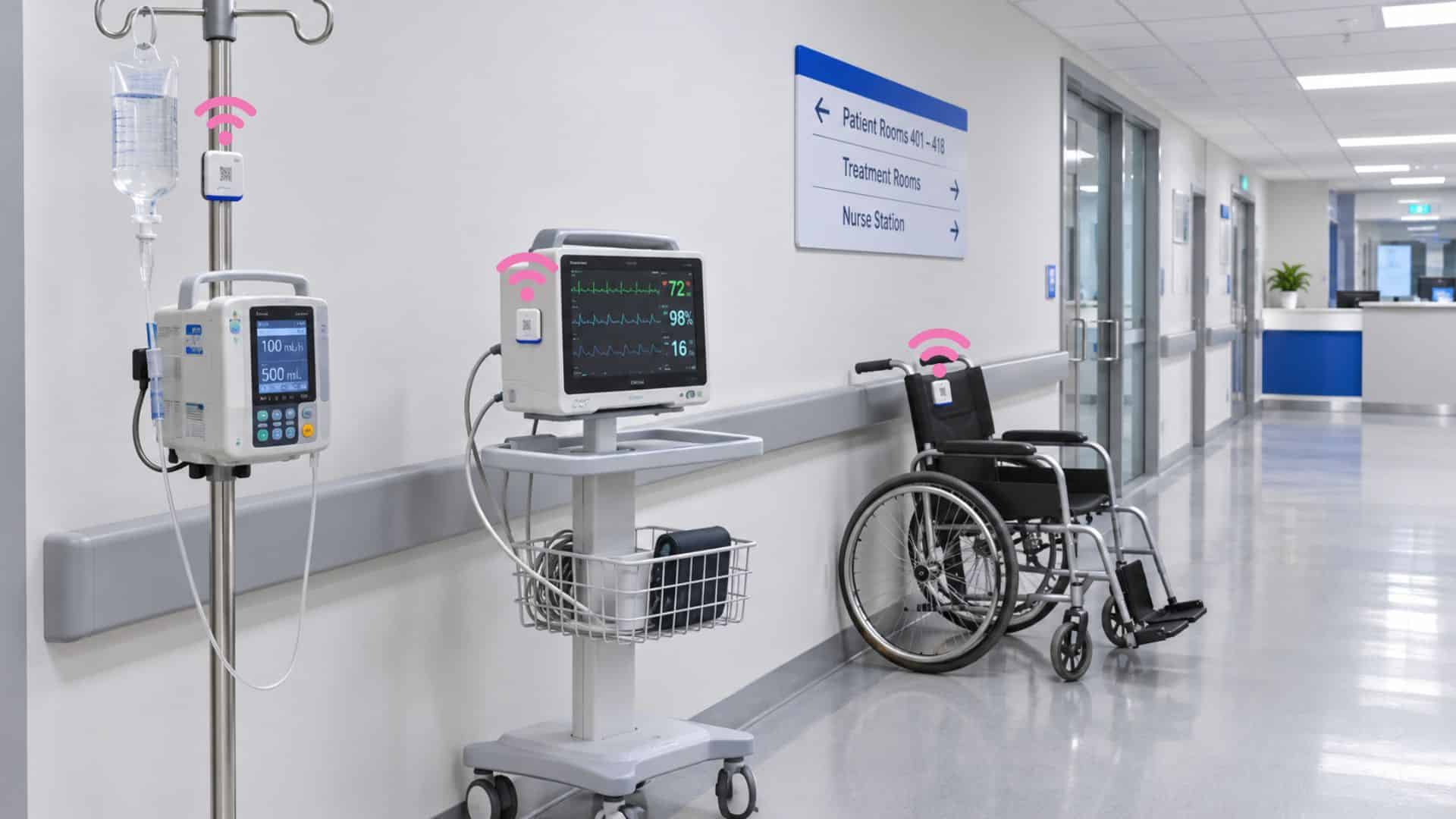
Healthcare asset management software shows where medical equipment is, what condition it is in, and whether it is ready for the next patient. Infusion pumps, wheelchairs, portable monitors, and surgical tools all fall in scope. Think of it as the system that answers one question fast: where is the thing I need right now?
Treat the purchase as an infrastructure decision, not a one-off tool. A hospital is a mixed environment. Older wings have legacy wiring, newer towers have different layouts, imaging suites shield radio signals, and device fleets span decades of purchasing. Software that works in one of those spaces and struggles in the others becomes costly to live with. Multi-year contracts make it costly to leave.
The decision also touches more teams than most buyers expect. Biomedical engineering needs to find devices for maintenance. Nursing needs equipment at the bedside. Supply chain needs utilization data to justify capital requests. IT needs a system that fits the network. A platform chosen by one group often disappoints the others.
The five criteria below separate a platform you can grow with from one you end up working around.
Criterion 1: Multi-Sensor, Environment-Agnostic Coverage
Most tracking platforms start with one radio and build the company around it. That works until the hospital footprint stops cooperating. A Bluetooth Low Energy (BLE) system delivers room and zone location, typically 3-10 feet. A shielded imaging suite or a legacy wing may need something different. Ultra-wideband (UWB) delivers sub-foot precision where it matters, and radio frequency identification (RFID) suits doorways and checkpoints.
A single-technology platform forces a tradeoff. You either leave gaps in the footprint or bend the building to fit the product. Neither helps a nurse hunting for an infusion pump.
Precision matters here too, and honest vendors state real ranges. Room-level location answers most “where is it?” questions. Sub-foot precision answers a narrower set, such as which bay or cabinet holds a device. Match the technology to the question you need answered, and do not pay for precision you will not use.
Thinaer takes the opposite approach. Your environment decides the technology mix, and the platform carries every sensing technology the space requires, with 40+ sensor types in total.
Ask every vendor:
- Which sensing technologies do you support today, and which would you recommend for only part of my facility?
- What happens in shielded rooms, older wings, and parking structures?
- Can I add a second technology later without replacing what I bought?
Criterion 2: Open Data Delivery for Hospital Asset Tracking
Hospital asset tracking only pays off when the data reaches the systems where people make decisions. Those usually include the computerized maintenance management system (CMMS), the electronic health record (EHR), and business intelligence (BI) tools. A platform that keeps location data inside its own dashboard creates one more screen to check and one more silo to reconcile.
Ask how data leaves the platform. Open protocols such as MQTT (a lightweight messaging standard) and REST APIs let your existing systems read the data directly. They also let any analytics or AI tool your team chooses do the same. Proprietary export formats rarely offer that freedom.
The payoff is practical. When location and utilization data reach the CMMS, biomedical teams can schedule preventive maintenance around devices that are actually in use. When the same data reaches BI tools, supply chain leaders can see which equipment sits idle before approving another purchase.
Then ask the portability question. If you switch vendors in three years, what happens to your historical data? Who owns it, in what format, and at what cost to retrieve it? With Thinaer, the customer owns the data. Sonar, Thinaer’s operational visibility application, an MQTT broker, and REST APIs all deliver it.
Criterion 3: Compliance-Readiness
Regulatory pressure on connected medical devices keeps rising in 2026. The FDA’s Quality Management System Regulation (QMSR) took effect in February 2026, and Section 524B of the Federal Food, Drug, and Cosmetic Act sets cybersecurity expectations for connected devices. Both rules land first on device manufacturers. Health systems feel them downstream, through device inventories, patch coordination, and network segmentation work.
Asset visibility supports that work, but it does not replace it. Ask whether the platform keeps a current inventory of what is deployed and where it sits. It should also produce evidence for audits and run inside your own security boundary.
Be wary of any vendor that claims to make you compliant. Visibility feeds compliance work, and your team still owns the posture. Thinaer does not certify a customer’s compliance. It gives your team the data to support it. For the deeper regulatory discussion, read our guide to RTLS in healthcare, which covers what 2026 changed for device visibility.
Criterion 4: Deployment Model for Healthcare Asset Tracking Software
Deployment is where many projects stall. Healthcare asset tracking software usually arrives in one of three models. Full service means the vendor surveys, installs, and supports the system. Self-managed means your team does the work. Hybrid splits the effort between the two.
Match the model to your staff, not to the brochure. Hospital IT and biomedical teams rarely have spare hours for a long implementation. Ask what you will see on day one, what your team must do to get there, and who answers when something stops reporting.
Day-one value has a concrete shape. Staff can open a live map, search for any tagged item, and get an alert when a device leaves its zone. It does not look like a project plan with first results due next year. If a vendor cannot describe the first week in plain terms, expect a long runway.
Thinaer offers tiered deployment: full service, on-site project management, or remote assist. Sonar delivers live maps, alerts, and search-and-find from day one, so value does not wait on a long runway.
Criterion 5: Total Cost of Ownership
The purchase price is the smallest part of the bill. Total cost of ownership (TCO) includes contract length, what you pay to expand, and what it costs to leave. Long contracts with a single vendor raise switching costs every year you stay. We cover that pattern in more detail in RTLS without vendor lock-in.
Watch for three hidden costs:
- Proprietary hardware. If tags and readers only work with one vendor’s software, you rebuy everything to switch.
- Per-sensor licensing. Fees that grow with every tagged device can penalize the coverage you actually need.
- Forced upgrades. Required version jumps can turn a stable system into an unplanned project.
Expansion belongs in the cost model too. Hospitals add wings, acquire clinics, and launch new use cases. Ask what it costs to cover the next building, and whether a new use case means a new contract.
Ask for a written answer to one question: what does it cost, in money and in time, to move to a different platform? A vendor confident in its product will answer plainly.
Comparing the Approaches at a Glance
The table below maps the five criteria across three approaches rather than named vendors. The approaches are a single-technology real-time location system (RTLS), manual or spreadsheet tracking, and an environment-agnostic capture layer.
| Criterion | Single-Technology RTLS | Manual / Spreadsheet Tracking | Environment-Agnostic Capture Layer |
|---|---|---|---|
| Works across mixed environments | Limited to one radio type | N/A | Yes. The technology adapts to the space. |
| Open data delivery | Often proprietary | N/A | MQTT and REST, customer-owned |
| Compliance-readiness support | Varies by vendor | None | Feeds audit and segmentation work |
| Deployment model | Varies | N/A | Tiered, from full service to remote assist |
| Lock-in risk | High. Single-vendor dependency. | Low, but no real visibility | Low. Open and standards-based. |
Read the table as a map, not a scorecard. Manual tracking costs little and shows little. Single-technology systems can work well inside the environment they were built for. The gaps appear when the footprint changes, the contract renews, or a second use case arrives.
Frequently Asked Questions
What is healthcare asset management?
Healthcare asset management is the practice of knowing where medical equipment and other physical assets are, what condition they are in, and how they are used. The goal is to keep care running and spend capital wisely. For authoritative definitions and supply chain guidance, AHRMM (the Association for Health Care Resource & Materials Management) is a good place to start. Software supports the practice, but process and ownership matter just as much.
How much does healthcare asset management software cost?
It depends on facility size, the number of assets you track, the sensing technologies your environment requires, and the deployment model. Anyone quoting a flat price without those details is guessing. Review the hidden cost drivers in Criterion 5, then request a quote based on your own environment.
Does healthcare asset management software replace my CMMS?
No. It feeds your CMMS. The CMMS stays the system of record for work orders, maintenance schedules, and service history. A capture layer like Thinaer adds live location, condition, and utilization data to it through open protocols. Some pages that rank for “medical asset management software” describe maintenance-management platforms, which are a different category. Confirm which kind you are evaluating.
Choose the Approach, Not Just the Vendor
Vendor rankings change every year. Ask which approach will not lock you in a year from now, rather than which vendor ranks first. Use the five criteria as your checklist: multi-sensor coverage, open data delivery, compliance-readiness, a deployment model that fits your team, and a total cost you can defend.
“Ask which approach will not lock you in a year from now, rather than which vendor ranks first.”
Start with the criteria that matter most to your facility, then pressure-test every vendor against all five. A short, honest list of tradeoffs beats a long list of feature claims.
Thinaer is the Physical AI capture layer. It captures the data your hospital’s systems and AI tools run on, across 150,000+ sensors at 33 locations and 12M+ square feet. Put Thinaer up against the same five criteria, see how it approaches medical equipment tracking, and then ask us the hard questions.