



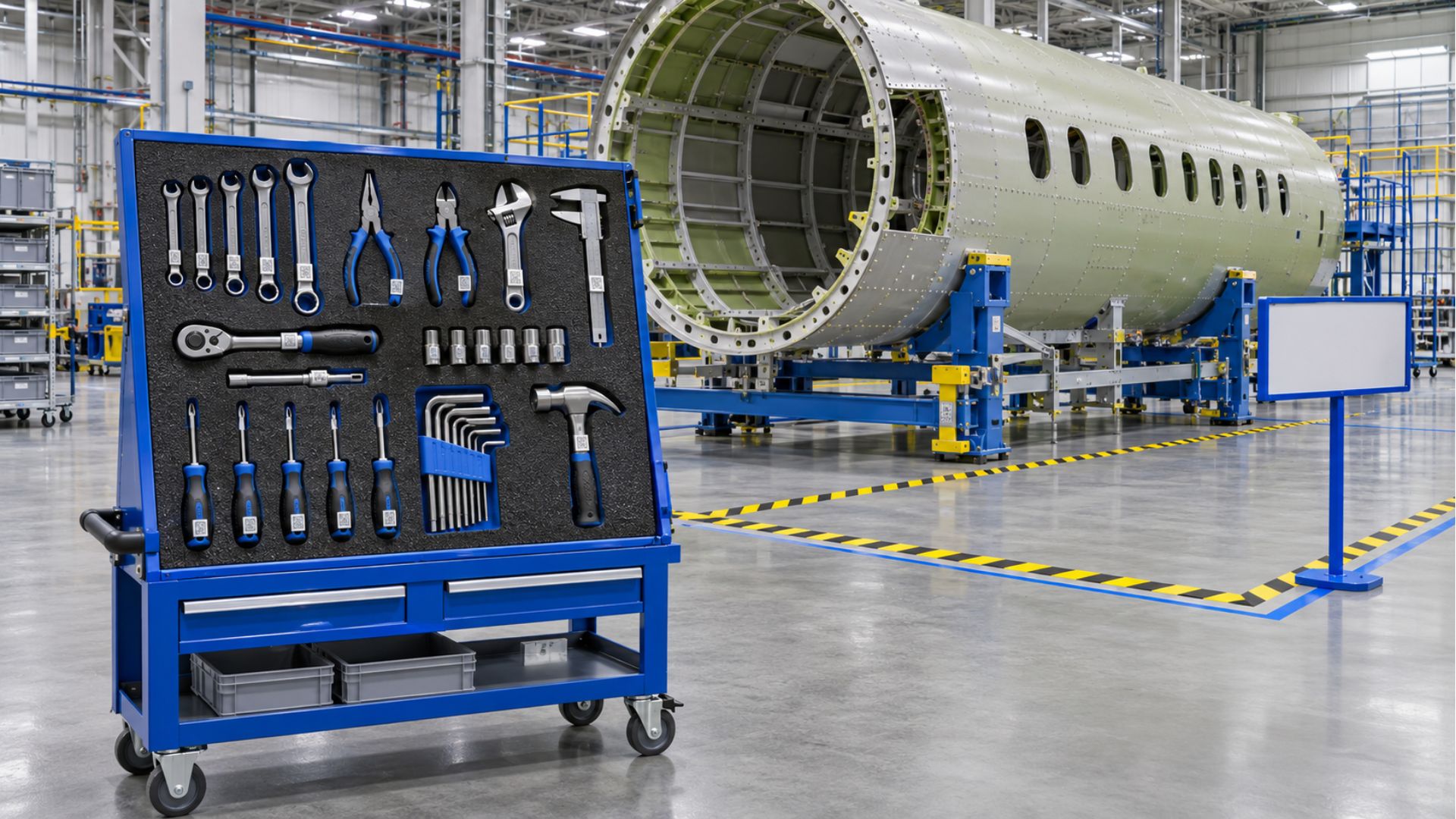
The supplier quality auditor from your prime has a simple request. They want the tool accountability records for the final assembly bay, every shift, for last month, including who checked out each torque wrench and what happened the day a socket went missing. If your tool accountability system lives in paper logs and a shared spreadsheet, someone spends the days before the audit rebuilding that trail.
That scramble is common on defense and aerospace production floors. AS9146 makes tool accountability one of eight elements of a FOD prevention program, and primes write it into supplier contracts. A system that captures tool movement as it happens produces that evidence on every shift, so nobody has to rebuild it before an audit.
What a Tool Accountability System Is
A tool accountability system is the set of records, rules and technology that shows where every tool in a FOD-controlled area is, who has it, and whether it came back whole. For any point in time, it should answer one question: can you account for every tool that entered the area?
It sits inside a broader tool control program, which also covers tool selection, storage, marking and training. The program sets the rules. The accountability system proves that people followed them, shift by shift.
An out-of-calibration tool is a quality risk even when you know exactly where it is, so real-time calibration monitoring often runs alongside location tracking.
Foreign Object Debris vs. Foreign Object Damage
The two terms share an acronym, so they’re easy to mix up. The IAQG 9146 guidance material separates three ideas:
- A foreign object (FO) is anything alien to the product that could get into it, including tools, hardware, consumables and personal items.
- Foreign object debris (FOd) is a foreign object that has actually entered or migrated into the product or system.
- Foreign object damage (FOD) is the harm that debris causes, measured in physical or economic terms.
A misplaced tool starts as a foreign object. If it ends up inside an assembly, it becomes debris. If nobody finds it before the product ships, it can cause damage. Tool accountability works at the first stage, while the tool is still something you can find and remove.
Where Tool Accountability Fits in AS9146
SAE AS9146 sets FOD prevention program requirements for aviation, space and defense organizations. The IAQG guidance material lists eight primary elements:
- Program management
- Operations
- Area designation
- Training and personnel access
- Product protection
- Housekeeping and clean-as-you-go
- Consumables, hardware and personal items accountability and control
- Tool accountability and control
Tool accountability depends on several of the others. Area designation decides which zones need the tightest tool control, and training decides who may enter them with tools. Program management adds the paperwork, which includes lost tool reports.
Many suppliers first meet 9146 as a contract requirement. A typical supplier quality clause requires compliance with 9146 and tells the supplier to flow the same requirement to its own supply chain. As a result, a shop several tiers down can inherit the same expectations as the prime.
What a Tool Accountability System Has to Prove
According to the IAQG guidance, tool accountability and control covers both company-owned and personally owned tools. It spans storage, identification and inventory, condition, and knowledge of where tools are at all times. It also calls for a documented process for reporting lost tools, including broken pieces of tools.
On a production floor, they turn into four questions an auditor can ask about any FOD-critical area:
- Which tools were in the area, and when did they enter?
- Who had each tool?
- Did every tool leave the area intact?
- When one didn’t, what happened next: the search, the report and the product disposition?
Your prime’s flow-down clauses and your own FOD procedures may add more, such as record retention periods or inspection steps. Check the current standard and your contracts before you design a system around these four questions.
Where Production Floors Lose the Trail
Shadow boards and check-out logs work well at a single toolbox. The trail breaks once tools start moving around a large floor.
Large Work Areas
A final assembly bay can cover enough floor that a tool checked out at the crib spends hours at the far end, out of sight. The log shows the tool as out but not where it is.
Shift Handoffs
A torque wrench checked out on first shift may still sit on the fixture when second shift arrives. Unless someone transfers it formally, the record names a person who has already gone home.
Tools That Travel With Work in Progress
Tools ride along on carts and kits as an assembly moves between stations, sometimes across zone boundaries. Each move gives a tool another chance to stay behind in a FOD-critical area, or inside the product.
Records Rebuilt Before the Audit
When records live in paper logs, spreadsheets and supervisor notes, someone has to reconcile them before the auditor arrives. That reconstruction eats hours. Even then, it only proves what people remembered to write down.
Continuous Accountability With Real-Time Capture
Real-time capture closes those gaps by recording tool movement as it happens. Thinaer tags tools and kits and captures their location continuously. Thinaer Sonar then turns that data into a live map of the floor that supervisors and quality teams can act on.
Geofence the FOD-Critical Areas
In Sonar, you draw a geofence around each FOD-critical area. When a tagged tool enters or leaves, Sonar logs the event and can send an alert. If the zone should be clear at the end of a shift and a tool is still inside, the supervisor sees it before the shift ends.
BLE locates tools to a room or zone, typically within 3 to 10 feet. For tighter boundaries, UWB delivers sub-foot location. Your environment decides the mix, and every technology runs through the same platform.
Flag Tools Out Past Their Limit
Time-out tracking flags any tool that stays checked out longer than the limit you set. A wrench that is overdue becomes an alert during the shift, while someone can still walk over and find it.
Keep the History as Audit Evidence
Every entry, exit and alert stays in the event history. When the auditor asks about the final assembly bay last month, you pull the record for that zone and date range. For a lost tool, the history shows when and where the tool was last seen. That gives the search team a starting point and gives the nonconformance report real data.
The history doesn’t have to stay in Sonar. Thinaer delivers data through MQTT and REST APIs to the QMS, MES or ERP you already run. Lost-tool events can then feed your nonconformance process directly. For defense plants, our guide to secure IoT integration with MES, ERP and enterprise systems covers how that data moves inside your security boundary.
Coverage for Defense Production Floors
Many defense plants include classified areas where standard tracking platforms can’t operate. Thinaer is DISA approved and has a patent pending for classified coverage, so the same accountability record can extend into those spaces. Across its deployments, Thinaer runs more than 150,000 sensors over 12M+ square feet.
What Stays With Your Team
Thinaer captures the data and keeps the record. It doesn’t certify your AS9146 compliance; your quality team maintains that, and your auditors judge it. Shadow boards, inventories and lost tool procedures stay in place. Capture gives them a continuous record, so the evidence exists every shift without anyone assembling it.
For more on the aerospace side of this work, see our post on tool tracking in aerospace manufacturing.
FAQ
Is AS9146 Mandatory?
AS9146 is an industry standard, so it isn’t required by default. It becomes a requirement when a customer or contract invokes it, which is common in aerospace and defense supply chains. Once it appears in your purchase order or quality clauses, it applies to that work.
How Is Tool Accountability Audited?
Auditors often pick a FOD-critical area and a time window, then ask for the records. Expect to show inventories, check-out and return history, lost tool reports and how each report closed. Many auditors also walk the floor and compare the shadow boards with what the records say. Personally owned tools are in scope too, so be ready to show how you account for them.
What Counts as a FOD-Critical Area?
Your organization decides, based on a FOD risk assessment of the product and the operations performed on it. The IAQG guidance shows three levels of designation: FOD awareness, FOD control and FOD critical. Critical areas get the tightest controls, typically where the product has open cavities or where debris could become trapped and go undetected.
To see what continuous tool accountability looks like on your production floor, talk to the Thinaer team about capturing it in your FOD-critical areas.