



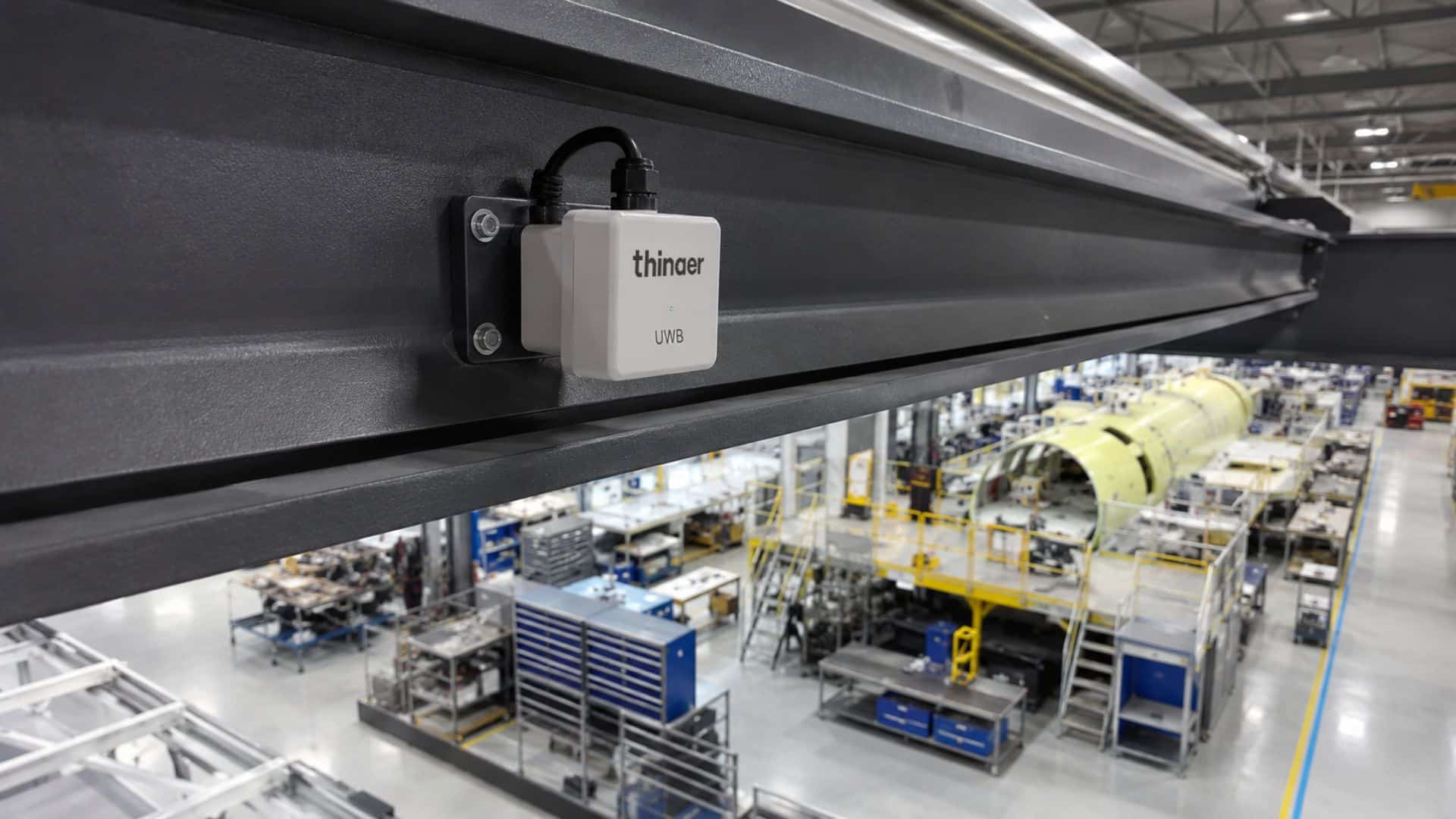
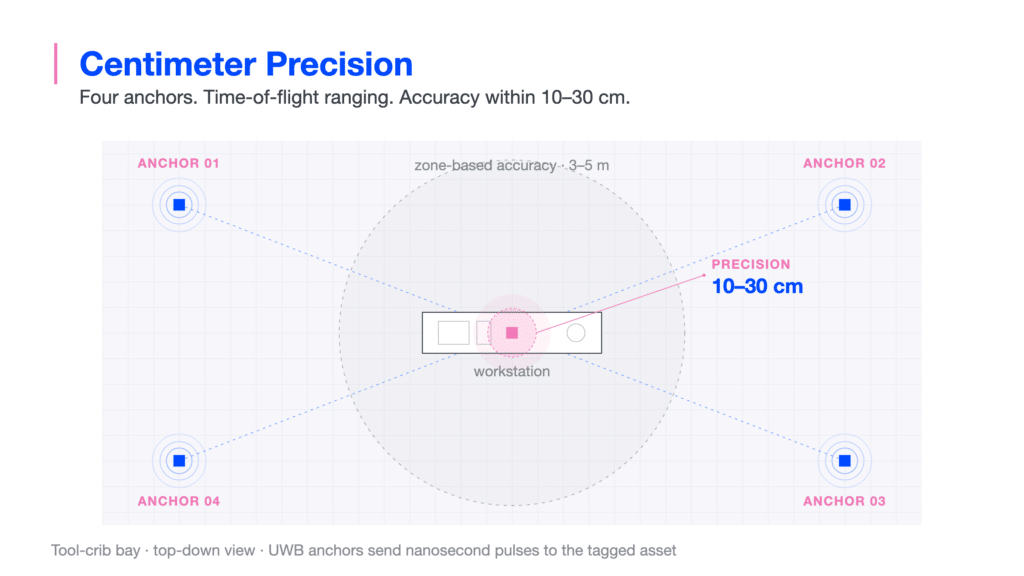
Ultra-Wideband (UWB) has earned a reputation as the most precise indoor positioning technology available today, capable of locating assets, tools, and people within roughly 10 to 30 centimeters in real time. That level of accuracy enables workflows that simply aren’t possible with zone-based technologies: tool accountability within a single bay, automated time-on-task measurement at the workstation level, and movement records detailed enough to reconstruct exactly where a critical asset was at any given moment.
In most facilities, the conversation about UWB starts and ends with accuracy. In classified facilities, defense manufacturing plants, secure research environments, and other high-security operations, the conversation starts somewhere else entirely. Before anyone gets excited about centimeter-level tracking, the security and IT teams want to know how the technology behaves inside their architecture.
- Can UWB operate within our existing security boundary?
- Does it introduce new attack surfaces, new radios, or new pathways for data to leave the facility?
- Will it interfere with mission-critical RF systems already in use?
- Who controls the data once it’s generated, and where does it actually live?
These are the right questions to ask, and they should be answered before any pilot is scoped. The answers determine whether precision tracking is something a secure facility can actually deploy, or just a capability that lives on the other side of a compliance wall.
Why UWB Behaves Differently from Other Wireless Technologies
To understand the security profile of UWB, it helps to look at how the signal itself works. UWB transmits extremely short pulses (on the order of nanoseconds) across a very wide slice of the radio spectrum, typically between 3.1 and 10.6 GHz, depending on the regulatory region and chipset. Most other wireless systems used in operational environments (WiFi, Bluetooth, Zigbee, LoRaWAN, cellular) work in narrower bands and rely on continuous or near-continuous signaling.
That architectural difference produces several properties that matter from a security standpoint.
The pulse duration is so short, and the energy is spread so thinly across the spectrum, that UWB signals sit at or below the noise floor of conventional receivers. To anything that isn’t specifically listening for UWB, the signal essentially isn’t there. That makes the transmissions difficult to detect, difficult to intercept, and meaningfully harder to spoof than narrowband alternatives.
The very wide bandwidth also means UWB and narrowband systems generally don’t compete for the same airtime. UWB can run alongside WiFi, Bluetooth, and most industrial wireless without producing the kind of cross-interference that secure facilities work hard to avoid. (This is also why UWB has been approved by the FCC for unlicensed operation in the U.S. and is governed by similar frameworks in Europe and Asia.)
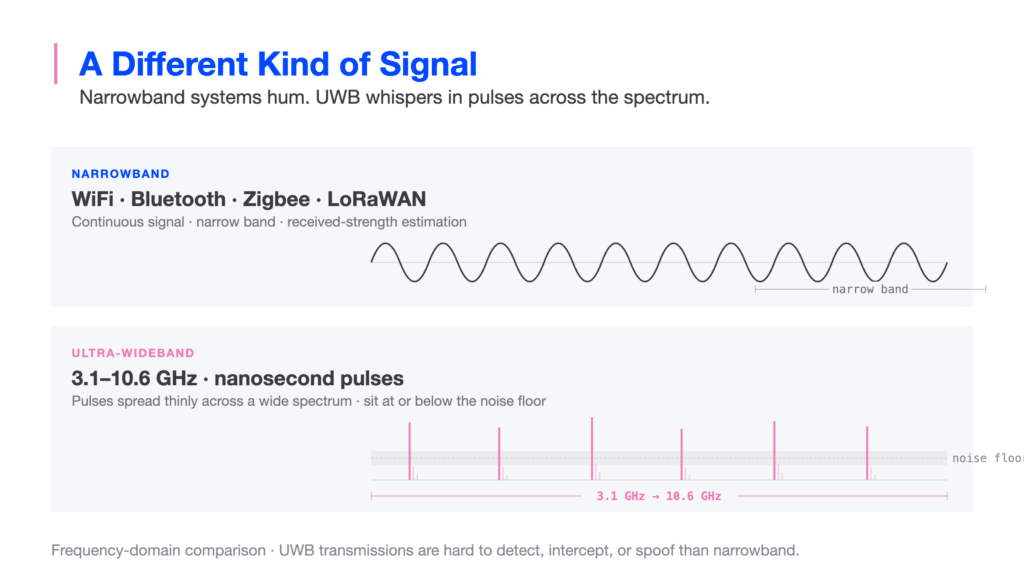
Finally, UWB measures position using time-of-flight rather than received signal strength. Instead of estimating distance from how strong a signal sounds (which is easy to fake), UWB times how long the pulse takes to travel from a tag to a fixed anchor and back. That ranging method is both more accurate and harder to manipulate from outside the system.
For IT teams in secure environments, the takeaway is straightforward. UWB doesn’t compete with the wireless infrastructure already in place. It operates in a different part of the spectrum, with distinct signaling characteristics and a different threat profile.
Deployment Architecture Matters More Than the Technology
The most important point about UWB in secure facilities is that the technology itself rarely fails the compliance test. The deployment architecture is what determines whether the review passes or fails.
Every wireless system can be deployed in a way that leaks data, opens unmanaged ports, or hands control of the management plane to an outside vendor. UWB is no different. What separates a deployment that clears an Authority to Operate review from one that doesn’t is where the components live, what they talk to, and who holds the keys.
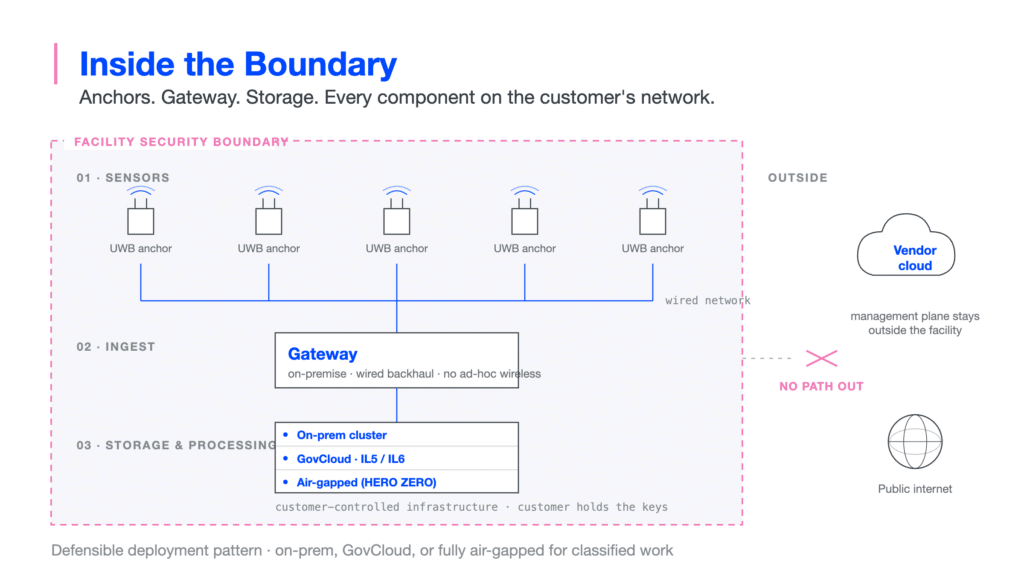
At a minimum, a defensible UWB deployment in a secure environment should keep all components within the facility’s security boundary. Anchors and gateways should connect via the facility’s wired network, not via an ad-hoc wireless backhaul. Data processing should happen on customer-controlled infrastructure: an on-premise server cluster, a GovCloud tenant, a Secret-level cloud, or, in the most sensitive cases, an air-gapped environment with hardwired gateways and no external connectivity at all.
The deployment Thinaer has built for the Defense Industrial Base reflects this pattern. UWB anchors and gateways are installed on the customer’s network. Position data is processed and stored on customer infrastructure (on-premise or in GovCloud), and a Secret Cloud version runs in Microsoft Azure for programs that require it. For HERO ZERO environments and other classified areas, the architecture is fully air-gapped, with no path for data to leave the facility. The first-mover work in those environments is the subject of a pending patent, but the broader point is that the architecture is what makes deployment possible, not any single proprietary feature.
What IT Teams Should Actually Evaluate
When a security or IT team assesses UWB for a secure environment, the evaluation should cover at least five areas. None of these are unique to UWB; they’re the same questions any networked sensor system should be able to answer.
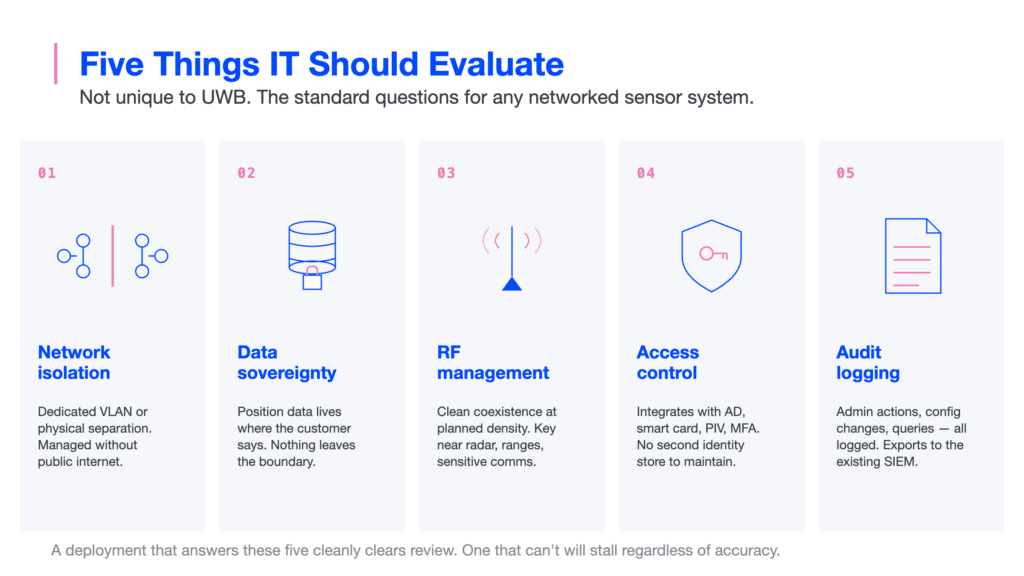
- Network isolation: Can the UWB infrastructure operate on dedicated VLANs, on a physically separate network, or in an enclave that already meets the facility’s segmentation requirements? Can the anchors and gateways be managed without giving them general internet access?
- Data sovereignty – Where does position data live, and does any of it leave the facility’s boundary, even for telemetry, diagnostics, or vendor support? Is there a documented data flow that the security team can review and approve?
- RF management – Does the UWB deployment, at the planned anchor density and power level, coexist cleanly with the facility’s existing RF environment? This matters less for general office space and quite a bit more in places where radar, test ranges, or sensitive communications are part of the mission.
- Access control – Does the management interface integrate with the authentication and authorization stack the facility already uses (Active Directory, smart card, PIV, conditional access, MFA), or does it introduce a separate identity store that must be maintained and audited?
- Audit logging – Are administrative actions, configuration changes, and data queries logged in a way that maps to the facility’s audit and compliance framework? Can those logs be exported to the SIEM the security team already uses?
A deployment that can answer these five questions cleanly tends to clear review. A deployment that can’t will get stuck regardless of how accurate the underlying technology is.
Mixing UWB with Other Technologies Where It Makes Sense
One of the more practical lessons from the last several years of operational visibility work is that UWB doesn’t need to cover every square foot of a facility. Centimeter-level precision is worth a great deal in a tool crib, an assembly bay, a calibration lab, or a controlled storage area where knowing which workstation an item is at, not just which room, drives real workflow value. In a long hallway or a warehouse aisle, zone-level accuracy from BLE or RFID is usually fine, and the cost and infrastructure footprint are considerably lower.
A hardware-agnostic approach allows the facility to choose the right technology for each space. UWB for precision-critical areas. BLE or RFID for general asset visibility. LoRaWAN or GPS for outdoor yards and long-haul movement. Wired sensors where the environment demands it. The data from each technology can then feed a single visualization layer (in Thinaer’s case, the Sonar application) so the end user isn’t trying to reason about five different dashboards.
This kind of mixed deployment tends to be easier to defend in a security review than a single-technology rollout, because each area gets the lightest footprint that meets its requirements.
The Compliance Reality
UWB in secure environments is rarely blocked by the technology’s physics. The physics are well understood, the regulatory posture is established, and the coexistence story with other wireless systems is, in most cases, the cleanest of any high-accuracy positioning option. What blocks deployments is almost always architecture, vendor practices, or both.
The questions worth asking up front are practical ones. Does the vendor understand the security framework you operate under (CMMC, NIST 800-171, IL5, IL6, or program-specific requirements)? Have they deployed in environments at or above your classification level before? Can they describe, in detail, where the data lives, who can touch it, and what happens when a sensor or gateway fails? Are they willing to operate fully on your infrastructure rather than routing through their cloud?
When those questions can be answered, precision tracking and security compliance stop being a trade-off. They become two requirements that the deployment is designed to meet at the same time, which is the only way a high-security facility can actually adopt the technology.
Across deployments spanning more than 100,000 sensors, 12 million square feet of operational space, and roughly 2.2 billion bytes of sensor data per hour (including programs at the highest classification levels), the consistent finding is that UWB works in secure environments when the architecture is right from day one. The technology has been ready for a while. The deployment model is what’s catching up.