



Every defense program office has had some version of this conversation: “We’d love to use AI here, but we’re classified.” It sounds like a policy problem. It isn’t. The real blocker is that nobody has been able to capture structured operational data inside the boundary at all. There’s nothing for an AI tool to consume once someone finally gets cleared to run one. AI in classified environments doesn’t start with a model. It starts with capture.
“We’d Love to Use AI, But We’re Classified” Is the Wrong Framing
This sentence gets repeated so often in defense IT circles that it’s treated as settled fact: classified environments and AI don’t mix. But look closer, and the objection isn’t really about AI policy at all. Security teams inside classified facilities are generally fine with the idea of AI running on-prem, in GovCloud, or air-gapped. That part of the conversation usually resolves quickly once IT and security are in the room together.
What doesn’t resolve quickly is data. Ask a program manager what operational data exists inside their classified boundary today — asset locations, tool custody, machine status, environmental conditions. The honest answer is usually “some spreadsheets and a lot of tribal knowledge,” with no structured, continuous stream behind it. No AI tool, however well-architected, has anything to work with in that situation.
That’s the reframe worth sitting with: classified environments aren’t AI-resistant. They’re capture-resistant. Fix capture, and the AI conversation gets a lot shorter.
Classified environments aren’t AI-resistant — they’re capture-resistant. Fix capture, and the AI conversation gets a lot shorter.
Why Standard IoT Platforms Stop at the Door
It’s not that vendors haven’t tried. Most industrial IoT platforms simply can’t cross into a classified boundary, for reasons that have nothing to do with paperwork.
Ordnance-adjacent and RF-restricted spaces impose real physical constraints. A sensor or gateway that emits radio frequency energy in an uncontrolled way can be a genuine hazard near explosives. That’s precisely why HERO ZERO (Hazards of Electromagnetic Radiation to Ordnance) certification exists in the first place. Most commercial IoT hardware was never built or tested against that standard, so it’s excluded before a security review even starts.
Single-radio vendors compound the problem. A platform built around one sensing technology — BLE-only, RFID-only, Wi-Fi-only — has no fallback. When that radio type is restricted in a given bay, hangar, or SCIF-adjacent space, the vendor is simply out. The vendor’s answer is usually “we can’t operate there,” which leaves the facility exactly where it started: no data.
Add DISA approval requirements, air-gapped network architectures, and the sheer variability of secure facility layouts. Most platforms rule themselves out well before anyone gets to the AI question.
The result is predictable. Program offices end up piecing together partial coverage from two or three vendors, each handling a different building or radio type. None of those systems talk to each other. That patchwork approach doesn’t produce a usable data foundation. It produces more silos — the opposite of what an AI initiative actually needs.
What Capture Looks Like Inside a Classified Boundary
Thinaer approaches this differently, starting with the environment rather than a fixed radio choice. That’s the core of the “your environment decides” principle. The facility’s physical and security constraints determine which sensing technology gets used: BLE, active or passive RFID, UWB, GPS, LoRaWAN, or Wi-Fi HaLow. The facility decides, not the other way around.
Thinaer holds patents for deployment inside classified environments, is HERO ZERO certified for ordnance-restricted spaces, and has completed DISA-approved deployments. Sensors and gateways operate entirely within the customer’s security perimeter, on the customer’s own identity and access management. There’s no requirement to send data outside the boundary to get value from it.
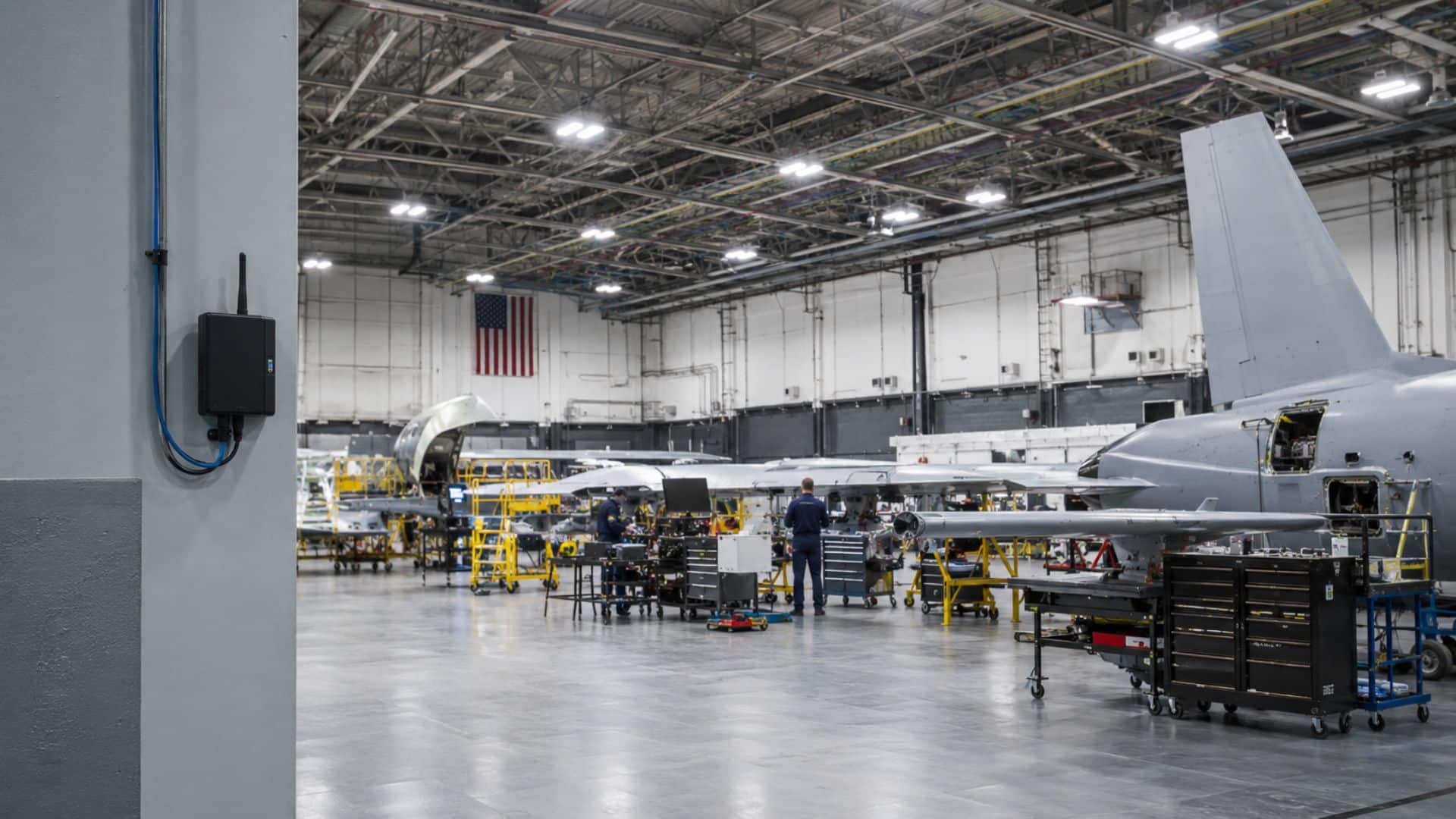
In practice, a classified bay, hangar, or shipyard space that has never generated a single structured data point can start capturing data. Location, custody, machine status, environmental conditions — all of it. It happens continuously, in real time, without violating the constraints that kept every previous vendor out.
Deployment happens through tiered support — full service, on-site project management, or remote assist, depending on what the facility’s access controls allow. That flexibility matters in classified environments specifically. Not every program can accommodate an outside team walking the floor, so the deployment model needs to bend to the facility, not the other way around.
From Raw Signal to AI-Ready Data — Still Inside the Boundary
Capturing raw signal is only half the job. Sensor pings need context before they’re useful: which asset, which zone, which time window, which threshold was crossed. Thinaer’s platform handles that contextualization and normalization inside the boundary. What comes out the other end is already structured, AI-ready data — not a firehose of raw telemetry someone has to clean up later.
That distinction matters because it changes what’s waiting for an AI tool on day one. Instead of a backlog of data engineering work, there’s a live, structured operational picture in Sonar, Thinaer’s visibility application. That same data stream is available to any AI or analytics platform the program is cleared to run, through MQTT, REST APIs, or direct export.
Then — and Only Then — AI Has Something to Work With
Once structured data exists inside the boundary, the architecture question becomes much more tractable: on-prem, air-gapped, or GovCloud AI deployment, consuming data the program already owns. That’s a real and important layer of the problem. Thinaer’s previous post on operational data in classified environments covers it in depth. It walks through how AI runs on-prem, air-gapped, or in GovCloud once the data foundation is in place.
This post is about the layer that comes before that one. Getting sensors deployed and data flowing inside a classified boundary is the harder, less-discussed problem. It’s the one that determines whether the AI conversation ever gets off the ground.
Common Misconceptions Worth Clearing Up
A few assumptions tend to derail this conversation before it goes anywhere useful:
- “Classified means no IoT, full stop.” In reality, the barrier is technical — RF restrictions, radio limitations, certification gaps — not a blanket prohibition on sensing technology.
- “We’ll just wait for the AI tool and figure out data later.” Backwards. Without a capture layer, the AI tool has nothing to analyze, and standing up data capture retroactively costs far more time than building it first.
- “Any RTLS vendor can be certified for this if we push hard enough.” Certification (HERO ZERO, DISA approval) is specific and earned. It isn’t a checkbox a general-purpose vendor can add on request.
Clearing these up early saves programs months of chasing vendors who were never going to clear security review in the first place. It also reframes the internal conversation. Instead of asking whether AI is allowed inside the boundary, the more useful question is whether the data exists yet to make AI worth deploying at all.
Physical AI Starts With Capture, Not With a Model
The models are here now. What classified environments have lacked isn’t AI readiness — it’s a capture layer that can legally and physically operate inside the boundary in the first place. Thinaer’s patented classified-area deployment exists to solve exactly that problem. By the time a program is ready to run AI, structured, AI-ready data is already waiting for it.
For program offices weighing an AI initiative against a classified boundary, the sequencing matters more than the sophistication of the model. A capture layer that can legally operate inside the perimeter changes everything. “We’d love to use AI, but we’re classified” turns from a permanent objection into a solved problem, months before the first model gets evaluated.
Exploring what a secure, scalable IoT platform looks like for defense and aerospace environments? See how Thinaer’s UWB deployments in secure environments handle compliance and control. Or explore on-premises, air-gapped, and GovCloud AI deployment options once your data foundation is in place.