



The Twin Looks Right. The Floor Disagrees.
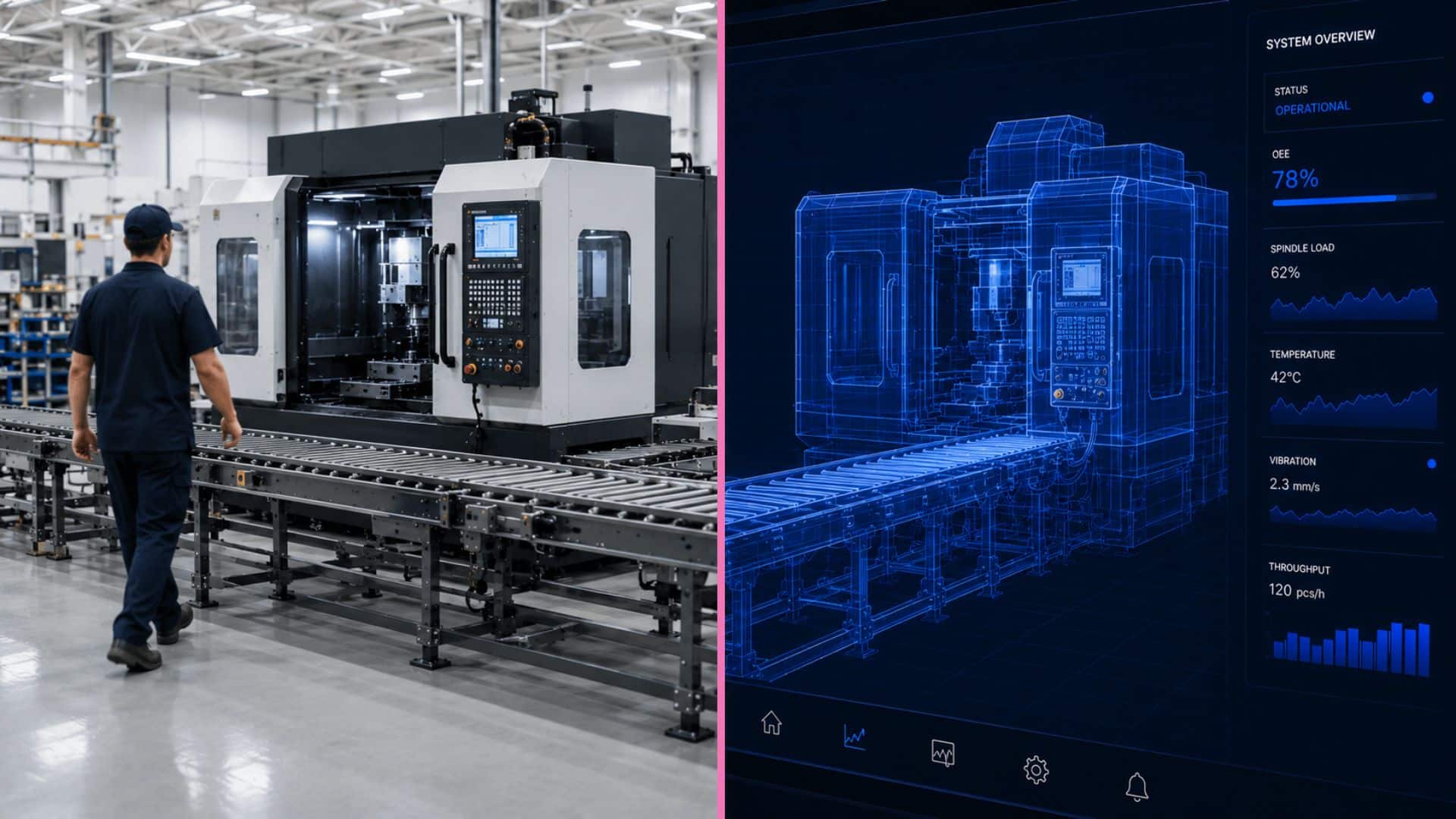
Picture a plant manager pulling up a digital twin mid-shift. The twin shows three CNC machines running, one idle for scheduled maintenance, and throughput tracking to plan. It looks clean, current, and actionable. However, one of the “running” machines stopped twelve minutes ago, when an operator stepped away to source a part. The twin has no way to know that yet.
This isn’t a flaw in the simulation logic. It’s a flaw in the assumption underneath it: that the data feeding the model is as real-time as the model itself. A digital twin is a mirror, and a mirror can only reflect what’s pointed at it. If the operational data feeding a twin arrives in batches, gets keyed in manually, or lags by hours, the twin isn’t tracking reality. Instead, it’s tracking a memory of reality that’s already out of date. That gap between “what the twin shows” and “what’s actually happening” is where trust in the whole system starts to erode.
Why Live Digital Twin Operational Data Is the Missing Assumption
Most content about digital twin platforms focuses on what the platform does once it has data. Simulation fidelity, 3D visualization, scenario modeling, and predictive scoring get most of the attention. Those are real capabilities. The vendors building them — Siemens, PTC, Microsoft, NVIDIA, and others — have invested heavily in making the modeling layer sophisticated. That investment helps explain why the digital twin market is projected to keep growing at a strong double-digit compound rate through the rest of the decade.
What that content rarely interrogates is the assumption sitting underneath all of it: that clean, continuous, real-time operational data already exists, simply waiting to be piped in. In practice, it usually doesn’t. Manufacturing floors, shipyards, and hangars generate plenty of data. However, much of it lives in spreadsheets updated once a shift, or barcode scans logged at a single checkpoint. Paper travelers keyed in the next morning are common, too. A twin built on top of that isn’t wrong so much as perpetually behind. In fact, industry research on simulation accuracy keeps pointing to the same root cause: the gap shows up in the data feed, not the model.
As a result, organizations often evaluate twin platforms the way they’d evaluate a camera: resolution, frame rate, lens quality. Few check whether there’s any light in the room. A digital twin without a live operational data feed can render a beautiful picture of nothing current — and that’s the failure mode this piece is really about.
The Missing Layer: Capture, Before Simulation
Thinaer thinks about this through the Capture, Learn, Act framework — the architecture behind what the industry now calls Physical AI. A digital twin sits squarely in the Learn layer. It’s one of the ways an organization reasons over operational data, once that data exists in a structured, usable form. However, Learn is only as good as the layer beneath it. Capture is where physical events become structured, timestamped, contextualized data in the first place. Specifically, that means a part moving between stations, a motor’s on/off/idle status, or a temperature swing inside a curing oven, all captured the moment they happen.
Skip Capture, and the twin has nothing current to reflect. This is the layer most digital twin conversations quietly assume away. It’s also the layer where most of the actual work lives.
What a Pulse Actually Requires
A genuine pulse for a digital twin means sensing technology matched to the environment, not a single radio standard applied everywhere and hoped to work. BLE (Bluetooth Low Energy) delivers room- or zone-level location at 3–10 feet of accuracy — often enough for asset and WIP tracking. UWB (Ultra-Wideband) delivers sub-foot precision where a twin needs exact positioning. For example, a tool cart on a hangar floor or a work package moving through a shipyard bay both need that level of precision. RFID handles high-volume checkpoint scanning. Environmental sensors track temperature, humidity, vibration, and pressure continuously, not on a walk-through schedule.
Critically, that data has to be normalized and contextualized as it’s captured. A temperature reading only means something once it’s tied to a specific asset, location, and timestamp. Batch-uploaded spreadsheet exports, however frequent, don’t produce a pulse. Instead, they produce a series of snapshots. A digital twin built on snapshots behaves like a video made from still photos: technically moving, never quite real time.
Environment-Agnostic Capture, Any Twin Platform
Thinaer doesn’t build digital twins and isn’t trying to compete with the platforms that do. Instead, it captures the operational data those platforms need to be accurate. It then delivers that data through open channels into whatever twin, simulation, or BI tool the customer already runs. Specifically, that means MQTT for real-time streaming and REST APIs for queried access. See how this works in shipyards, bays and hangars on our Physical AI Digital Twin page.
That’s the practical version of your environment decides. Instead of forcing a facility to standardize on one sensing technology, Thinaer carries BLE, RFID, UWB, GPS, LoRaWAN, and Wi-Fi HaLow across 40+ sensor types. A single-radio vendor sells whatever radio it happens to build around; Thinaer deploys the right mix for each environment instead. A shipyard bay might need UWB for precision positioning alongside environmental sensors for humidity control. A defense manufacturing floor might need classified-area coverage alongside standard asset tracking. The twin platform doesn’t change. What feeds it does, based on what the environment actually requires.
This matters because adopting a live data feed doesn’t force a rip-and-replace of the twin platform an organization has already invested in. Thinaer’s data lands in Sonar for immediate operational visibility. From there, it flows out to whatever twin or simulation environment is already in place, whether that’s Azure, AWS, or any other cloud the customer runs.
What Changes When the Twin Has a Pulse
The difference between a twin fed by snapshots and a twin fed by continuous capture shows up first in predictive maintenance. A twin built on synthetic baselines or manufacturer-spec assumptions can flag “normal” behavior that doesn’t match how a specific machine, in a specific facility, actually runs. A twin fed by real utilization data grounds its predictions in what’s really happening instead. That means actual on/off/idle cycles and actual environmental exposure, not a generic model of what should happen.
Root-cause analysis improves the same way. When a batch of parts comes back with a defect, a twin with live environmental data can correlate the defect window against actual conditions from that station. Specifically, it can pull the exact temperature, humidity, or vibration readings from that time and place. Compare that to relying on a technician’s memory of “it felt a little warm in there that week.” That correlation only becomes possible once the operational data exists at the resolution and speed the twin needs.
None of this replaces the specialized sensing that complex machinery diagnostics depend on, like acoustic emission or high-frequency vibration signatures. That’s a distinct discipline, and Thinaer’s data complements it rather than replacing it. What changes is the baseline: a twin working from a continuous, contextualized pulse instead of a periodic snapshot.
A digital twin is only as current as the data feeding it. Everything downstream — prediction, simulation, root-cause analysis — inherits that ceiling.
The Twin Was Never the Hard Part
Simulation and visualization technology has matured fast. What hasn’t kept pace, in most facilities, is the operational data feeding it. That’s the layer worth auditing before evaluating the next twin platform. The right question isn’t “how good is the simulation,” but “how current, structured, and complete is the data reaching it?”
This is the first of three ways Physical AI shows up in partner and environment stories. For example, the same pattern applies to how Thinaer’s capture layer feeds Microsoft Azure environments. It also applies to what a digital twin actually is, before Capture ever enters the picture. See how a live operational data feed changes what your digital twin can actually tell you.