



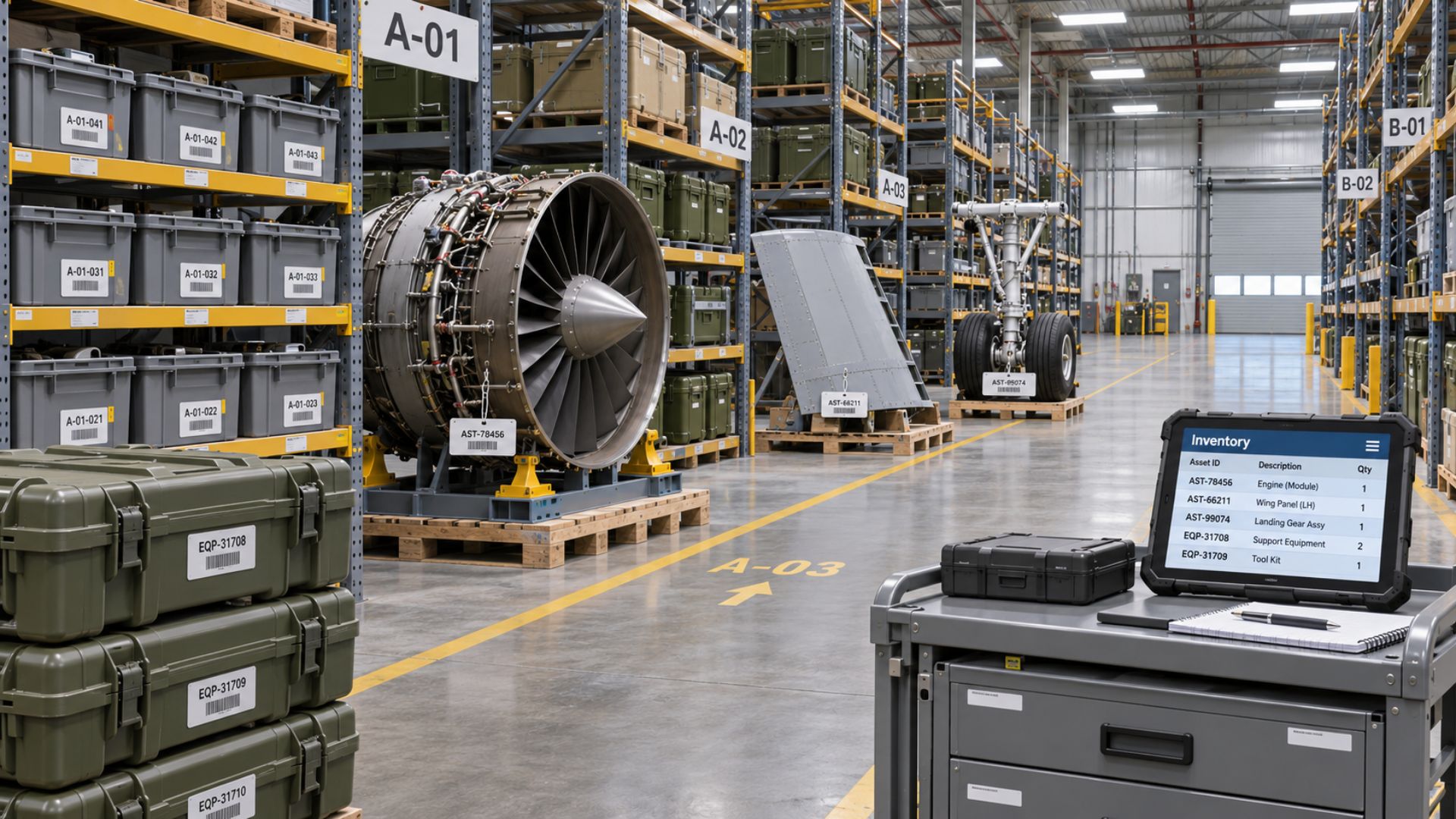
If you manage DoD property, you have seen a record and a shelf disagree. The system says a part sits in bay 4. The bin is empty, or it holds something the system has never heard of. DoDI 5000.64 is the Department of Defense instruction written to close that gap. It sets the rules for how DoD accounts for its equipment and other accountable property, wherever that property sits.
On Nov. 9, 2026, the Government Accountability Office (GAO) published a report showing how hard those rules are to meet at scale. It covers roughly 26 million F-35 parts worth about $31 billion. This post explains what the instruction requires, then looks at what GAO found.
What Is DoDI 5000.64?
DoD Instruction 5000.64, Accountability and Management of DoD Equipment and Other Accountable Property, sets DoD policy for tracking government property through its life cycle. It assigns responsibilities, defines who is accountable, and lists the data every property record must hold. The Office of the Under Secretary of Defense for Acquisition and Sustainment owns it.
The current version took effect April 27, 2017. Change 3, an administrative update, followed on June 10, 2019. You can read the full text in the official DoDI 5000.64 PDF.
The instruction covers tangible DoD equipment and other accountable property, including property held by contractors and other third parties. Other DoD rules govern real property, software, intellectual property, and operating materials and supplies, so the instruction leaves those out. That last exclusion matters later in this post.
What DoDI 5000.64 Requires
The instruction runs 25 pages. For anyone managing property day to day, four requirements carry most of the weight.
An Accountable Property System of Record
Every DoD component must track its accountable property in an accountable property system of record (APSR). The APSR holds the official records for accountability and audit. It also works as a sub-ledger to the component’s accounting system, so its numbers flow into financial statements.
Records must stay current. Each one has to reflect the asset’s status, location, financial information, and condition. Updates for completed transactions must post within 7 working days. Required data elements include serial number, National Stock Number (NSN), quantity, value, and location. For government furnished property (GFP), the record also names the authorizing contract.
Contractor custody doesn’t change the rule. The government must keep records for GFP of any value, even when a contractor holds it, and contractor systems can’t replace the APSR. Property in transit stays the shipper’s responsibility until the receiver formally acknowledges receipt.
Physical Inventories
A physical inventory checks two things. Existence means every item in the records is where the records say. Completeness means every item on the shelf appears in the records.
All accountable property needs an inventory at least every 3 years, and classified or sensitive property needs one every year. The accuracy target is 98%, rising to 100% for classified or sensitive property. Components can choose wall-to-wall counts, cyclic counts, sampling, or inventory by exception. A wall-to-wall inventory counts everything at a location at one time.
The instruction also expects automatic identification technology, such as barcode scanners and RFID. Its use is mandatory unless a documented analysis shows it isn’t practicable. Commanders must reaffirm that decision every 2 years.
Clear Roles, Appointed in Writing
Each component appoints a component property lead (CPL) in writing. The CPL owns property accountability for the component and makes sure procedures exist. Accountable property officers (APOs), also appointed in writing, maintain the records, plan inventories, and certify the results. In addition, personnel must be trained to their level of responsibility. Production floors apply the same discipline to tools, where a tool accountability system supports foreign object debris (FOD) prevention.
Losses Investigated and Documented
When property goes missing, APOs evaluate culpability and process financial liability investigations. At government sites, the DD Form 200, Financial Liability Investigation of Property Loss, documents the outcome. According to GAO, contractor sites follow a different path. Contractors report losses in DoD’s GFP Module, and the Defense Contract Management Agency (DCMA) adjudicates them.
Case Study: What GAO Found in the F-35 Program
GAO’s report, GAO-27-108713, reviewed how DoD accounts for F-35 parts. The program shares a common pool of parts across more than 700 contractor-managed and government-managed facilities. About 30% of the parts sit at contractor sites and 70% at government sites. The F-35 Joint Program Office (JPO) manages the program.
One caveat first. DoDI 5000.64 doesn’t govern every F-35 part, because DoD will report some of them as operating materials and supplies. GAO cites the instruction for the program’s property officer structure, internal controls, and loss reviews. Read the findings below as the accountability structure the instruction describes, applied to a large program under audit.
| Area | What the instruction requires | What GAO found |
|---|---|---|
| Records | Current status, location and condition, updated within 7 working days | Joint spares data arrives quarterly and may be 3+ months old; about 17,000 parts were never entered |
| Inventories | Verify existence and completeness; all property at least every 3 years | $17M+ spent since FY2020 without verifying either; some part locations unknown |
| Roles | Property lead and officers appointed in writing and trained | Officers lacked program-specific procedures and training |
| Losses | Losses investigated and documented (DD Form 200) | Status of $85M+ in losses unknown; 24 of 57 cases reported a year or more late |
Records That Arrive Months Late
The program’s APSR is the Enterprise Logistics Management System (ELMS). ELMS can capture changes in real time, but it doesn’t interface with either prime contractor’s property management system. For the joint spares pool, the JPO updates ELMS from contractor data reports delivered quarterly. As a result, that data may be more than 3 months old. The instruction’s update window is 7 working days.
The records themselves had gaps, too. As of March 2026, about 17,000 parts in maintenance or repair, worth about $1.3 billion, weren’t in ELMS at all. Officials said the true value may reach $2.5 billion. In a December 2025 contractor report, only 29% of records had serial numbers and 43% had NSNs. Almost 6% listed an acquisition cost of $0.01 or less.
The JPO was testing an interface with one prime contractor as of July 2026, with a live connection expected that September. Contracts for the second prime’s interface could come in September or October at the earliest.
Inventories That Couldn’t Confirm the Count
Since fiscal year 2020, the program has spent at least $17 million on physical inventories. Even so, GAO found they didn’t verify existence or validate completeness. Some parts sat at sub-subcontractor sites whose locations neither DoD nor the primes knew. Parts moving through commercial shippers may not appear in any tracking system. One prime’s property management system also carried a “disapproved” rating from DCMA.
Program officials judged a wall-to-wall inventory infeasible across 700-plus facilities. Instead, the Defense Contract Audit Agency is building toward a full baseline inventory, with a target date of March 2027.
Losses Without a Clear Trail
In 2023, GAO reported that one prime contractor had lost over 1 million F-35 parts valued at over $85 million. As of March 2026, the JPO didn’t know the status of those losses. The office began tracking DD Form 200 losses in a spreadsheet in September 2025. By April 2026 it held 57 cases. Of those, 24 cases worth almost $400,000 arrived more than a year after discovery, against a 30-day rule.
What GAO Recommended
GAO also found the APO program unfinished. Officers lacked program-specific procedures and training, and the person picked to oversee loss reporting hadn’t been appointed in writing. GAO made four recommendations: monitor loss reporting and analyze trends, write program-specific APO procedures, provide program-specific APO training, and define the APO program’s structure. All four are management fixes, and DoD concurred with each.
Why an Accountable Property System of Record Depends on Capture
Across the findings, one pattern repeats. The system of record learned about parts secondhand, on a schedule, from someone else’s system. When a part moved, entered repair, or went missing, the record found out months later, if at all.
GAO points out the limit of the obvious fix. Data quality issues may continue even after the contractor interface goes live, the report says, because the primes will still supply the data. An interface changes how fast data arrives. Accuracy depends on how the data was captured in the first place.
Capture at the Source
Accurate records start where the property sits. When location and status are captured at the source, continuously, the APSR always has something current to post. A part that leaves a bay or sits too long in transit shows up in the record when it happens, without waiting for the next quarterly report.
The instruction already leans this way. It expects automatic identification technology, and it lets APOs authorize inventory by exception. That method counts documented transactions and usage logs toward the inventory cycle.
Defense property also sits in places most tracking can’t reach, such as secure bays and classified areas. Thinaer is the Physical AI capture layer built for those environments. It is DISA approved and HERO ZERO certified, with patent pending in classified environments. Thinaer has deployed 160,000+ sensors across 12M+ square feet, and it can run in the cloud, on premises, in GovCloud, or in IL5 enclaves. Accuracy follows the environment: BLE locates assets to a room or zone within 3–10 feet, and UWB delivers sub-foot precision where it matters.
Where Thinaer Fits
Thinaer’s role is deliberately narrow. It captures location and status data and delivers it to the APSR, ERP, MES, or other systems the customer runs. That data moves through secure integration with MES and ERP systems. The APSR stays the official record, as DoDI 5000.64 requires. Procedures, training, and accountable property officers still carry accountability, and better data gives them current facts to work from.
Customers own their data and choose any cloud, any model for analysis. For more on matching tracking technology to defense environments, see our guide to military asset tracking.
Building Records That Hold Up
DoDI 5000.64 asks for records that match reality, kept current and checked by inventory. GAO’s F-35 report shows how hard that gets when records depend on periodic reports from other people’s systems. Procedures and trained property officers carry the requirement. Accurate capture gives them data they can trust.
See how Thinaer Sonar shows asset location and status in real time, or talk with our team about capture for your accountable property.