



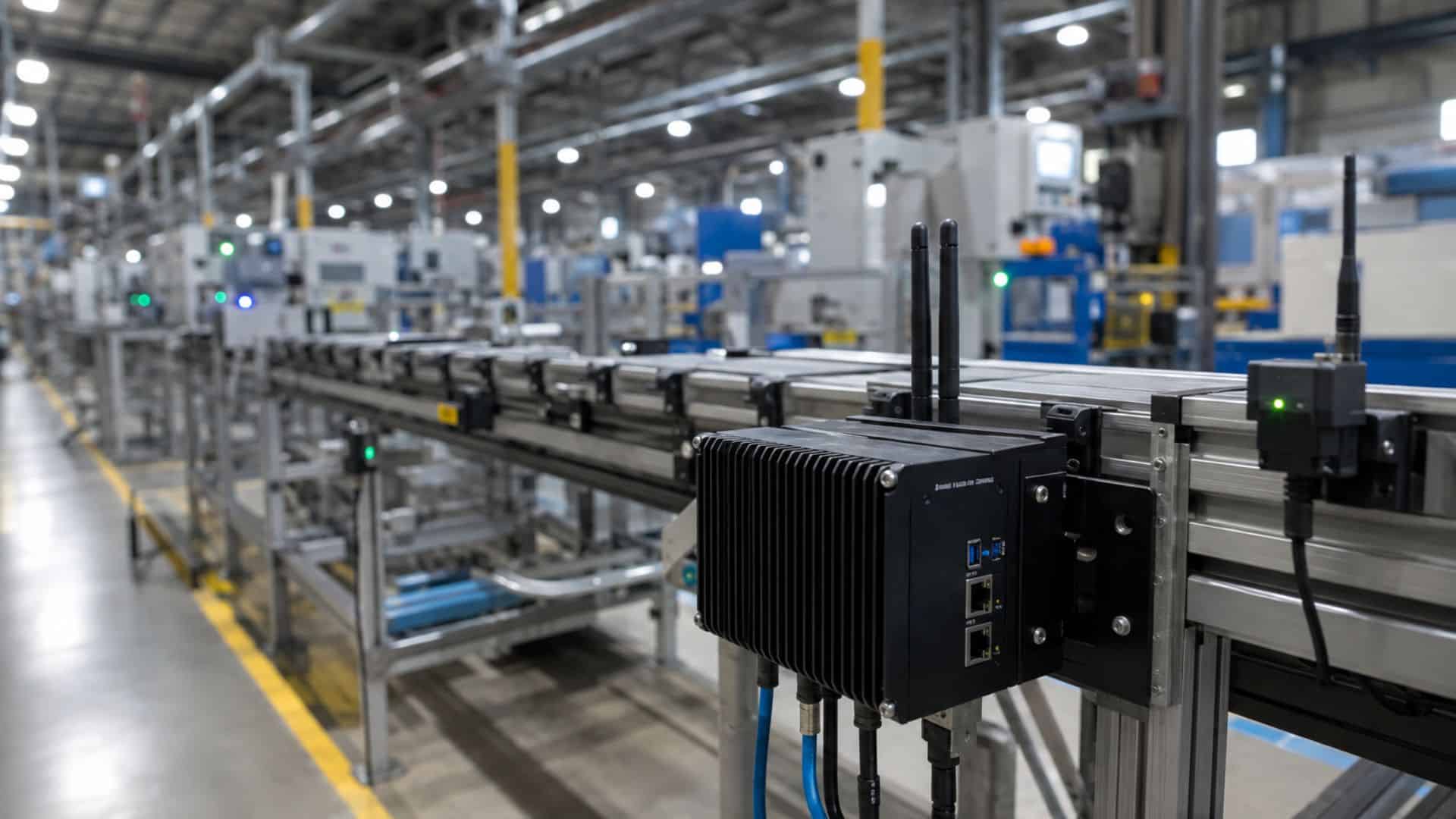
You’ve got budget approved for an edge AI pilot. A vendor is promising real-time predictive maintenance or quality control right at the machine. No cloud round-trip required. Before you sign anything, it’s worth asking what actually changed in 2026 to make this possible — and what didn’t.
The honest answer: industrial edge AI got a lot cheaper to deploy this year. Compute costs dropped. Silicon shipped at volume. Buyers finally had a real reason to run inference on the device instead of the cloud. What didn’t change is the data problem underneath it. An edge model making a decision in milliseconds needs cleaner data than a cloud model ever did. That part of the stack still has to be built, deliberately, by someone.
This piece is for the operations leader, product manager, or CTO who’s already past the “should we do this” conversation. You’re evaluating vendors now. The question worth sitting with isn’t whether edge AI works. It’s what has to be true underneath it for that pilot to actually scale.
What Exactly Is Edge AI — and What Changed in 2026?
Edge AI means running an AI model on or near the device generating the data. That could be a sensor, a controller, or a gateway, instead of sending everything to the cloud first. Industrial AI, in this context, is edge AI applied to plant, fleet, and facility operations: motors, conveyors, HVAC systems, production lines. Some vendors call this edge computing IoT; others just call it industrial edge AI. Either way, it’s the industrial half of the broader AIoT trend — the fusion of AI and the Internet of Things — playing out specifically in manufacturing, logistics, and utility settings.
Global industrial edge market, 2025–2030
$21.19B → $44.73B
16.1% CAGR — MarketsandMarkets, 2025
What changed in 2026 isn’t the concept. It’s the cost. The global industrial edge market is on pace to grow from $21.19 billion in 2025 to $44.73 billion by 2030. That’s a 16.1% compound annual growth rate, according to MarketsandMarkets. That kind of growth reflects real buyer behavior, not hype. Module prices fell far enough that mid-market manufacturers can justify a fleet-wide rollout, not just a flagship pilot line.
Zoom out further and the pattern holds. The broader IoT technology market — of which industrial edge computing is one fast-growing slice — is projected to climb from $959.30 billion in 2025 to $1,148.62 billion by 2030, per a MarketsandMarkets report covered by eeNews Europe. An edge AI device, in other words, isn’t a niche category anymore. It’s one expression of a much larger shift toward putting connected, AI-capable hardware directly into industrial environments.
Why Buyers Are Choosing the Edge Over the Cloud
Three motivations show up again and again in why buyers choose the edge over the cloud. Latency matters, because a defect-rejection decision can’t wait on a network round trip. Cost matters, because constant cloud data transfer adds up fast at scale. And data residency matters, because sensitive operational data can stay inside the plant instead of leaving it.
None of that changes what the model needs in order to run well. A model at the edge still consumes contextualized, timestamped, asset-tagged input. That’s the same requirement a cloud model has always had. There’s just less room for error, because the decision happens in real time instead of getting reviewed later. We’ve made a version of this argument before, in the context of generative AI on the shop floor. It applies just as directly to edge inference: Physical AI Starts on the Floor.
Where Industrial Edge AI Is Actually Winning
Three use cases dominate the industrial edge AI conversation this year. Each one depends on data that never stops arriving.
Predictive maintenance is the most common entry point. Vibration and current signatures on motors, pumps, and compressors feed models that flag bearing wear or imbalance before a failure happens. Maintenance gets scheduled during planned downtime instead of after a line stop. Thinaer’s role here is specific, and worth stating plainly. We capture the utilization, environmental, and on/off/idle data a predictive maintenance model needs as context — the foundation we’ve written about before in Predictive Maintenance Is Not Enough. We don’t perform vibration-signature or acoustic-emission analysis ourselves. That’s specialized sensor technology, built for exactly that job. Our data complements it. It doesn’t replace it.
Quality control and machine vision is the second major use case. Vision models inspect parts at line speed. They catch defects a human inspector misses, and ones a cloud round-trip is too slow to flag in time. Because the model runs locally, throughput isn’t gated by network conditions. Image data that might be IP-sensitive never has to leave the building.
Energy and emissions optimization is the third use case, and it’s growing in relevance as disclosure requirements mature. Edge AI on HVAC, compressed air, and process equipment continuously tunes setpoints against live load and utility data. It trims energy intensity without a person manually adjusting a dial.
What all three have in common is easy to miss. None of them work on periodic snapshots. A model checking bearing vibration once an hour isn’t really doing predictive maintenance — it’s doing spot-checking with extra steps. Same with a vision model inspecting parts once a shift instead of continuously. The value in each case shows up specifically because the sensor stream never stops.
Why Edge Inference Doesn’t Remove the Need for a Capture Layer
Moving inference to the edge changes where a decision gets made. It doesn’t change what has to happen before that decision can be made at all.
An edge model still consumes a data stream: location, condition, timestamp. That stream has to be captured, normalized, and delivered before the model ever runs. Reducing round-trip latency to the cloud doesn’t remove that requirement. It just means the requirement has to be met faster, closer to the source.
Thinaer describes this relationship with a simple framework: Capture, Learn, Act. Capture is the sensor and gateway layer. It’s the part that turns an unstructured physical environment into structured, AI-ready data. Learn is where models, simulations, and digital twins live. Act is where autonomous systems and agentic workflows take over.
Edge AI is a deployment pattern that sits inside Learn and Act. It’s a choice about where inference runs, not a replacement for Capture. Without the capture layer, an edge model has nothing reliable to reason over. It doesn’t matter how fast the chip underneath it is.
Data Discipline, Not Model Choice, Separates the Winners
The organizations succeeding with industrial edge AI aren’t the ones running the most sophisticated models. They’re the ones who solved data capture first. Sensor placement, sampling rate, labeling discipline — that work happens before picking a model, and before deciding where it runs, cloud or edge.
Get that sequence backward, and even a well-chosen model ends up reasoning over data that’s incomplete or mistimed. It’s an expensive way to find out the hard part was never the model.
Environment-First: Why the Right Sensor Mix Still Matters at the Edge
Edge AI doesn’t remove sensing-technology tradeoffs. It just makes them matter faster. A shipyard bay, a classified facility, and an open factory floor each present different radio-frequency conditions. Different physical obstructions. Different accuracy requirements. A model is only as good as the sensor feed underneath it, and no single radio technology covers every one of those environments well.
This is the principle behind what we call environment first: your environment decides the sensing technology, not the other way around. BLE covers room- and zone-level tracking at roughly 3 to 10 feet of accuracy. UWB delivers sub-foot precision where that level of detail matters, like tracking a specific tool inside a shipyard bay. RFID, GPS, LoRaWAN, and Wi-Fi HaLow each have a place too, depending on the asset, the building, and the backhaul available.
Most IoT vendors pick one radio and build a company around it. That means the customer bends to the technology, instead of the other way around. It works fine until the next building doesn’t fit. Or the next use case. Or the next classified area doesn’t fit the one radio the vendor happens to sell. An edge AI deployment inherits whatever sensing gaps already exist underneath it. The sensor mix deserves the same scrutiny as the model itself — not less.
This is also where a lot of edge AI pilots quietly stall. A team picks a model, gets promising results on one line in one building, and then hits a wall scaling to the next site. Often the model wasn’t the problem. The sensing approach underneath it simply couldn’t cover the new environment, and nobody planned for that until it was already a blocker.
Checklist: What This Means for Operations Leaders Evaluating a Vendor
Whether you’re piloting your first edge AI deployment, or scaling one past the initial line, the sharpest questions to ask a vendor are less about the model. They’re about what feeds it:
None of these questions require an operations leader to become a data scientist. They just require treating data capture as the foundation it is. Not a checklist item alongside model selection and connectivity choice.
The Hardware Got Easier. The Data Problem Didn’t.
2026 solved the compute half of industrial edge AI. Module prices came down. Silicon shipped at volume. The business case for on-device inference finally penciled out for mid-market operations, not just flagship pilot lines. That’s real progress. It’s worth taking seriously, especially since the growth numbers behind it aren’t speculative.
What 2026 didn’t solve is the half that actually determines whether any of it works. That’s the structured, contextualized, AI-ready data an edge model depends on to make a decision worth trusting. A model can be state of the art and still fail in production, if the stream feeding it is incomplete, stale, or missing context. No amount of silicon fixes that.
That’s the layer Thinaer builds. We capture operational data across 150,000+ sensors in 33 locations, covering more than 12 million square feet of deployed environments. Classified bays, shipyards, hospital corridors, open factory floors — the same capture layer, adapted to what each environment requires. Whatever model you run, cloud or edge, it has something real to reason over.
See how real-time visibility changes the case for your next edge AI pilot.