



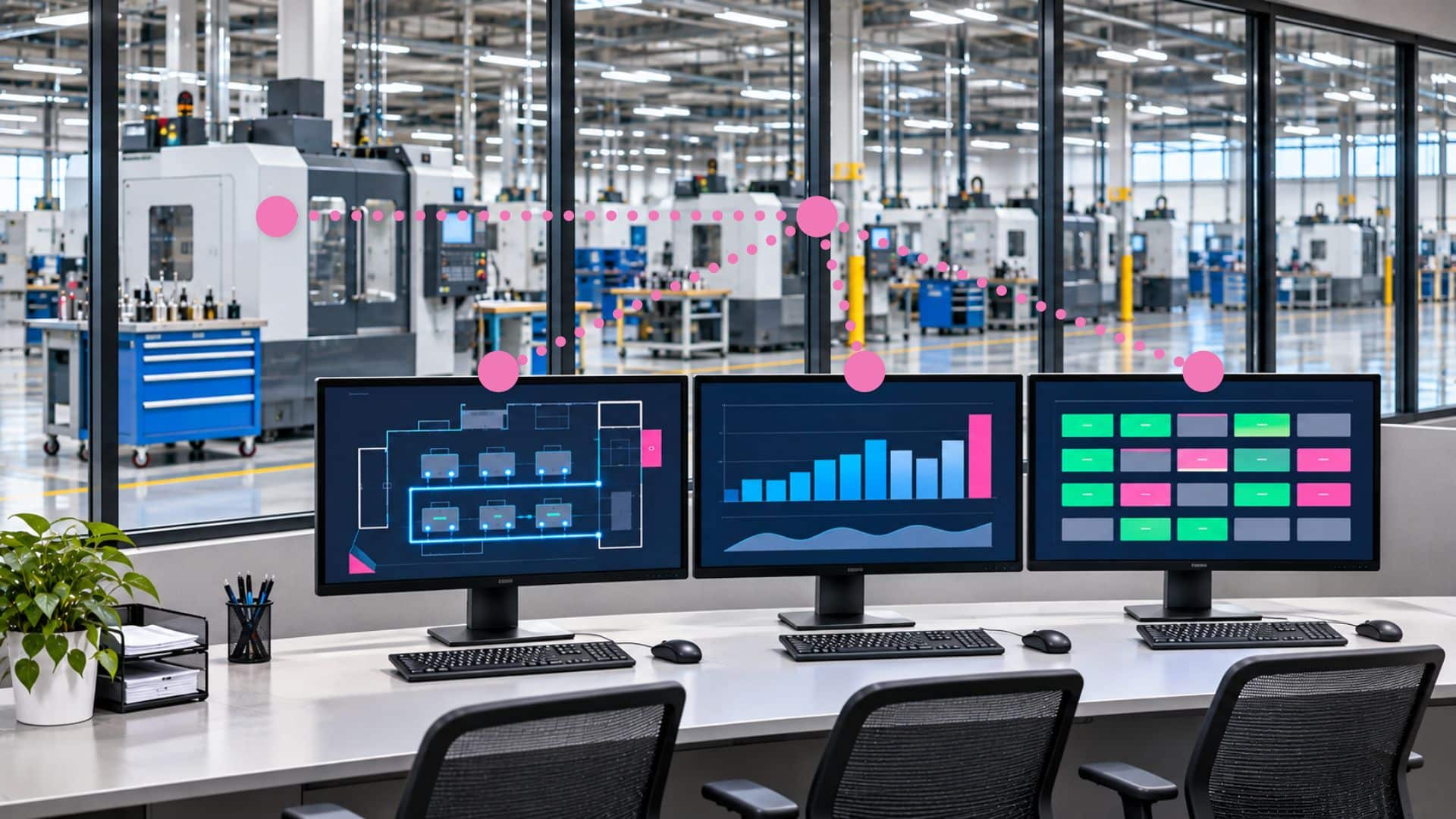
Picture a typical plant. A historian pulls from a handful of PLCs (programmable logic controllers). A dashboard reads from the historian. An analytics tool runs its own separate collector. An ERP (enterprise resource planning) integration points straight at one operational system.
Every arrow on that diagram is a maintenance liability. Someone built each one for a single source and a single consumer. In practice, each one breaks on its own schedule. That is IoT data integration done point to point, and it costs more with every sensor and every application you add.
Hiring a bigger integration team only treats the symptom. The lasting fix is a different architecture: capture the data once, structure it where it’s captured, and let any number of systems consume it. Below, we cover why point-to-point connections stop scaling, what a single data layer requires, and how to evaluate your options.
The Hidden Cost of Point-to-Point Connections
Point-to-point integration feels cheap at first: one source, one consumer, one connection. However, the cost shows up when the second, third, and fourth consumers arrive.
Every new data source needs a path to each application that wants its data, and every new application needs a path to each source. With 10 sources and 10 consuming applications, you can end up maintaining up to 100 separate integrations. An 11th application adds 10 more.
Little of this cost is visible. Each new connection means scoping, credentials, field mapping, testing, and a handoff to someone who may not own it next year. As a result, the integration backlog quietly limits what operations can do with its data.
Context Gets Lost in Transit
A raw reading is just a number. Without knowing which asset produced it, and where that asset sat at the time, it means little to the system downstream. In a point-to-point setup, someone has to rebuild that meaning by hand. As a result, they usually do it per project, and often more than once for the same data.
Failure Points Multiply
Every connection can break on its own. A change on either end means someone has to update the link between them. For example, a renamed field in one application can silently stop a feed that another team depends on. Each outage also pulls engineers away from improvements and into root-cause hunts across systems they don’t own. Over time, nobody can say with confidence where a given number came from, and people stop trusting the numbers.
What IoT Data Integration Looks Like Done Once
A single data layer rests on one idea: publish once, consume many times. Teams often reach for IoT middleware to untangle point-to-point sprawl. Middleware helps, but only when it sits on top of a structured IoT data pipeline instead of a pile of raw feeds. Three requirements follow.
Separate Capture From Delivery
In practice, one side of the architecture turns signals from the physical world into structured data. The other side makes that data available to any number of consumers. Because the two sides stay independent, a change in one doesn’t force a rebuild of the other.
Structure Data at the Point of Capture
Meaning has to attach when the data is captured. If a data engineering project stitches context onto raw values downstream, the bottleneck has only moved. As a result, the team still waits on custom work before anyone can use the data. In contrast, data that arrives structured is usable the moment it lands.
Make a New Consumer a Subscription
With capture and delivery separated, adding a consumer stops being a project. It becomes a subscription or an API call. In other words, the new tool reads from the stream that already exists, and nothing upstream changes.
A new consumer should mean writing a subscription, not building a new pipe.
Why AI Raises the Stakes
The models are here. The data isn’t. Point-to-point integration is where that gap gets widest.
AI and analytics tools need clean, structured data on demand. Suppose your team wants an AI assistant to answer which assets sat idle last shift. In a point-to-point landscape, that assistant needs its own path to every system holding part of the answer. As a result, the team spends months on plumbing while the model waits. Point-to-point also slows iteration. Each experiment with a new tool restarts the integration clock, so teams test fewer ideas.
By contrast, a single structured layer changes the sequence. A dashboard, a BI (business intelligence) tool, and an LLM (large language model) can all draw from the same clean stream. That is one set of connections instead of three separate efforts. Our post on how unstructured data becomes AI-ready data covers that step in more detail.
Thinaer doesn’t build AI models. It makes AI work by supplying the data those models depend on, to any cloud and any model the customer chooses.
What This Looks Like in Practice
Thinaer is the Physical AI capture layer, and its own architecture follows this principle. Sensors and gateways across multiple technologies feed one pipeline. Every reading arrives tied to the asset and place it came from, so it’s usable on arrival.
That same stream reaches Sonar, Thinaer’s operational visibility application. It also reaches any system that subscribes through an MQTT (Message Queuing Telemetry Transport) broker or REST APIs. From there, it can feed an ERP, an MES (manufacturing execution system), a CMMS (computerized maintenance management system), a BI tool, or an AI platform. As a result, nobody builds a separate integration for each destination.
That said, Thinaer doesn’t replace any of those systems. The ERP still runs the business, and the MES still tracks work orders. The capture layer gives them what they were missing: structured data from the physical environment. In Capture, Learn, Act terms, Thinaer owns capture. Digital twins, foundation models, and agentic workflows sit downstream and consume the stream.
The approach already runs at scale: 150,000+ sensors across 33 locations and more than 12 million square feet. For the full picture of how clean data supports AI, read The Thinaer Difference.
How to Evaluate an IoT Integration Platform
Whether you’re assessing a vendor or auditing your own stack, four questions separate an architecture that scales from one that doesn’t. If you want background on the technology first, start with our Industrial IoT explainer.
- Does a new application mean new integration work? A scalable setup needs only a subscription.
- Is context added at the point of capture? If it’s left for you to reconstruct later, the cost lands on your team.
- Does data move over open protocols? MQTT and REST keep you free to choose. A proprietary format creates lock-in.
- Does it span multiple sensing technologies? If a new building or use case means starting over, it won’t scale.
A single “no” doesn’t disqualify an option, but two or three usually mean you’re buying point-to-point integration under a new name.
The last question deserves extra weight. Most IoT vendors pick one radio and build a company around it. In contrast, Thinaer lets your environment decide the technology mix, so the platform stays the same for the next building or use case.
Build the Layer Once
Point-to-point integration is a cost that compounds quietly. It grows with every sensor and every application until it becomes a line item nobody planned for. Fixing it takes a different architecture.
Capture the data once, structure it where it’s captured, and let every system subscribe. Done that way, IoT data integration scales without adding people.
If your integration diagram looks like the one in the intro, Physical AI starts here. A capture layer gives every system the same clean data. Talk to Thinaer about what that looks like on your floor.