



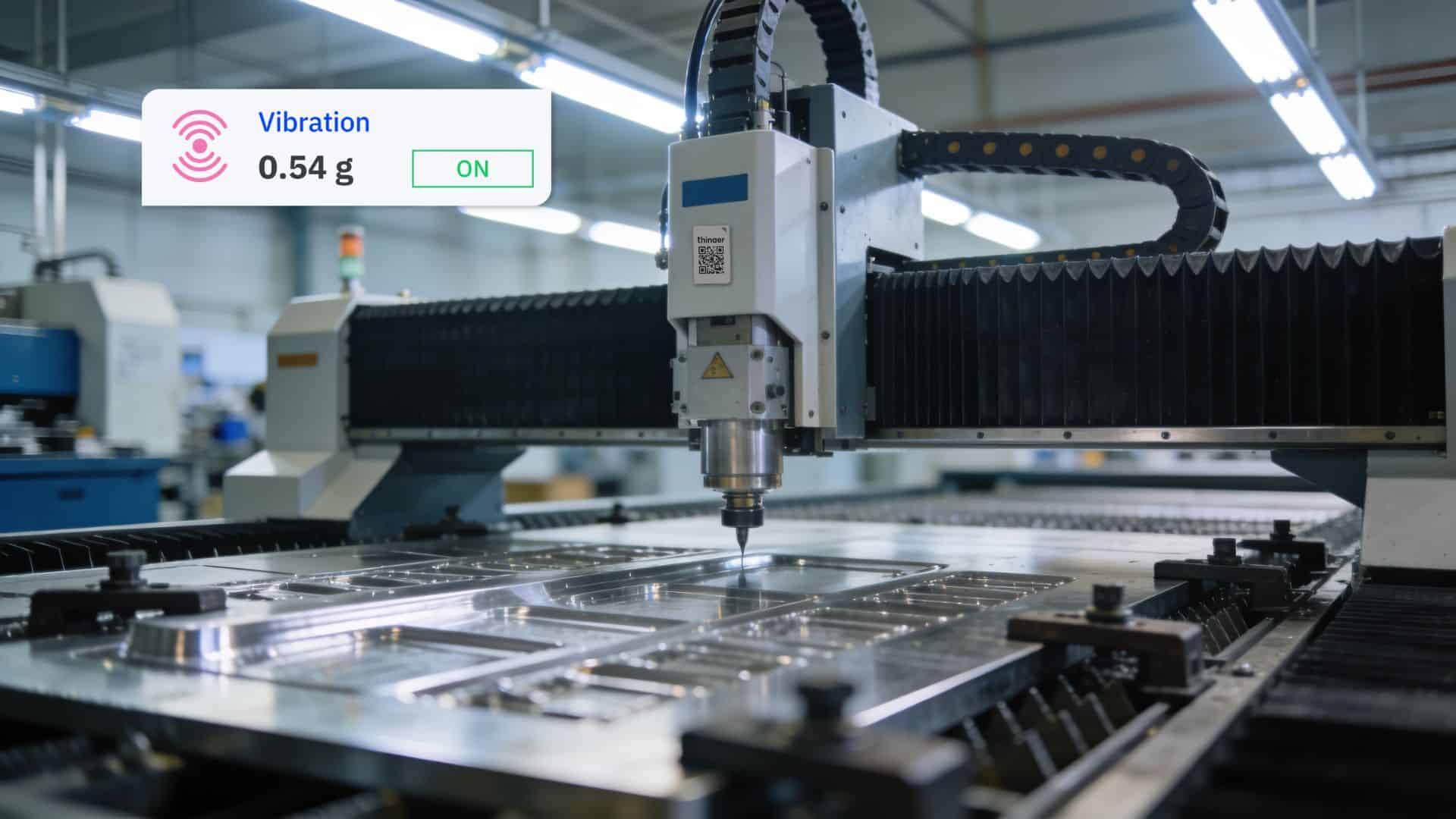
If you run operations in manufacturing, aerospace, defense, or healthcare, someone has already told you that IIoT will transform your facility. They probably didn’t tell you what it actually takes to make it work.
IIoT, the Industrial Internet of Things, is the network of sensors, devices, and software that connects physical operations to digital systems. It turns a production floor, a shipyard, a warehouse, or a hospital into an environment where real-time data flows from equipment, assets, and processes directly into the tools your teams use to make decisions.
That’s the concept. The reality is messier. Your facility has metal walls that scatter wireless signals, legacy equipment that predates Bluetooth, zones with strict security requirements, and a dozen systems that were never designed to talk to each other. Bridging the gap from concept to working deployment is where IIoT either delivers or becomes another stalled initiative.
The Definition Without the Buzzwords
IIoT refers to the use of connected sensors, devices, and platforms in industrial settings to collect, transmit, and act on operational data. That includes manufacturing, aerospace and defense, energy, healthcare, and logistics. Any environment where physical work happens and visibility matters.
At its core, IIoT answers one question: what’s actually happening on the floor right now?
Where are your critical assets? Is that machine running within spec? How long has that work-in-process been sitting at station 3? When did the last calibration happen on that torque wrench?
Without IIoT, those questions get answered by walking the floor, calling a supervisor, or pulling up a spreadsheet that was last updated yesterday. With IIoT, the answers arrive in real time: on a dashboard, in an alert, or as a structured data stream feeding your analytics tools.
The “Industrial” part of that acronym does real work. Consumer IoT (smart thermostats, fitness trackers, connected doorbells) operates in controlled, predictable environments. Industrial IoT operates in environments that are anything but: factory floors with RF interference, classified defense facilities, hospitals with sensitive equipment, and warehouses spanning hundreds of thousands of square feet. The technology has to perform in conditions that consumer devices would never survive.
IIoT vs. IoT: Why Operations Leaders Should Care About the Difference
The gap between IoT and IIoT isn’t branding. It’s a difference in scale, complexity, and what happens when something goes wrong.
Scale. A smart home has maybe 20 connected devices. A single manufacturing facility can run thousands of sensors tracking assets, equipment, environmental conditions, and personnel movement across multiple buildings. Thinaer has deployed over 100,000 sensors across more than 12 million square feet of operational space. That’s the scale IIoT has to handle.
Environment complexity. Consumer IoT assumes reliable Wi-Fi and climate-controlled rooms. Industrial environments have spotty connectivity, metal structures that scatter signals, multiple buildings with different construction materials, equipment that predates wireless technology, and security requirements that limit what can transmit data and where it can go.
Protocol diversity. Your smart home runs on Wi-Fi and maybe Bluetooth. A single industrial facility might need BLE (Bluetooth Low Energy) for indoor asset tracking, UWB (Ultra-Wideband) for centimeter-level precision in assembly bays, RFID for inventory management and access control, LoRaWAN for long-range coverage across outdoor yards, and GPS for fleet tracking. Sometimes all of those exist under one roof.
Consequence of failure. A smart speaker goes offline and you can’t play music. An IIoT system loses visibility on a defense manufacturing line and it can mean missed deadlines, compliance violations, grounded aircraft, or millions in lost productivity.
This is why IIoT platforms have to be fundamentally different from consumer-grade solutions. They need to handle multiple protocols, harsh physical environments, strict security constraints, and the reality that no two facilities look the same.
How IIoT Actually Works: Three Layers
Strip away the jargon and every IIoT deployment comes down to three layers.
Layer 1: Sensing (What’s Collecting the Data?)
This is the physical hardware (sensors, tags, beacons, readers, gateways) that captures information from the real world. Each technology has a purpose:
BLE (Bluetooth Low Energy) is flexible, cost-effective, and good for asset tracking and proximity detection. Works well in most indoor environments. Battery life measured in years, not months.
RFID (Radio Frequency Identification) is ideal for inventory management, access control, and high-volume scanning. Passive RFID tags need no battery because they’re powered by the reader’s signal.
UWB (Ultra-Wideband) delivers sub-meter accuracy for precision location tracking. It’s the answer when you need to know exactly where something is, not just which zone it’s in.
LoRaWAN covers large outdoor areas (yards, ports, sprawling campuses) where Wi-Fi and BLE signals don’t reach.
GPS handles outdoor tracking for vehicles, shipping containers, and assets that move between sites.
The critical point: your environment should decide the technology, not your vendor. A vendor that only sells BLE will tell you BLE is the answer to everything. A vendor that only sells RFID will frame every problem as an RFID problem. A hardware-agnostic approach means assessing what each zone of your facility actually needs and deploying the right technology for each use case.
Layer 2: Platform (Where Does the Data Go?)
A BLE signal strength reading, an RFID tag scan, a GPS coordinate. None of these are useful on their own. The platform layer ingests raw sensor data, normalizes it across protocols, applies context (this signal means this asset is in this location at this time), and makes it available for visualization and action.
This is where IIoT implementations commonly stall. If your BLE data lives in one system, your RFID data in another, and your GPS data in a third, you don’t have operational visibility. You have three partial views that nobody has time to reconcile.
A unified visualization layer like Thinaer’s SONAR application turns normalized data into real-time facility maps, configurable alerts, and interactive dashboards. When a calibrated tool leaves its designated zone, when a curing oven exceeds its temperature window, when work-in-process stalls at a bottleneck, the right people know immediately. Not at shift change.
Layer 3: Integration (What Else Uses This Data?)
IIoT data becomes exponentially more valuable when it flows into the systems your organization already runs: ERP, MES, CMMS, BI platforms, and increasingly, AI and machine learning tools.
Open data delivery through standard APIs (MQTT for real-time streaming, REST for query-based access) means your IIoT platform doesn’t become another silo. The data flows wherever you need it: into Power BI for executive reporting, into a predictive maintenance model, into a compliance system for audit trails.
This is a fundamental architectural decision. Closed platforms that trap your data behind proprietary interfaces create vendor lock-in and limit what you can do with your own operational information. Open platforms give you the freedom to use any analytics, BI, or AI tool you choose, now and as better tools emerge. We don’t do AI. We make AI possible by delivering the clean, structured data it needs to work.
The Hard Part: Connecting Diverse Environments to Digital Systems
Here’s what the IIoT sales pitch usually glosses over: the hardest part isn’t the sensors or the software. It’s the connecting.
Most industrial environments aren’t clean, uniform spaces designed for IoT. They’re a mix of new and legacy equipment, multiple buildings with different construction materials, secure zones with specific compliance requirements, and existing systems that were never designed to communicate with each other.
Making data flow reliably from a 30-year-old CNC machine to a modern analytics platform is where IIoT projects either deliver or die.
The challenges that derail real-world deployments:
Legacy equipment without native connectivity. That CNC machine from 2004 works perfectly but has no way to report its status digitally. Retrofitting it with sensors bridges the gap between keeping proven equipment and gaining visibility into its performance.
Mixed-protocol environments. Your receiving dock needs RFID for pallet scanning. Your production floor needs BLE for WIP tracking. Your tool crib needs UWB for precise location. Your outdoor yard needs GPS. Each protocol has its own infrastructure, and all of the data needs to come together into a single operational view.
Security and compliance constraints. In aerospace and defense manufacturing, data can’t just flow anywhere. ITAR, NIST, and facility-specific security requirements dictate how data moves, where it’s stored, and who can access it. Deployments in classified facilities, GovCloud environments, and HERO ZERO zones add layers of complexity that most IIoT vendors aren’t equipped to handle. Thinaer was the first mover in classified areas (patent pending). If it works there, it works anywhere.
Physical environment interference. Metal structures scatter RF signals. Concrete walls attenuate them. Moving equipment creates dynamic interference patterns. A deployment plan that performs perfectly in a conference room demo can fail on a factory floor. There’s no substitute for experience deploying in real industrial environments.
These aren’t edge cases. They’re the norm. Solving them requires deployment expertise and a platform built for industrial reality, not adapted from consumer technology.
What to Look for in an IIoT Platform
Feature lists are long and everyone has one. These are the questions that actually matter:
Is it hardware-agnostic? Can the platform work with BLE, RFID, UWB, LoRaWAN, and GPS, or does it lock you into one technology? Your needs will evolve. Different zones of your facility may need different protocols. A single-technology platform is a platform you’ll outgrow.
Is the data open? Can you access your operational data through standard APIs (MQTT, REST) and feed it into any analytics, BI, or AI tool? Or does the vendor require you to use their ecosystem? Your operational data is your asset. You should own it completely.
Does the vendor deploy, or just ship a box? There’s a meaningful difference between receiving sensors with installation instructions and having an experienced team assess your environment, design the deployment, install infrastructure, and validate performance. Professional deployment services matter, especially at scale and in complex environments.
Can they prove it at scale? A pilot with 50 sensors in one room is straightforward. A deployment across 12 million square feet with 100,000+ sensors across multiple facilities is a fundamentally different engineering challenge. Ask for real-world scale references, not pilot success stories.
What happens on day one? Some platforms need months of configuration before delivering value. Look for solutions that provide immediate visualization (real-time maps, alerts, dashboards) from the moment the deployment goes live. If you can’t see what’s happening in your operations on day one, the platform isn’t earning its keep.
Getting Started Without Ripping and Replacing
The biggest misconception about IIoT is that it demands a massive upfront investment: new equipment, new infrastructure, new everything. It doesn’t have to.
Start with one problem. Don’t instrument your entire operation at once. Pick the challenge that’s costing you the most: lost tool time, unplanned downtime, WIP bottlenecks, environmental compliance gaps. Solve that first.
Start with one zone. Deploy in a single production line, a tool crib, or a receiving area. Prove the ROI in a contained environment before expanding. One Thinaer customer reduced “go-find” time by 85%, and that kind of result builds internal momentum for broader rollout.
Use existing infrastructure where possible. Hardware-agnostic platforms can integrate with sensors and systems you may already have in place. The goal is to connect what exists, not replace it.
Plan for expansion from day one. The architecture should support growth. A pilot that can’t scale to enterprise-wide deployment is a dead end. Make sure the platform, the data model, and the integration approach are built for what comes after the pilot succeeds.
The Bottom Line
IIoT isn’t a technology decision. It’s an operational visibility decision. The sensors and protocols are important details, but they’re details. The real question is simpler: do you have the real-time data you need to run your operations, or are you still working with blind spots?
If the answer involves clipboards, spreadsheets, phone calls, and “let me go check,” then IIoT is how you close that gap. And closing that gap is the foundation for everything else: better analytics, smarter maintenance, AI-powered decision-making, and continuous improvement.
Connect your operations first. Everything else follows.