



The $50 Billion Problem Hiding in Plain Sight
Every year, organizations across industries lose billions in productivity to a deceptively simple problem: they can’t find their own tools and equipment. Maintenance teams waste hours searching for assets that should be immediately available. Construction sites lose expensive power tools between job locations. Hospitals can’t locate critical medical equipment when patients need it most. Manufacturing operations stall because the right tool isn’t where it should be.
This isn’t just an inconvenience. It’s a fundamental blind spot in operational visibility that leads to equipment over-purchasing, productivity loss, downtime, and missed optimization opportunities. The challenge isn’t about buying better tracking devices or deploying more sophisticated software alone. The real challenge is connecting your physical assets to digital systems in a way that actually works across diverse environments, varied equipment types, and complex operational requirements.
This guide covers everything you need to understand about asset tracking solutions and tool inventory management, from technology selection and deployment approaches to industry-specific applications and ROI realization. Most importantly, we’ll address why the connect phase is the hardest part of any tracking initiative and how to make it easy.
Understanding Asset Tracking Solutions: Technologies and Approaches
Selecting the right asset tracking solution starts with understanding the technologies available and matching them to your specific operational environment. The biggest mistake organizations make is choosing a technology first and then trying to force it into their environment. Your environment should decide the technology, not the other way around.
Active Tracking Technologies
BLE (Bluetooth Low Energy) has become a cornerstone technology for indoor asset tracking and tool inventory management. BLE-based tracking devices provide real-time location data, proximity detection, and can integrate sensors for temperature, humidity, vibration, and other environmental factors. The low power consumption means multi-year battery life even with frequent updates. BLE works exceptionally well in manufacturing facilities, warehouses, hospitals, and any indoor environment where you need continuous visibility of asset location and status.
RFID tag asset tracking serves a different but complementary purpose. Radio frequency identification excels at checkpoint-based inventory management where you need to quickly scan large volumes of items. RFID asset tracking tags can be passive (no battery required) or active (battery-powered for extended range). Construction sites use RFID for tool checkout systems. Healthcare facilities use it for inventory verification. Distribution centers rely on RFID for rapid item counting and location confirmation at specific control points.
GPS asset tracking systems become essential when monitoring outdoor assets, vehicles, or equipment that moves between distant locations. A GPS asset tracking system provides global positioning data that tracks assets across cities, states, or countries. Construction companies use GPS to monitor equipment moving between job sites. Oil and gas operations track vehicles and mobile equipment across remote locations. The tradeoff is higher power consumption and reduced effectiveness indoors where satellite signals can’t penetrate.
UWB (Ultra-Wideband) technology delivers precision indoor positioning down to centimeters, making it ideal for applications requiring exact location data. High-value asset tracking in controlled environments, automated guided vehicles, and safety applications benefit from UWB’s accuracy.
LoRaWAN offers long-range, low-power connectivity perfect for distributed assets across large outdoor areas. Remote monitoring applications, agricultural equipment tracking, and infrastructure monitoring leverage LoRaWAN’s ability to communicate over miles with minimal power consumption.
Why Hardware-Agnostic Approaches Win
The fundamental challenge in asset tracking isn’t choosing a technology. It’s dealing with operational environments that demand different technologies for different asset types and locations. Your facility might need BLE for indoor tool tracking, GPS for vehicles, RFID for inventory checkpoints, and environmental sensors for compliance monitoring, all working together as a unified system.
A hardware-agnostic asset tracking solution adapts to your needs rather than forcing you into a single-technology approach. This flexibility prevents vendor lock-in, allows you to add or change technologies as requirements evolve, and ensures you’re always using the right tool for each specific tracking challenge. When you deploy 100,000+ sensors across 12M+ square feet like proven deployments have achieved, that flexibility becomes essential.
Tool Inventory Management: Beyond Basic Location Tracking
Tool tracking software has evolved far beyond simple “where is it” functionality. Modern tool inventory management systems capture utilization data, maintenance schedules, checkout history, and operational patterns that drive optimization decisions and cost reduction.
The best tool tracking software delivers real-time availability status that eliminates search time. When a technician needs a specific power tool, the system shows exactly where it is, whether it’s available, and when it’s due back if currently in use. This seemingly simple capability translates directly into productivity gains. Organizations report eliminating 30-60 minutes of daily search time per technician, which compounds across teams into significant ROI.
Usage pattern analytics reveal which tools are over-utilized and which sit idle. This data prevents unnecessary purchases while identifying opportunities to redistribute underutilized assets. Construction tool tracking systems show which job sites consistently need specific equipment, optimizing rental decisions and equipment allocation. Manufacturing facilities discover that expensive specialized tools purchased for one department could serve multiple areas with better visibility and coordination.
Maintenance scheduling becomes proactive rather than reactive. Tool tracking devices that monitor vibration, runtime hours, or cycle counts trigger maintenance alerts before failure occurs. This prevents the cascade of problems that happen when a critical tool fails during production, including downtime, delayed deliveries, and emergency replacement costs at premium prices.
The Connect Challenge in Tool Management
Here’s where most tool tracking initiatives struggle. Your tools weren’t designed with connectivity in mind. Legacy equipment lacks built-in sensors. Power tools move between harsh job sites and controlled environments. Some tools operate in explosive atmospheres requiring intrinsically safe tracking devices. Others face extreme temperatures, moisture, vibration, and impact that destroy standard electronics.
Connecting these diverse tools to digital inventory systems requires matching tracking technology to each specific environment and tool type. A vibration-monitoring sensor attached to rotating equipment needs different capabilities than a simple location beacon on a hand tool. Outdoor construction tool tracking demands weatherproof, impact-resistant devices with different range requirements than indoor manufacturing applications.
This is why professional deployment services matter. Assessment of your specific environment, tool types, and operational requirements determines which technologies work where. Installation that accounts for metal interference, structural obstacles, and environmental factors ensures reliable performance. Integration that connects tracking data to your existing work order systems, CMMS platforms, and operational dashboards delivers immediate value rather than creating another isolated data silo.
Industry-Specific Asset Tracking Applications
Different industries face unique asset tracking challenges that demand tailored approaches. Understanding these industry-specific requirements helps select technologies and deployment strategies that actually solve real problems rather than creating expensive science projects.
Healthcare Asset Tracking Software
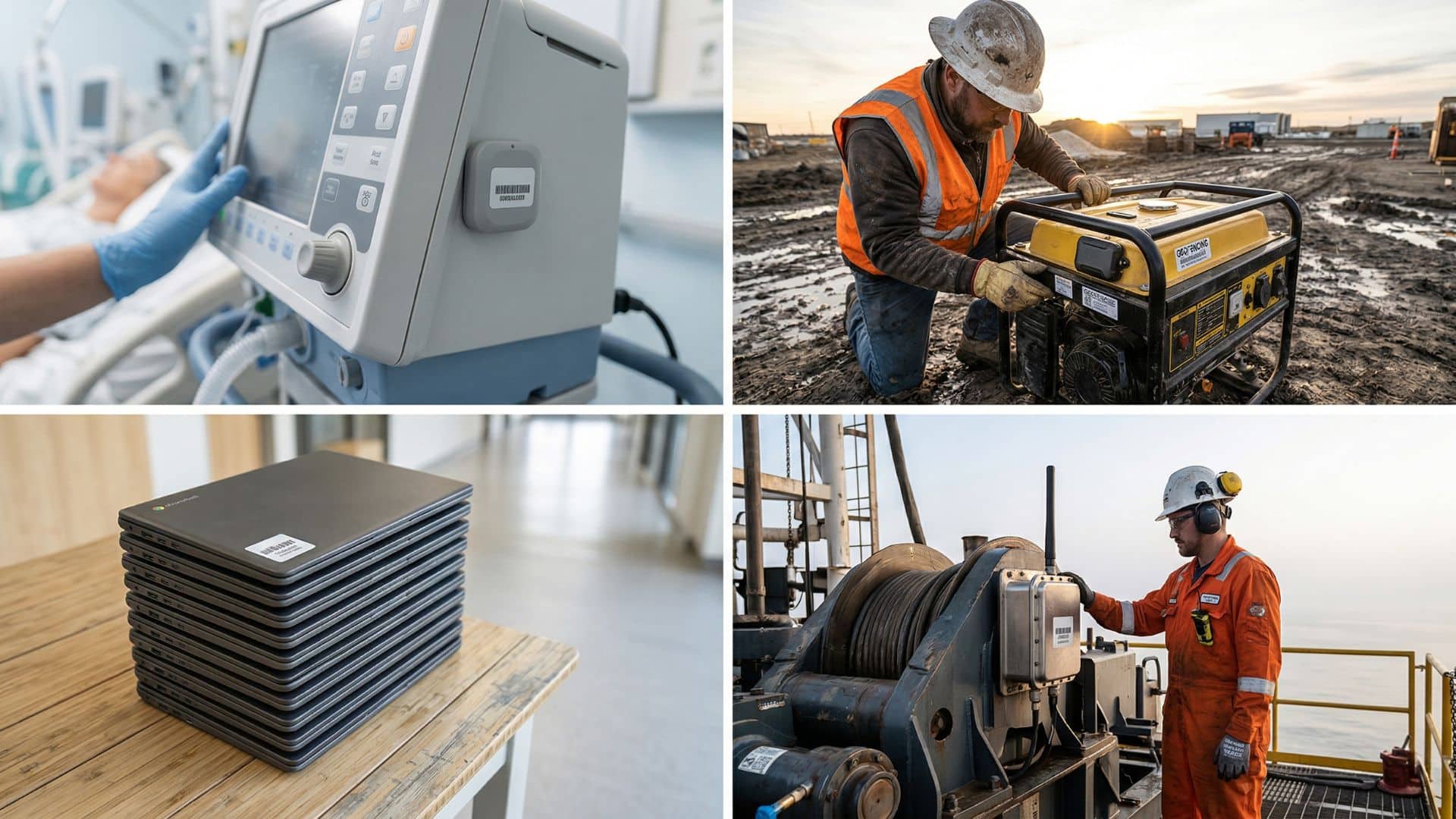
Hospital asset tracking software must deliver more than location data. Healthcare facilities need to track critical medical equipment like IV pumps, ventilators, wheelchairs, and specialized diagnostic devices that directly impact patient care. When a patient needs a ventilator, knowing it’s somewhere in a 500-bed hospital isn’t good enough. Real-time location down to the specific floor and room becomes essential.
Environmental monitoring integrates with location tracking for regulatory compliance. Medications, specimens, and biologics require continuous temperature monitoring with documented proof of proper storage conditions. Healthcare asset tracking software that combines location with environmental sensor data provides the compliance documentation required while alerting staff to exceptions before problems occur.
Utilization patterns reveal equipment hoarding, where departments stockpile assets “just in case” rather than trusting availability. One hospital discovered that 30% of their mobile equipment sat unused in specific departments while other areas faced shortages. Asset tracking software healthcare implementations often deliver ROI within weeks by optimizing existing equipment distribution and preventing unnecessary purchases.
Patient flow optimization leverages real-time bed and equipment availability. Emergency departments need to know which beds are available, which are being cleaned, and which have the necessary equipment already in place. This visibility reduces patient wait times and improves outcomes through faster treatment access.
Construction Asset Tracking Software and Tool Tracking
Construction tool tracking faces unique challenges from mobile job sites, outdoor environments, temporary structures, and the constant movement of tools and equipment between locations. Construction asset tracking software must handle these complexities while providing the visibility needed to prevent loss, optimize utilization, and improve project efficiency.
GPS asset tracking systems monitor high-value equipment moving between job sites. Excavators, generators, scaffolding, and specialized machinery represent significant capital investments that need location visibility. Geofencing creates virtual boundaries around job sites, triggering alerts when equipment leaves designated areas. This prevents theft while automating checkout tracking as equipment moves to new projects.
Power tool tracking at the individual tool level requires different technology. Rugged tracking devices that survive job site conditions attach to expensive power tools, providing location data and usage monitoring. Construction companies report that simply knowing tool locations eliminates the common practice of over-purchasing “just in case” because tools can’t be found when needed.
Tool checkout systems integrate with project management platforms. When a crew arrives at a job site, they know exactly which tools are available, where they’re located, and whether all required equipment is present before starting work. This prevents the productivity loss from discovering missing tools mid-project and eliminates the delays from returning to get forgotten equipment.
Weather-resistant technology becomes non-negotiable. Construction asset tracking software must function reliably in rain, extreme heat, cold, dust, and the vibration from heavy equipment operation. Indoor-rated devices that fail in outdoor construction environments create frustration rather than value.
Asset Tracking for Education
Educational institutions manage diverse asset portfolios across multi-building campuses with limited budgets and increasing accountability requirements. Asset tracking for education addresses IT equipment management, facility resources, lab equipment, and the unique challenges of tracking assets used by hundreds or thousands of students and staff.
IT asset management represents the most visible tracking need. Laptops, tablets, Chromebooks, and projectors move between classrooms, labs, storage rooms, and student homes. Schools need to know what equipment exists, where it’s located, its condition, and its assignment status. When budget decisions require proving utilization rates and demonstrating that resources are actually being used rather than sitting in closets, tracking data becomes essential.
Library and media resources extend beyond books to include cameras, recording equipment, and specialized devices for student projects. Asset tracking labels and tracking devices provide checkout systems that prevent loss while ensuring equitable access to resources.
Facility management benefits from tracking maintenance tools, furniture, and equipment across campus buildings. Knowing which building has spare desks, where the projector cart went, or which maintenance tools are at which location saves time and prevents duplicate purchases on tight education budgets.
Multi-building complexity makes education tracking different from single-facility operations. Assets move between buildings throughout the day. Students carry equipment between locations. Tracking systems must provide campus-wide visibility while distinguishing between authorized movement and potential theft or loss.
Oil and Gas Asset Tracking
Oil and gas asset tracking operates in some of the most challenging environments imaginable. Remote locations, hazardous atmospheres, extreme weather, and high-value specialized equipment create requirements that standard asset tracking solutions can’t meet.
Intrinsically safe tracking devices certified for hazardous locations become mandatory rather than optional. ATEX and IECEx certifications ensure that tracking devices won’t create ignition sources in explosive atmospheres. These certifications add cost and complexity but remain non-negotiable for oil and gas applications.
Remote site connectivity challenges standard approaches. Many oil and gas operations lack reliable WiFi or cellular coverage. Asset tracking solutions for these environments must support long-range technologies like LoRaWAN or satellite connectivity. Some deployments require hybrid approaches that cache data locally and sync when connectivity becomes available.
High-value asset protection justifies investment in comprehensive tracking. Drill equipment, safety gear, specialized tools, and vehicles represent millions in capital equipment distributed across remote locations. GPS asset tracking systems combined with geofencing prevent loss while providing the utilization data needed to optimize expensive asset portfolios.
Safety equipment tracking adds life-safety dimensions. Knowing that every worker has proper safety gear and that equipment certifications are current prevents accidents while maintaining regulatory compliance. Environmental sensors monitor gas detection equipment, breathing apparatus, and other safety devices to ensure they’re functioning properly when needed.
Selecting Asset Tracking Companies and Solutions
Choosing among asset tracking companies requires looking beyond feature lists to understand deployment approaches, technology flexibility, integration capabilities, and long-term partnership models. The wrong choice leads to expensive failed implementations. The right choice creates the foundation for operational visibility that drives continuous improvement.
Critical Selection Criteria
Deployment approach separates successful implementations from abandoned projects. Some asset tracking companies ship boxes and leave you to figure out installation, configuration, and integration. This DIY approach works only if you have internal expertise in RF propagation, protocol integration, and site survey methodology. Most organizations don’t. Professional deployment services that include site assessment, technology recommendation, installation, and integration support eliminate the complexity that causes most projects to fail.
Technology flexibility prevents vendor lock-in and ensures you can adapt to changing needs. Single-technology vendors force you into their preferred solution regardless of whether it fits your environment. A BLE-only vendor will recommend BLE even when RFID or GPS would work better. Hardware-agnostic asset tracking companies assess your specific requirements and deploy whatever technologies make sense, including mixing multiple approaches within the same facility. This flexibility becomes critical as you scale across diverse environments.
Integration capabilities determine whether your tracking data creates value or becomes another isolated system. Open architecture built on MQTT and REST APIs ensures your asset data flows to CMMS systems, ERP platforms, BI tools, and whatever analytics or AI systems you choose. Proprietary integration approaches lock your data in vendor-specific formats, forcing you to use their dashboards and limiting your ability to combine asset data with other operational information.
Scalability matters more than initial deployment scope. You might start with tracking tools in one facility, but you need a platform that scales to multiple sites, different asset types, and expanding use cases. The best tool tracking software grows with you rather than requiring replacement when requirements expand.
Data ownership isn’t negotiable. You generate the data through your operations. You should own it completely with unrestricted access and no vendor lock-in. Some asset tracking companies treat your data as their asset, limiting extraction or charging for API access. This creates dependency that restricts your ability to use your own operational information.
The Hidden Cost of “Just Shipping Boxes”
The apparent cost savings from DIY asset tracking solutions disappear when you account for the complexity of successful implementation. Site assessment requires understanding RF propagation, interference sources, and optimal gateway placement. Someone needs to determine which technologies work in which areas, accounting for metal structures, concrete walls, outdoor exposure, and environmental factors.
Installation demands technical knowledge of network configuration, device provisioning, and troubleshooting. When tracking devices don’t communicate reliably, you need expertise to diagnose whether the problem is gateway placement, device configuration, network settings, or environmental interference. Ongoing optimization responds to facility changes, new equipment, and evolving requirements.
Organizations that choose full-service deployment approaches report faster time to value, more reliable performance, and better ROI. When professional services are included rather than charged separately, you get expertise without the consulting fees that can exceed hardware costs. Deployments that would take months with DIY approaches happen in days with professional deployment support.
The Foundation for Operational Intelligence
Asset tracking creates more than location visibility. Done right, it establishes the connected operations foundation that makes AI adoption, advanced analytics, and continuous optimization possible. This is where strategic value compounds over time.
Real-time asset data flowing from your operations enables predictive maintenance, utilization optimization, workflow analysis, and automated decision support. But only if that data reaches the systems that process it. Asset tracking solutions built on open architecture with MQTT streaming and REST APIs feed your operational data to whatever tools you choose: ERP systems that track asset value and depreciation, CMMS platforms that schedule maintenance, BI tools that analyze utilization patterns, and AI systems that identify optimization opportunities.
The immediate value comes from visualization applications that show asset locations, trigger alerts for exceptions, and provide dashboards for operational metrics. You see everything, everywhere, as it happens. Search time disappears. Exception handling becomes proactive. Asset utilization improves through visibility.
The long-term value comes from using that same operational data for strategic initiatives. The asset location data that helps technicians find tools also feeds AI models that predict maintenance requirements. The utilization metrics that optimize tool inventory also identify workflow bottlenecks. The environmental sensor data that ensures compliance also reveals energy efficiency opportunities.
This dual-value approach, immediate operational benefits plus strategic data foundation, distinguishes asset tracking solutions that deliver ROI from technology installations that remain disconnected from business value. You can’t do AI without data. Asset tracking creates the connected operations that make that data possible.
Making the Connect Phase Easy
The hardest part of any asset tracking initiative is connecting your physical assets to digital systems. Different asset types, varied environments, legacy equipment, and operational complexity create challenges that stop most projects before they start. This is where deployment expertise matters most.
Professional deployment follows a proven approach. Site assessment identifies blind spots and determines which technologies work where. Your facility might need different solutions in different areas: BLE for indoor tool tracking, GPS for outdoor equipment, RFID for inventory checkpoints, and environmental sensors for compliance monitoring. The assessment accounts for metal interference, structural obstacles, connectivity requirements, and operational constraints.
Installation handled by experienced teams ensures reliable performance from day one. Gateway placement that accounts for RF propagation characteristics, device provisioning that integrates with your network infrastructure, and configuration that matches your operational workflows eliminate the trial-and-error that extends DIY deployments from weeks into months.
Integration support connects tracking data to your existing systems. MQTT streaming to real-time dashboards, REST API connections to your CMMS platform, and data feeds to your ERP system ensure that asset data flows where it needs to go. The goal isn’t creating another isolated system. It’s enhancing your existing operational infrastructure with comprehensive asset visibility.
Ongoing optimization responds to changing needs. As you add equipment, expand facilities, or modify operations, your tracking solution adapts. This isn’t a deploy-and-forget installation. It’s a partnership that evolves with your organization.
Deployments at scale prove the approach works. Organizations have deployed tracking across 12M+ square feet with 100,000+ sensors in production. These aren’t laboratory experiments. They’re operational systems handling real-world complexity across manufacturing facilities, aerospace campuses, defense contractors, and healthcare systems. When you can deploy successfully in HERO ZERO environments with classified operations and strict security requirements, you can deploy anywhere.
From Tracking to Transformation
Asset tracking solutions deliver immediate value through eliminated search time and improved utilization. But the strategic value comes from the operational visibility that enables continuous improvement. When you can see everything, you can optimize everything.
The foundation starts with connecting your physical assets to digital systems. This is the hard part that most organizations struggle with. Different technologies for different environments, professional deployment that ensures reliability, and open architecture that delivers data where you need it. Without this foundation, asset tracking remains a promising idea rather than operational reality.
The transformation continues through using that visibility for better decisions. Which assets are underutilized? Where are workflow bottlenecks? What maintenance patterns predict failures? Which tools justify purchase versus rent decisions? Asset tracking data answers these questions when it flows to analytics systems that process it.
The evolution expands into AI-powered optimization, automated exception handling, and predictive resource allocation. But all of that requires the operational data that only comes from connected assets. No data, no AI. No connection, no data. Making the connect phase easy is what turns asset tracking from a technology project into a business transformation.
See Your Blind Spots Disappear
Asset tracking success requires matching technology to environment, professional deployment that ensures reliability, and open architecture that delivers your data to any system you choose. The organizations achieving measurable ROI, including documented returns exceeding $30M for single deployments, share a common approach: they treat the connect phase as a critical success factor rather than an implementation detail.
Your tools and equipment represent significant capital investment and operational leverage. Knowing where they are, how they’re used, and when they need maintenance transforms that investment from necessary expense into optimization opportunity. The question isn’t whether to implement asset tracking. It’s how to implement it in ways that actually work across your specific operational complexity.
Stop searching, start seeing. Discover how to eliminate blind spots in your tool and asset management operations with a solution that adapts to your environment, deploys in days instead of months, and delivers your data wherever you need it.