



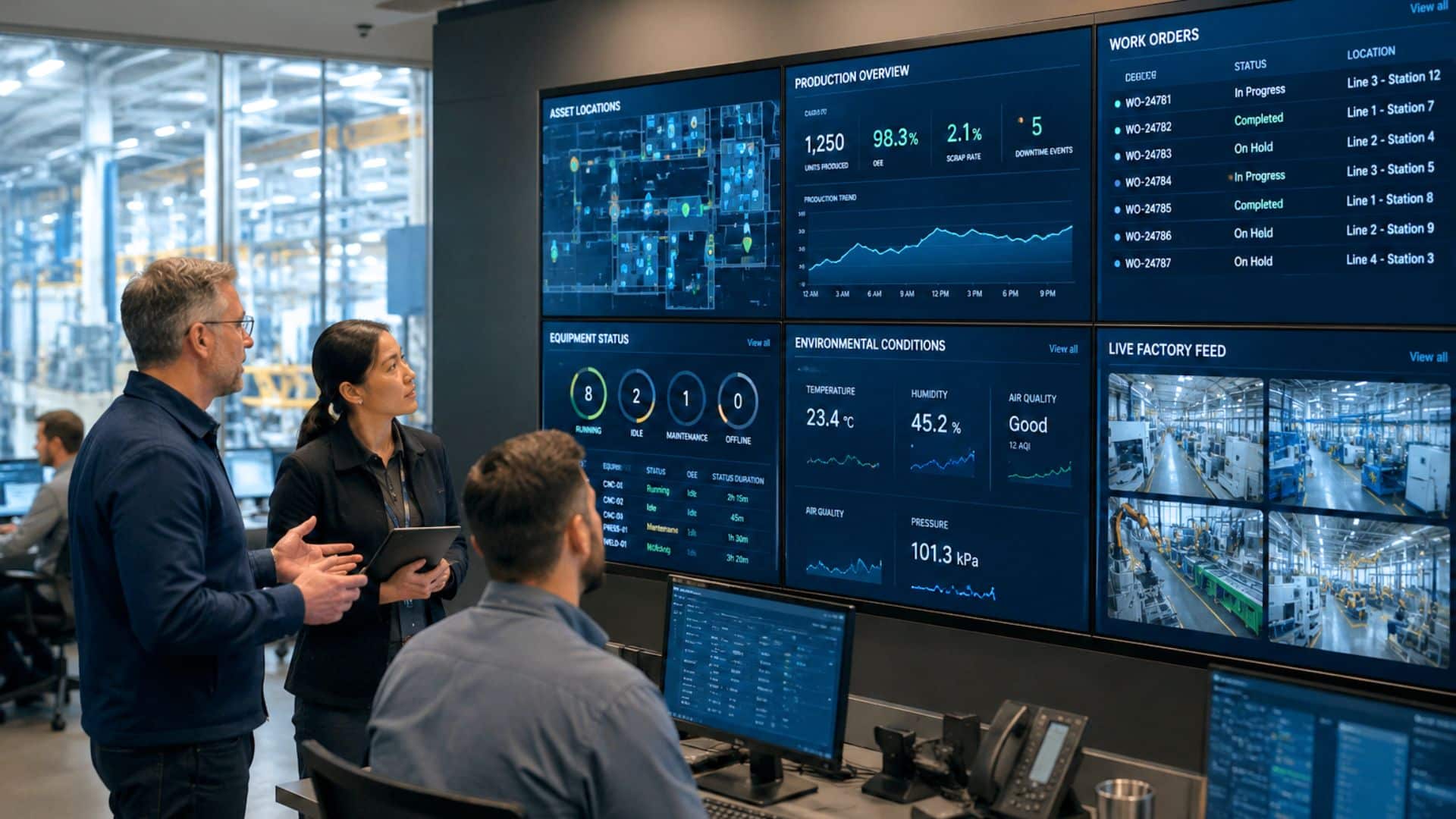
Every operations leader has been in this meeting: someone pulls up a dashboard, the data is six hours old, and the conversation becomes a debate about what’s actually happening right now instead of what to do about it.
The dashboard isn’t the problem. The data feeding it is.
Real-time operations dashboards have been promised for years by every MES, ERP, and analytics vendor in the market. Most of them deliver “near-real-time,” which means batch updates every 15 minutes, or manual data entry by operators, or periodic syncs from disconnected systems. That’s not real-time. That’s recent history.
True real-time operational visibility requires something upstream of the dashboard: a connected operations layer that continuously captures what’s happening on the floor and delivers it as structured, live data. The dashboard is the display. Connection is the hard part.
What “Real-Time” Actually Means on a Production Floor
Real-time in operations doesn’t mean millisecond latency like financial trading. It means the data on the screen reflects the current state of the floor — not the state from the last shift change, the last manual update, or the last batch export.
When an operations manager looks at a dashboard and sees that Work Order 4471 is at Station 12, it means the work package is physically at Station 12 right now. When the dashboard shows three calibrated torque wrenches available in Tool Crib B, those tools should actually be there — not checked out 20 minutes ago by someone who didn’t scan out.
This level of accuracy requires automated data capture. Sensors — BLE beacons, RFID readers, UWB anchors, environmental monitors — continuously report the state of physical operations without requiring anyone to scan, type, or update a system. The data flows from the floor to the dashboard without human intervention, which eliminates the gap between what’s happening and what the system shows.
The Dashboard Isn’t the Differentiator — The Data Layer Is
Plenty of tools can render beautiful dashboards. Grafana, Power BI, Tableau, custom React apps — the visualization options are endless. The differentiator isn’t the charts and maps. It’s whether those charts and maps are connected to live operational data or stale snapshots.
This is where most dashboard projects stall. The operations team specifies what they want to see: asset locations, production status, environmental conditions, and equipment utilization. The IT team builds the dashboard. Then everyone discovers that the data sources feeding it are fragmented — location data in one system, temperature data in another, production status in a third, and none of them are updating in real time.
Thinaer solves this at the source. Rather than trying to aggregate data from disparate systems after the fact, our platform captures operational data directly from the physical environment through hardware-agnostic sensor deployment. BLE for asset tracking, RFID for inventory, UWB for precision location, environmental sensors for conditions — all unified into a single structured data stream.
The Gartner-recognized SONAR application then renders this data as real-time maps, geofenced alerts, trend charts, and operational dashboards. But what matters isn’t SONAR’s interface — it’s that the data behind it is genuinely live, automatically captured, and structured for consumption.
Five Things a Real-Time Dashboard Should Show You
An effective operations dashboard isn’t a wall of numbers. It’s a decision-support tool that answers the questions operations leaders actually ask throughout the day.
Where are things?
Asset location is the foundation. Where are the calibrated tools? Where are the work packages? Where is the mobile equipment? If your dashboard can’t show you this in real time — with actual sensor-derived location data, not last-scanned location — then every other metric on the screen is built on incomplete information.
Thinaer tracks assets across facilities using whatever combination of BLE, RFID, UWB, LoRaWAN, and GPS the environment requires. SONAR displays these locations on facility maps with real-time updates, geofence boundaries, and zone-based analytics.
What are the conditions?
Temperature, humidity, vibration, air quality — environmental conditions affect product quality, equipment health, and worker safety. In composites manufacturing, a curing area that drifts outside the specified temperature range can cause quality escapes worth $50K–$500K per incident. In pharmaceutical storage, temperature excursions can destroy inventory.
Real-time environmental dashboards catch these conditions as they happen, not after the damage is done. Automated alerts trigger when readings cross thresholds, giving operations teams time to intervene.
How is production flowing?
Work-in-progress visibility shows whether production is on pace, where bottlenecks are forming, and which stations are idle. Traditional MES systems track this through operator input — someone scans a barcode when they start a task and scans again when they finish. That creates a checkpoint-based view with gaps between checkpoints.
Sensor-based production tracking fills those gaps. When assets and work packages are continuously tracked through the facility, the dashboard can show flow rates, dwell times at each station, and throughput trends without manual updates.
What needs attention right now?
Alerts and exceptions should surface at the top. An asset that left its designated zone. A temperature reading that crossed a threshold. A work package that’s been at the same station for longer than expected. A tool that’s overdue for calibration.
The best dashboards don’t just display data — they highlight the exceptions that require human judgment. Everything running normally should fade into the background. Everything that needs a decision should be obvious.
What’s the trend?
Real-time data becomes more valuable over time. A single temperature reading is a fact. A week of temperature readings is a trend. A month of production flow data reveals patterns — which stations bottleneck on which products, which times of day see the highest throughput, which environmental conditions correlate with quality issues.
Dashboards that display both current state and historical trends give operations leaders the context they need to make decisions that aren’t just reactive but informed by patterns.
Why Human Context Still Matters
A dashboard that shows everything but tells you nothing is just expensive wallpaper. The data needs to be presented in context that matches how operations leaders actually think about their floor.
This means organizing views by production lines, not sensor types. It means showing asset locations on actual facility maps, not abstract grids. It means grouping alerts by severity and area, not by timestamp. It means letting a shift supervisor customize their view differently from a maintenance planner.
SONAR was designed with this in mind. The application was built for operations teams — not data scientists, not IT administrators. The maps, alerts, and dashboards reflect how people actually manage physical operations, because the team that built it has deployed across 12 million+ square feet of production environments.
The Path from Dashboard Wish List to Operational Reality
Most organizations don’t lack dashboard ideas. They lack the connected data infrastructure to make those dashboards real.
The path forward starts with connection — deploying sensors that capture operational data directly from the physical environment. Thinaer handles this with hardware-agnostic deployment that matches the right sensor technology to each area of the facility.
From there, the data is automatically structured, contextualized, and delivered through SONAR for immediate visualization — and through MQTT/REST APIs for integration with whatever BI, analytics, or AI tools the organization uses.
The dashboard is the output. Connected operations are the input. Get the input right, and the dashboard takes care of itself.
See Sonar in action at thinaer.io