



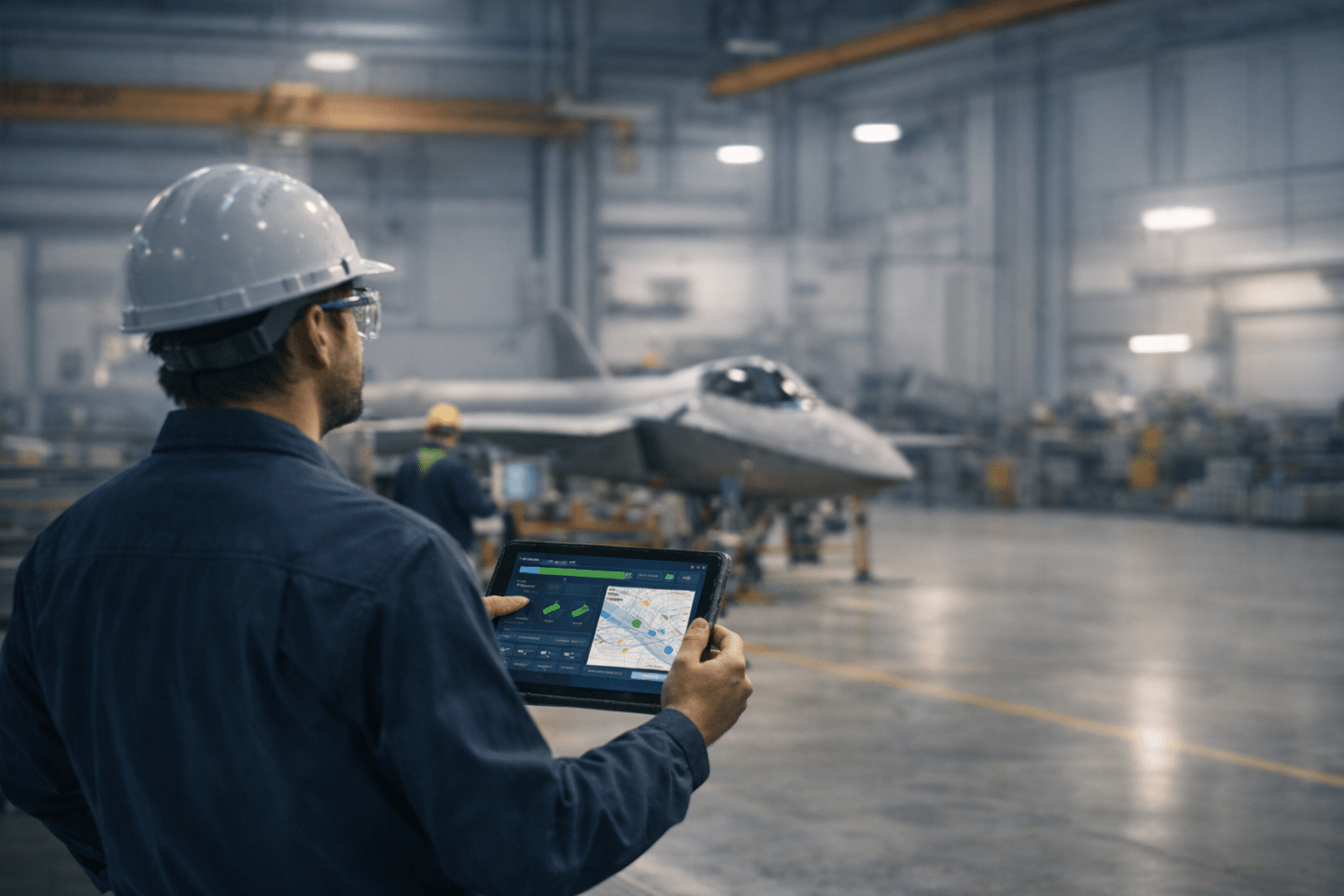
Digital transformation in defense manufacturing is not failing due to lack of investment or intent. It is failing because the industry continues to approach the problem from the top down instead of from the ground up.
Over the past decade, defense organizations have invested heavily in enterprise systems, analytics platforms, and more recently, AI. These investments are often positioned as the catalysts for modernization. Yet across programs, the outcomes remain inconsistent. Some initiatives show promise in isolated pockets, but few scale across facilities or sustain long-term operational impact.
The issue is not the sophistication of the tools. It is the order in which they are being applied.
A Sequencing Problem, Not a Technology Problem
Most transformation strategies begin with the assumption that better analysis will lead to better decisions. That assumption only holds true if the underlying data accurately reflects reality.
In defense manufacturing, that condition is rarely met.
A large portion of production activity still operates outside of connected systems. This is not always visible at the executive level, where dashboards present a structured and controlled view of operations. But at the facility level, the reality is different. Mechanics still spend time locating tools without a reliable system of record. Environmental conditions are validated through periodic checks rather than continuous monitoring. Production status is assembled from system inputs, manual updates, and informal communication.
These gaps are not exceptions. They are part of the operating model.
The Hidden Data Layer
What emerges is a fragmented data environment where critical operational signals are delayed, incomplete, or entirely absent. Enterprise systems aggregate this imperfect data and present it as truth. Analytics platforms process it. AI models attempt to predict outcomes based on it.
But the outputs are constrained by the inputs.
This is where many digital transformation efforts lose momentum. Underperformance is often attributed to the tools themselves, leading to additional investments in analytics, dashboards, or AI. Yet results remain flat because the core issue has not been addressed.
The data layer is incomplete.
In effect, the industry is attempting to optimize visibility without first establishing it.
Why AI and Analytics Plateau
AI models and analytics platforms depend on consistent, high-frequency, structured data. Without it, they default to retrospective analysis rather than forward-looking insight.
This is why many initiatives plateau.
Organizations are asking predictive systems to operate on delayed or reconstructed data. The models may be sophisticated, but they are operating without a reliable representation of real-world conditions. As a result, decision-making remains reactive, even in environments that have invested heavily in advanced technologies.
The limitation is not intelligence. It is observability.
What Changes When Operations Are Measured
When real-time data capture becomes the starting point, the operating model shifts.
Instead of periodic updates, operations become continuously observable. Instead of reconstructing events after the fact, teams can see conditions as they evolve. Tool movement, environmental stability, production flow, and equipment health are measured directly rather than inferred.
This establishes a true system of record for physical operations.
Once that foundation is in place, analytics and AI begin to perform as intended. Models are trained on complete datasets. Predictions reflect current conditions. Decisions move from reactive to proactive.
This is the inflection point that separates stalled initiatives from scalable transformation.
Why the Gap Persists in Defense Manufacturing
Defense manufacturing environments introduce a level of complexity that most commercial solutions are not designed to handle. Facilities span multiple buildings with different connectivity requirements. Some areas operate under strict compliance constraints, including classified and air-gapped environments. Legacy equipment must function alongside modern systems.
Because of this complexity, many organizations focus on the enterprise layer, where integration appears more manageable. The shop floor is treated as a secondary challenge.
But this is where transformation must begin.
The physical environment is where production occurs, where quality is determined, and where delays originate. If that layer remains uninstrumented, enterprise-level optimization will always be limited.
Speed to Value Drives Adoption
There is also pressure to demonstrate progress quickly. Dashboards, reports, and AI capabilities are visible outputs that signal advancement. Foundational data work is less visible, but far more consequential.
In practice, speed to value is not about how quickly a dashboard is deployed. It is about how quickly accurate, real-time data becomes available.
Organizations seeing measurable results are prioritizing instrumentation over interpretation. Data begins flowing within days, not months. Early improvements are observable, reduced time searching for tools, fewer environmental excursions, improved production flow, and better equipment utilization.
These outcomes build internal momentum and support broader adoption.
Where Transformation Actually Begins
Digital transformation in defense manufacturing does not begin with AI or analytics. It begins with capturing reality as it exists on the shop floor.
As more of the physical environment becomes instrumented, the dataset expands. Patterns become clearer. Opportunities for optimization increase. At that point, advanced technologies can be applied with meaningful impact because they are operating on a complete and current representation of operations.
This is not a single deployment or initiative. It is a progression.
Defense manufacturing does not lack innovation. It lacks alignment between where data is created and where decisions are made.
Closing that gap requires starting in the right place, with real-time operational data as the foundation.