
Topics:

Real Time Asset Tracking: 6 Ways BLE Beats RFID

by | Blog

Many organizations use IoT real time asset tracking platforms to pinpoint asset location within an indoor space. There’s a distinct advantage to using Bluetooth Low Energy (BLE) devices over RFID devices. In this post, we highlight 6 advantages that BLE holds over RFID.
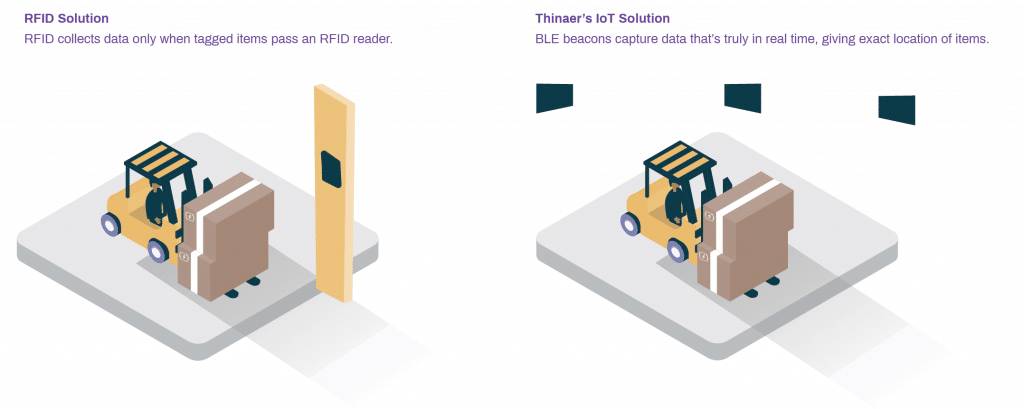
1. BLE Asset Tracking with Real-time Location

BLE sensors let you know exactly where your assets are at all times. While RFID readers can track location, its real-time capability is energy inefficient, constrained by its need for cellular connectivity and GPS

2. High Read-Range

BLE sensors have a range of over 200 feet. BLE sensors continuously emit information to readers and can easily upload information to cloud-based devices, which allow you to easily keep all relevant personnel in the loop. RFID also has a high read-range, but it is far less intuitive for IoT integration and continuous asset tracking. 

3. Less Power Consumption

While RFID tags work by using antennae and radio-frequency waves, BLE sensors communicate directly with each other and use much less energy. Since BLE beacons use such little power, they can operate for months and even years on one button cell battery. While cost effective for your company, this also means that BLE sensors are an ‘always on’ solution for your real-time asset tracking system.

4. BLE Devices are Cost Effective

BLE is among the least expensive real-time asset tracking systems on the market. They require very little hardware and are easily integrated into daily operations using ubiquitous technology like wifi, smartphones, tablets, and hotspots. 

5. Ability to Read BLE Beacons with Your Phone

Most cell phones have bluetooth capabilities and work as bluetooth readers. Tablets, smartphones, and hotspot devices are all compatible with BLE. This saves hardware costs for your company and provides flexibility for real time asset tracking. In order to use RFID, specialized RFID readers are required. These readers are expensive, and they are more difficult to integrate into an existing infrastructure. 

6. An Evolving Technology

While BLE is still an emerging technology with many industries investing in development, RFID has improved as much as it can. Investing in BLE technology now means that your company can reap even more benefits down the line

Thinaer’s use of BLE offers the best outcomes for clients in terms of cost-effectiveness, scalability, and successful digital transformation. Read more about our suite of services, and feel free to contact us for more information.

Empowering Resilience in the Face of Disruption

In recent years, the vulnerability of supply chains has been exposed, with global trade fluctuations, resource scarcity, and labor limitations causing widespread disruptions across sectors. Organizations require transparency and robustness, necessitating the capacity to adapt promptly to dynamic circumstances.

Thinaer facilitates this resilience by providing anticipatory analysis of equipment performance and stock patterns, enabling entities to manage potential issues proactively. Whether through preventative maintenance scheduling or demand-driven inventory adjustments, Thinaer converts data into actionable strategies.

During a significant logistical disruption, a Thinaer-utilizing manufacturer successfully reallocated inventory across regional distribution centers based on current capacity data, thereby preventing production interruptions. This level of responsiveness would have been unattainable with conventional methodologies.

From Insights to Efficiency: Smart Manufacturing in Action

Effectiveness stems not merely from increased effort, but rather from strategic methodologies. Thinaer empowers manufacturers to transcend simple tracking, enabling a comprehensive comprehension of causal factors and subsequent remedial actions. The SONAR platform simplifies intricate data sets, furnishing users with lucid dashboards that accentuate pivotal trends, deviations, and areas for enhancement.

Upon identification of protracted machine idle time by a plant manager, the issue can be traced back to antecedent constraints, facilitating the scheduling of corrective maintenance and the realignment of workloads. Similarly, should a procurement manager observe the underutilization of materials at one site coinciding with a shortage at another, an immediate transfer can be initiated, circumventing protracted delays.

In a specific instance, a food and beverage producer discerned that a substantial proportion of their production machinery, specifically 20%, was operating below capacity due to suboptimal scheduling and oversight. Following the deployment of Thinaer’s solutions, the manufacturer implemented operational restructuring, resulting in a significant increase in output, measured at 22%, without necessitating additional capital expenditure on new equipment.

A Seamless Upgrade from Disconnected Solutions

Numerous organizations began their initial digital transformation efforts with solutions such as Amazon Monitron. While providing an initial advantage, these instruments frequently prove inadequate in circumstances necessitating scalability, integration, and real-time analytical capabilities. After the discontinuation of Monitron, Thinaer presents a robust and definitive trajectory for advancement, offering a comprehensive, secure, and future-oriented solution.

Thinaer extends beyond the mere monitoring of machinery; it establishes a unified operational ecosystem by integrating tools, inventory, equipment, and personnel into a singular, actionable platform. Distinct from inflexible and developer-dependent alternatives, Thinaer employs a no-code, low-maintenance framework tailored to the enterprise’s specific operational requirements, thereby facilitating adaptability in accordance with organizational dynamics.

IT and OT: Finally on the Same Page

Thinaer distinguishes itself through its proficiency in harmonizing IT and OT operational domains. IT leadership is assured a robust, regulation-adherent framework featuring expedited integration capabilities and comprehensive infrastructure oversight. Simultaneously, user-friendly interfaces empower operational teams, delivering immediate analytics pertaining to production efficiency, stock inventory, and equipment functionality, thus obviating the requirement for specialized technical instruction.

This synchronized availability of real-time data promotes enhanced interdepartmental cooperation, expedited strategic resolutions, and minimized discrepancies. Within sectors where temporal efficacy and precision are paramount, this degree of interalignment transcends mere utility and becomes an indispensable operational mandate.

Looking Ahead: AI, Automation, and the Next Generation of Supply Chain Optimization Tools

Thinaer is engineered to address not only current operational challenges but also to facilitate future advancements. By integrating embedded artificial intelligence insights, enterprises can transition from reactive management approaches to proactive, predictive strategies, encompassing demand forecasting, failure prevention, and continuous optimization of inventory management within their operational frameworks.

As the adoption of automation technologies, robotic systems, and blockchain platforms increases across diverse industries, Thinaer’s adaptable architectural design ensures scalability and evolution in concert with these advancements. Whether the requirement involves tracking serialized assets, materials, and tooling within the aerospace manufacturing sector or monitoring temperature-sensitive inventory within healthcare environments, the platform demonstrates readiness to accommodate a broad spectrum of future demands.

Conclusion

Inventory management within the supply chain has evolved from a back-office function to a strategic organizational capability. Thinaer facilitates the transformation of operational tracking, management, and optimization, offering real-time visibility, expedited deployment, and actionable insights from the outset.

In a complex environment characterized by volatility, speed, and competitive pressures, Thinaer functions as a strategic transformation ally, not merely a technology supplier. Thinaer empowers organizations with the requisite insights and assurance to progress effectively in achieving goals such as cost reduction, operational efficiency enhancement, and the acceleration of artificial intelligence deployment.

A demonstration of Thinaer is available to provide practical experience with operational visibility and help achieve optimal inventory management and supply chain modernization.