



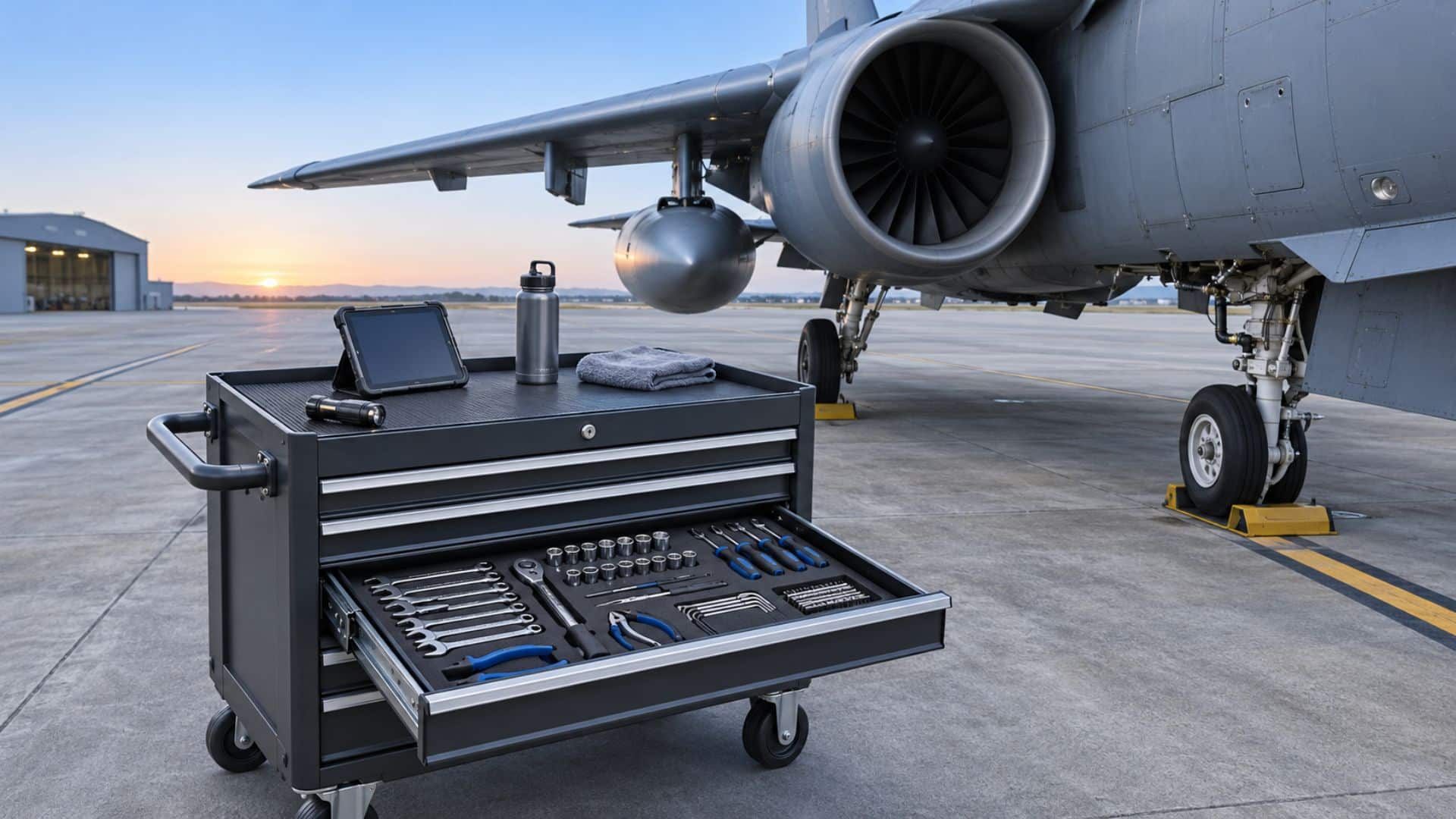
A torque wrench comes back to the tool room one short. Within minutes, the aircraft it was used on stops moving. It stays parked until someone finds the wrench or a release authority signs off that it isn’t inside the airframe. On a busy flight line, one missing tool can cost a sortie. It can also pull a crew off other work for the rest of the shift.
Preventing that outcome is the job of an aviation tool control program. The Air Force sets its rules in DAFI 21-101, and the Navy and Marine Corps set theirs in the Naval Aviation Maintenance Program (NAMP). Below, we compare the two, then look at where flight line programs lose time and what live location data changes. For the basics of building one, start with our guide to building a tool control program.
Why Tool Control Matters More in Aviation
A dropped socket on a factory floor is a cleanup job. On a flight line, the same socket near an engine intake becomes a foreign object damage (FOD) hazard. An engine can ingest it, damaging compressor blades or causing a mishap in flight. A tool left in a wheel well or behind an access panel carries the same risk. The next crew to work the aircraft may never see it.
That is why military aviation runs tool accountability as a flight safety program with its own instructions and inspections. Tool control and FOD prevention run side by side. We cover the FOD side in our guide to tool accountability systems for FOD prevention.
Air Force Tool Control Under DAFI 21-101
DAFI 21-101, Aircraft and Equipment Maintenance Management, is the Department of the Air Force’s base maintenance instruction. Chapter 8, Tool and Equipment Management, sets the tool control requirements. Major commands and wings then publish supplements that add local rules. In practice, the program at any base is the base instruction plus every supplement layered on top of it.
Consolidated Tool Kits and Equipment Marking
The core unit is the consolidated tool kit (CTK). Many unit instructions call it a composite tool kit. Each kit has a custodian, a master inventory list and a sign-out record. Tools carry an equipment identification designator (EID) that ties them to the owning unit. As a result, a tool found on the ramp can be traced back to its kit. Many units manage CTKs in an automated tool control system instead of paper logs.
Inventories and Lost Tool Procedures
Wing instructions show how the rules play out locally. McConnell AFB’s instruction on tools, equipment and electronic devices, for example, defines controlled areas as aircraft parking areas, runways, taxiways and maintenance areas. Units that dispatch tools to those areas must write their own control procedures. Dispatched tools get inventoried at checkout, before the job, at job completion before leaving the site, and again at check-in. The same instruction counts radios, phones and laptops as tools.
When a tool goes missing, the lost tool process starts. Maintainers search and notify the maintenance operations center or expediter. They also file a lost tool report and document the event in the aircraft forms. The aircraft stays put until a designated release authority decides the search can stop.
Navy and Marine Corps Tool Control Under NAMP
Naval aviation maintenance runs on COMNAVAIRFORINST 4790.2, the Naval Aviation Maintenance Program. The current revision is 4790.2E, dated October 28, 2024. The Tool Control Program (TCP) is one of the NAMP standard operating procedures (NAMPSOPs) in Chapter 10. It applies to Navy and Marine Corps squadrons alike.
The TCP rests on an instant inventory concept. Tools sit in containers with a silhouetted slot for each one, so an empty slot shows a missing tool at a glance. Each tool is etched with the organization code, work center and container number. An approved Tool Control Plan (TCPL) defines the containers and inventories for each type, model and series of aircraft.
Maintainers inventory the container when a task starts and again when it ends, and the container number goes on the work document. If a tool can’t be found, the work center supervisor notifies Maintenance Control and the maintenance officer so the aircraft isn’t released. A designated program manager runs the TCP for the squadron, and quality assurance spot-checks compliance.
Contractors and Commercial MROs
Defense contractors who maintain military aircraft work under the customer’s program. Air Force wing instructions direct the sponsoring unit to brief contractors on tool control and lost tool reporting. The unit also gives them an on-duty point of contact. On the naval side, contractor maintenance teams run squadron tool control programs to NAMP standards. A contractor tool control coordinator often works alongside the squadron’s maintenance leadership.
Commercial maintenance, repair and overhaul (MRO) providers and aerospace suppliers meet tool control through a different route. Customers flow down SAE AS9146, the FOD prevention standard for aviation, space and defense organizations, by contract. AS9146 treats tool and hardware accountability as one part of a broader FOD program. For background, see our explainer on what MRO means for day-to-day operations.
How the Programs Compare
Both services want the same result: every tool accounted for before an aircraft moves. They get there with different kit structures and reporting chains.
| Air Force | Navy and Marine Corps | |
|---|---|---|
| Governing document | DAFI 21-101, Chapter 8 (Tool and Equipment Management), plus MAJCOM and wing supplements | COMNAVAIRFORINST 4790.2E (NAMP), Tool Control Program NAMPSOP in Chapter 10 |
| Kit approach | Consolidated (composite) tool kits with a master inventory list; tools marked with an equipment identification designator (EID) | Silhouetted "instant inventory" containers defined by a Tool Control Plan (TCPL); tools etched with organization code, work center and container number |
| Inventory points | At checkout, before the job, at job completion before leaving the site, and at check-in (per wing instructions such as McConnell AFB's) | Sight inventory at task start and completion; container number recorded on the work document |
| Lost tool process | Search, notify the maintenance operations center or expediter, file a lost tool report, document in aircraft forms; a release authority decides when the search ends | Notify the work center supervisor, Maintenance Control and the maintenance officer; the aircraft is not released until the tool is resolved |
| Who audits | Maintenance group quality assurance, plus unit self-inspections | Quality assurance spot checks and NAMP self-evaluation (CSEC) audits |
Supplements and local instructions add requirements. Confirm each cell against the documents that govern your unit.
Where an Aviation Tool Control Program Loses Time
Most of the lost time comes from what a sign-out log can’t show between checkout and check-in.
Once a CTK or container heads to the flight line, the tool room knows who signed it out and little else. Where the kit sits and what’s still in it stay unknown until it comes back.
Kits that cross shifts add risk. Shift-change inventories and jobsite transfers are where counts get rushed and a discrepancy can pass to the next crew.
Searches also start late. A missing tool usually surfaces at the end-of-job or check-in inventory, which can be hours after someone set it down. By then, the search area covers every aircraft, panel and vehicle the kit touched.
How an Alert at the Moment of Loss Shortens a Lost-Tool Event
Illustrative sequence. Release decisions stay with the unit's designated authority.
Then there’s the paperwork. Before an inspection, someone has to match sign-out records against lost tool reports and inventory sheets by hand, and the gaps they miss are the ones an inspector finds.
What Real-Time Capture Adds
Real-time capture works inside the program your governing instructions already define. It gives maintainers and quality assurance a live record of where each tool is and how long it has been out. Crews spend less time hunting for tools as a result.
Where Tools Are and How Long They’ve Been Out
Bluetooth Low Energy (BLE) places a tagged tool or kit within 3 to 10 feet. That’s enough to show which hangar bay, parking spot or work area it’s in. Where a job calls for more precision, ultra-wideband (UWB) delivers sub-foot location. Thinaer carries both and deploys the mix your flight line requires, because your environment decides the technology.
Sonar, Thinaer’s operational visibility application, raises an alert when a tool stays out past its time limit or crosses a flight line geofence. The search can then start within minutes of a tool going astray instead of at the next inventory.
When a tool does go missing, Sonar’s search-and-find shows its last captured location, so crews search one zone instead of the whole ramp. That location history also fills in lost tool reports and inspection prep.
Security for Flight Lines and Ordnance Areas
Data stays inside your security boundary and under your own identity and access management (IAM), whether Thinaer runs on-premises, air-gapped or in GovCloud. The Defense Information Systems Agency (DISA) has approved Thinaer, and its coverage for classified environments is patent pending. Thinaer is also HERO ZERO certified, which matters in munitions and ordnance areas where Hazards of Electromagnetic Radiation to Ordnance (HERO) rules limit what can transmit. For a deeper look, read about UWB in secure environments and evaluating secure defense platforms.
Your unit still owns its program and its compliance. Thinaer captures the data that makes an aviation tool control program faster to run and easier to audit.
Frequently Asked Questions
Who manages a squadron tool control program?
In naval aviation, the maintenance officer designates a TCP program manager, who works with maintenance control, material control and quality assurance. In the Air Force, CTK custodians manage kits within each section, the maintenance group sets wing procedures, and quality assurance inspects. Exact titles vary with supplements and local instructions.
What happens when a tool is lost on the flight line?
Maintainers search, notify their supervisor and the maintenance control or operations center, and file a lost tool report. The aircraft isn’t released until the tool turns up or a designated release authority clears it.
Do contractors follow the unit’s program?
Yes. Contractors maintaining military aircraft follow the host unit’s tool control program, and sponsoring units brief them on lost tool procedures. Commercial suppliers usually receive FOD requirements, including AS9146, through contract flow-down.