



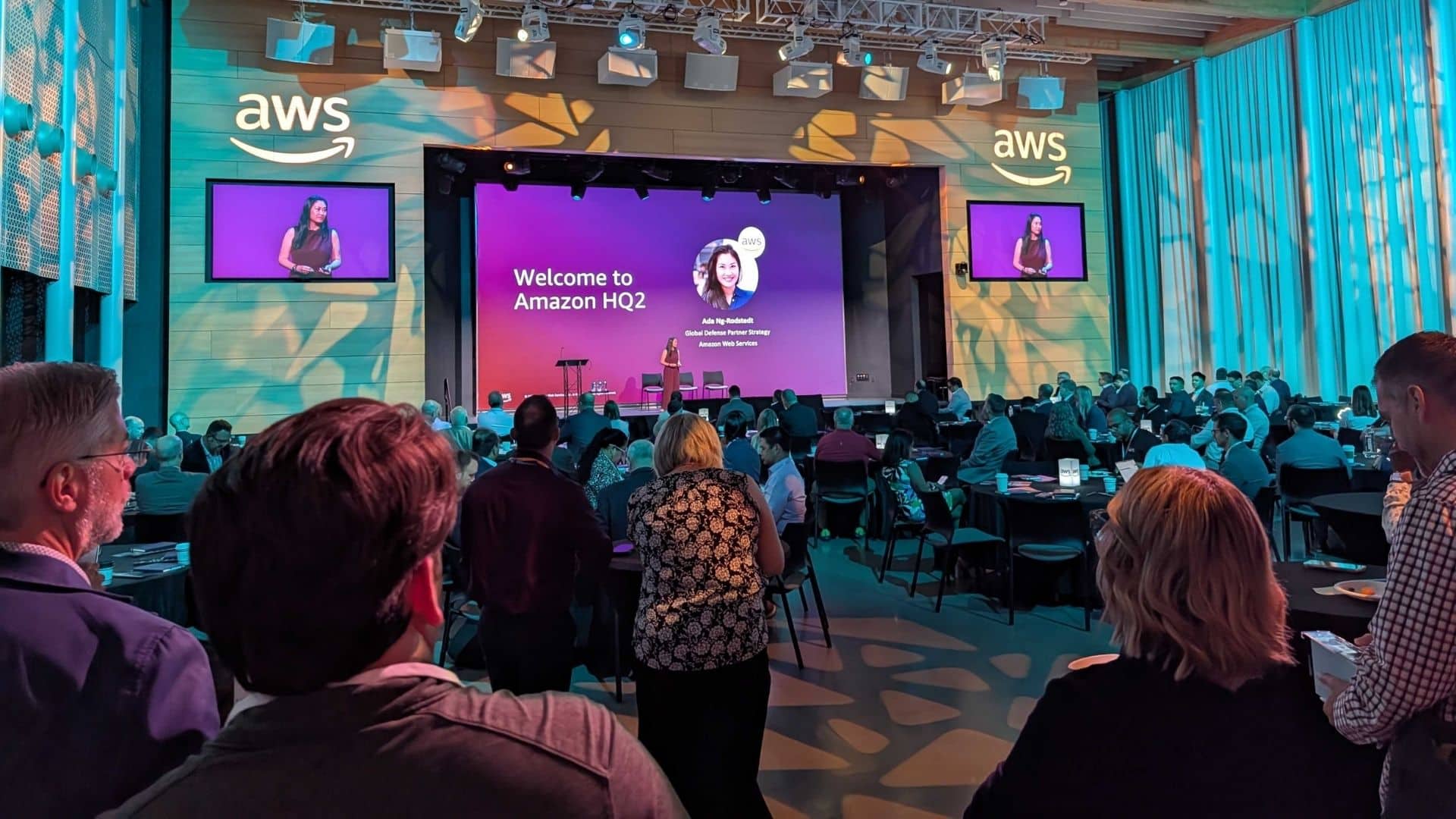
Notes from AWS’s keynote, with Thinaer on stage, at the AWS Defense and National Security Industry Partner Forum
Inside the AWS Defense and National Security Industry Partner Forum
Last month, Thinaer spent a week at Amazon HQ2 in Arlington, Virginia, for the AWS Defense and National Security Industry Partner Forum. On August 5, AWS hosted its Defense and National Security Industry Partner Forum with a keynote titled ‘Rebuilding the Arsenal of Freedom with Physical AI,’ led by Lee Cardona of AWS. Lee opened by framing the scale of the challenge facing the defense industrial base, from global manufacturing capacity to what producing autonomous systems at volume actually requires. Thinaer’s Bryan Merckling and Cory LaFleur joined Lee on stage midway through to share where Physical AI capture fits into that picture. Roughly 150 registered executives from across the defense industrial base were in the room.
The same problem came up in the keynote, on the panel, and in the hallways between sessions. Everyone in the room is already investing in AI. Almost nobody has a reliable way to tell those models what is actually happening inside their own facilities.
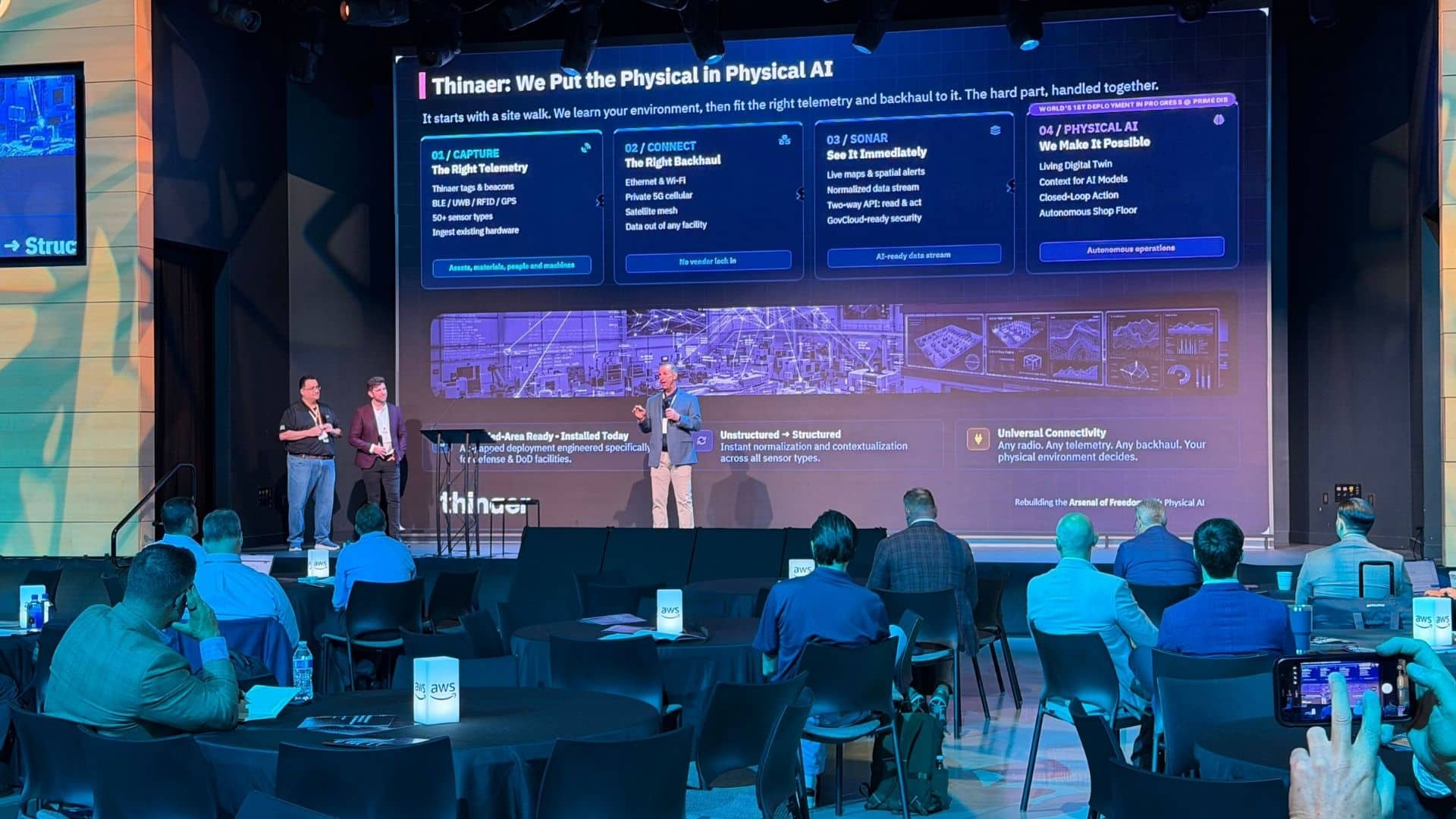
As Bryan Merckling, Thinaer’s CEO, put it from the stage:
“Models are only as good as the data underneath them, and the hardest data lives in the physical world. The factory floor. The classified bay. The shipyard.”
The models are not the constraint. They are here, they are capable, and the money is already committed. The constraint is that AI models only see what has been digitized, and in most facilities the floor has never been instrumented to produce a usable record of itself.
People Could Walk Over and Check. Models Cannot.
For decades, operational data in a defense facility existed to inform a person: a report at the end of a shift, a scan-based record at a material handoff, a spreadsheet tracking work in process across a bay. That design worked because the person could fill the gaps themselves, walking over to check when the record was stale and closing the distance between what the system said and what was true on the floor with what they carried in their heads.
AI cannot do that. It acts on whatever the data says is true, so the gaps people used to quietly work around become the first thing that has to be fixed.
Those gaps are mundane. Nobody logged the machine that has been idle since Tuesday. The environmental threshold drifted overnight in a space nobody walked through. An asset moved and the record never caught up. Each one is a hole in the model’s picture of the floor, and the model has no way of knowing it is there.
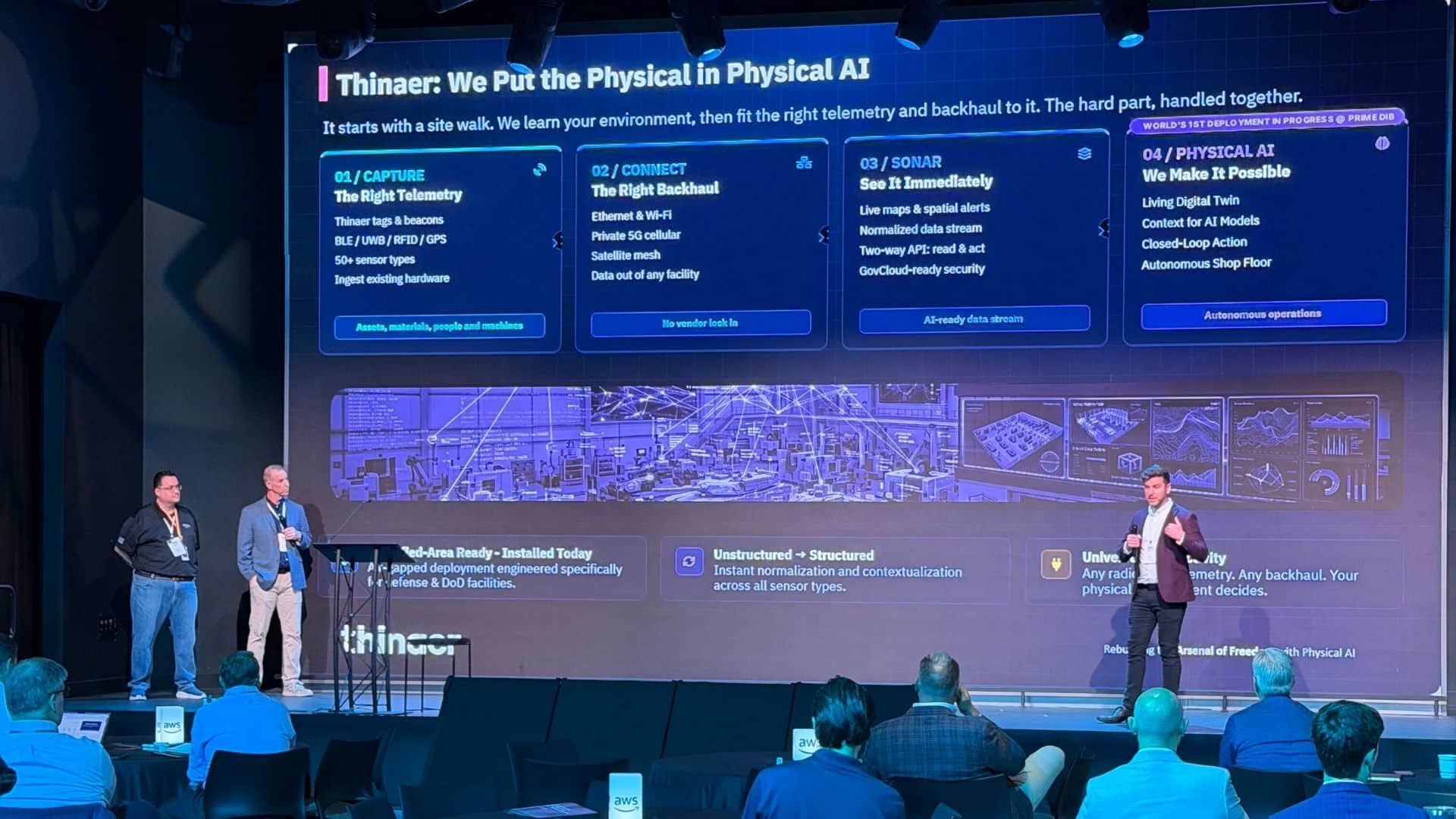
“Industry 4.0 built data for people. Physical AI needs data built for machines. Thinaer provides both.”
That line, delivered on stage by Cory LaFleur, Thinaer’s VP of Partnerships and Strategy, is the argument in miniature. Sonar is the data people use today, with live maps, alerts, and reports on the floor, and that same underlying layer produces the AI-ready stream machines use. Closing the gap between the two is what we’ve written about in more detail in how unstructured data becomes AI-ready data — it is a different exercise than building another dashboard. What it produces is a continuous, structured, real-time account of what is actually happening on the floor, written for machines to consume rather than for people to interpret.
Defining the Capture Layer
Bryan drew the line plainly for the room:
“Thinaer is the capture layer for Physical AI. We don’t make the models. We make them work.”
We’ve laid out that framework in full elsewhere — see Capture, Learn, Act: The Physical AI Framework Explained and What Is Physical AI? for the plain-English version. The short version, told in four stages from the floor to the model:
|
Stage |
The Position |
|
01 Capture: The Right Telemetry |
Tags and beacons across BLE, UWB, RFID, and GPS, more than 50 sensor types, plus ingest of hardware a site already has. |
|
02 Connect: The Right Backhaul |
Ethernet and Wi-Fi, private 5G cellular, satellite mesh. Any radio, any telemetry, any backhaul. The physical environment decides. |
|
03 Sonar: See It Immediately |
Live maps and spatial alerts, a normalized data stream, a two-way API that reads and acts. |
|
04 Physical AI: We Make It Possible |
A living digital twin, context for AI models, closed-loop action, the autonomous shop floor. |
Most vendors pick a radio and build a company around it, which means the customer bends to the technology. We assess the facility first and fit the mix to what is there, because a classified bay, a shipyard, and a hangar each rule out something the others depend on, and no single radio survives all three. What has sharpened since the forum is that it does not matter whether a site is the easiest place to sense or the hardest: the capture layer fits either, and your environment decides.
Security Comes Before AI, and It Should
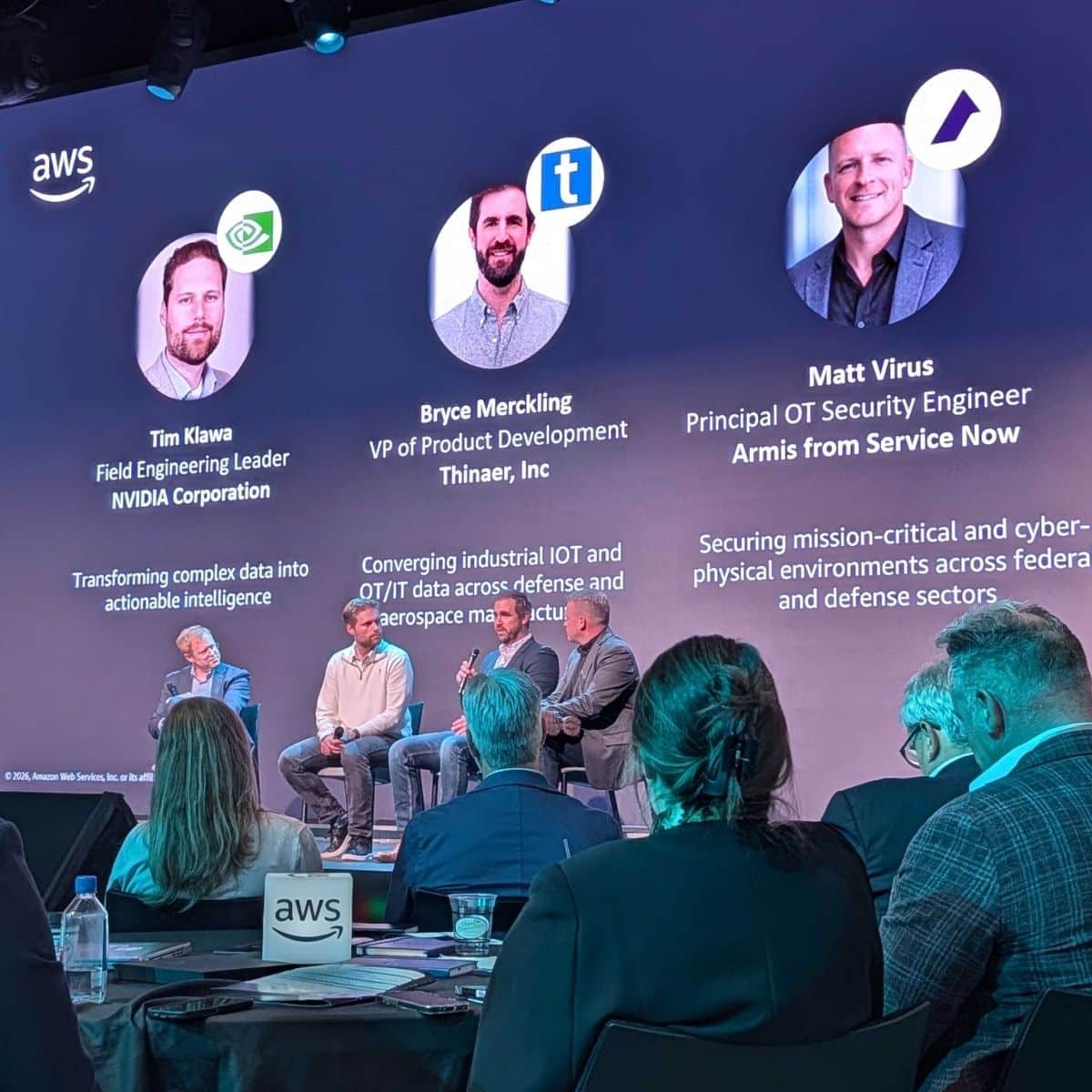
Bryce Merckling, Thinaer’s VP of Product Development, joined AWS, NVIDIA, and Armis on the forum’s OT/IT security panel, where the conversation covered secure industrial innovation and open models. It landed where these conversations tend to land in this industry, which is that you cannot get to the AI question in a defense facility until you have answered the security one:
“Every AI conversation in the defense industrial base eventually hits the same wall. The models are ready and the data isn’t there, because the hardest environments to sense are the ones that matter most. Getting real-time data out of an operating facility without loosening the security posture is the actual engineering problem. That’s what we build.”
Cory echoed the same point from the keynote stage:
“We put the capture layer inside your environment, and you set the rules. Your RF policy, your security boundary, your network. GovCloud, on-prem, wherever it needs to live.”
Thinaer runs inside the customer’s environment, on the customer’s network, under the customer’s rules, whether that means cloud, on-premises, GovCloud, or an IL5 enclave, with customer-owned IAM and the customer’s RF policy governing what we deploy. Our claim stops there. We do not certify compliance, and we do not own the analytics layer above the data.
The Receipts
Thinaer runs 160,000 sensors across 33 locations and 12 million square feet, firing more than 10 million triggered events. The platform is HERO ZERO certified for ordnance areas and DISA approved, with patented and patent-pending coverage in classified environments, and Sonar is Gartner recognized.
The number that tends to land hardest in a room like this one is that a leading defense OEM has documented more than $30 million in ROI on the platform. What is worth noting is where that figure comes from, because it is not exotic. Most of it is people not spending a shift looking for tools, and parts not getting reordered because nobody could find the ones already sitting on site.
As Bryan put it to close out his remarks: “Our platform runs across more than 12 million square feet of active defense manufacturing today. If it works there, it works anywhere.”
Where the Urgency Was
The strongest pull at the forum came from three places: factory and shipyard modernization owners at the primes, federal industrial-base modernization leadership, and AI and digital-twin platform teams who need physical-world data and have no reliable way to get it.
That last group is the one worth paying attention to. These are teams with models already running and budget already committed, which means the blocker is not ambition or funding. It is that the floor does not produce data their systems can use, and no amount of work above the capture layer fixes a problem that originates below it.
The first step is smaller than most teams expect. As Cory told the room:
“Step one is deliberately small. Just a walk of your facility.”
We learn the environment, then fit the telemetry and backhaul to it, and Sonar is live for your operators in days, not months. This is only the first stop: Thinaer will be back on stage this fall at the AWS Federal AI Symposium for an all-federal audience.