



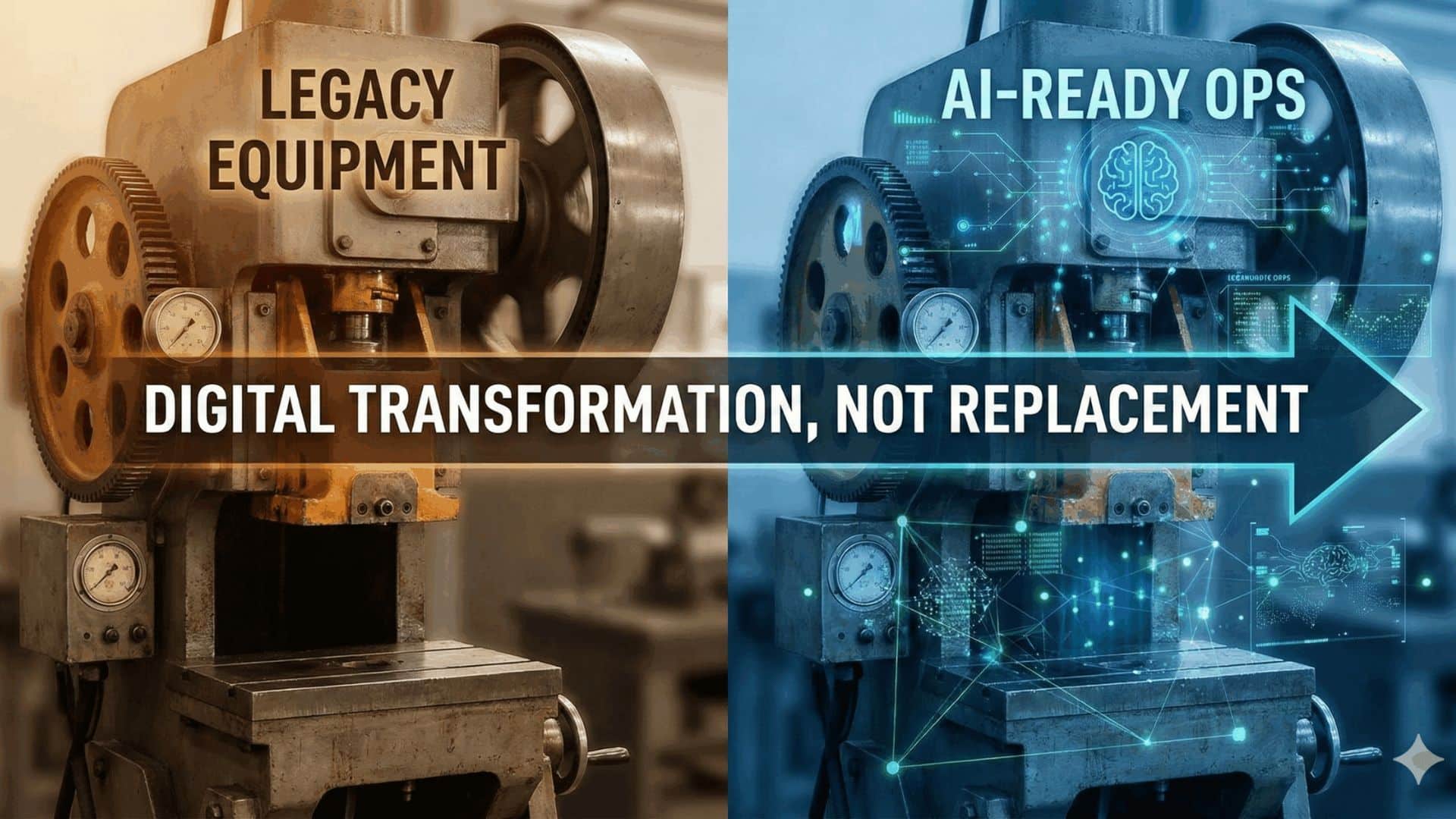
Walk onto any manufacturing floor, shipyard, or aerospace hangar, and you will rarely see a pristine, uniform fleet of brand-new machinery. The reality of modern operations is a mosaic of eras. Cutting-edge CNCs sit alongside stamping presses commissioned during the Clinton administration. Critical autoclaves that have cured composite parts for decades operate next to automated guided vehicles (AGVs).
For the C-suite, this mixed-vintage environment presents a massive hurdle. The mandate is clear: adopt AI, leverage Generative AI (GenAI), and drive digital transformation. However, the operational reality is that valuable data is trapped in “dumb” iron—legacy equipment that lacks native connectivity or speaks proprietary protocols that refuse to integrate with modern ERPs.
There is a misconception that modernization requires capitalization—a massive “rip and replace” strategy to swap old machines for smart ones. That approach is slow, prohibitively expensive, and operationally risky.
The strategic alternative is to overlay a digital fabric on top of existing physical operations. By retrofitting legacy assets with a hardware-agnostic sensor layer, organizations can transform 20-year-old equipment into AI-ready data sources in days, not years. This is how you build a digital thread without breaking the bank or the production schedule
Step 1: Strategic Assessment and Blind Spot Identification
Digital transformation fails when it tries to boil the ocean. Success comes from targeting specific operational blind spots that cause downtime or inefficiency. In aerospace and defense, where precision is non-negotiable, we learned that you don’t need to track everything—you need to track the right things.
The process begins by identifying high-value assets and bottlenecks. Is a specific motor on a legacy conveyor prone to overheating? Is there a “go-find” time issue where skilled technicians waste hours searching for calibrated tools? By mapping these pain points, we define the data requirements. This isn’t about technology looking for a problem; it’s about the environment dictating the solution.
Step 2: Non-Invasive Connectivity
The biggest barrier to connecting legacy equipment is the fear of disruption. Plant managers are rightfully hesitant to let IT teams splice into the PLCs of critical infrastructure.
The solution lies in a non-invasive, hardware-agnostic approach. Instead of trying to extract data from the machine’s internal brain, you could, for instance, deploy external sensors to monitor its physical output.
- Vibration and Temperature Sensors: These are affixed to motors, gearboxes, and bearings. They establish a baseline of “normal” operation for a machine of any age.
- Current Transducers (CT Clamps): These monitor power draw to determine run cycles and utilization rates without touching the control logic.
- Asset Beacons (BLE/UWB): These provide location context, tracking the movement of mobile assets or work-in-progress (WIP) through the facility.
This overlay approach respects the integrity of the legacy equipment while capturing the fidelity of data needed for advanced analytics.
Step 3: Contextualization and the Unified View
Raw data from a sensor is just noise. To become intelligence, it requires context. This is the bridge between Operational Technology (OT) and Information Technology (IT).
Data must be aggregated and normalized. A vibration spike on a 1995 milling machine means nothing unless the system knows what that machine is making, who is operating it, and where it is located. Platforms like SONAR ingest these disparate data streams—merging location data with machine health telemetry—to create a real-time digital twin of operations.
This contextualization is what turns a “dumb” machine into a smart node in the network. It allows for the creation of geofences and logic triggers—alerting maintenance teams not just that a machine is vibrating, but that it is vibrating outside of acceptable parameters while in a critical production cycle.
Step 4: The AI-Ready Data Foundation
Once legacy equipment is sensing and the data is contextualized, the operation is effectively AI-ready. This is the “Evolve” phase.
Clean, structured data streams via MQTT or REST APIs can now flow directly into advanced platforms like AWS Bedrock, SageMaker, or Microsoft Copilot.
- Predictive Maintenance: Instead of calendar-based maintenance (which is often wasteful), AI models analyze the vibration signatures of that 20-year-old pump to predict failure weeks in advance.
- GenAI Integration: With clean data, operators can query an LLM: “Show me utilization trends for Press #4 over the last quarter compared to ambient temperature.” The AI can process this because the foundational data layer exists.
The Strategic Imperative
In high-consequence industries—whether manufacturing munitions or monitoring healthcare equipment—waiting for a full fleet refresh is not an option. The risk of downtime and the cost of inefficiency are too high.
By decoupling the digital strategy from the machine lifecycle, organizations gain agility. They secure their operations by creating visibility where there was once darkness. This approach transforms legacy liabilities into digital assets, ensuring that the equipment you bought two decades ago can power the intelligence you need for the next two decades.
Connecting physical operations is hard, but it is the requisite first step. Once connected, the evolution toward AI and predictive operations becomes not just possible, but inevitable.
Ready to eliminate your operational blind spots? Explore how Thinaer connects the unconnected.