




Artificial Intelligence and Large Language Models (LLMs) have dominated boardroom conversations for the past two years. The promise is undeniable: systems that can predict failures, optimize supply chains in real-time, and democratize expertise across the workforce. However, for industrial organizations, particularly those in high-consequence sectors like aerospace, defense, and healthcare, there remains a significant gap between the promise of AI and its practical application on the shop floor.
That gap is not a lack of computing power or sophisticated algorithms. The gap is data. Specifically, the lack of live, contextualized data from the physical world.
AI is only as intelligent as the information it consumes. In the digital realm, data is native and structured. In the physical realm of manufacturing and operations, however, data is often trapped in legacy machines, siloed in disparate software (ERP, MES), or simply non-existent. Without a real-time connection to the physical assets, AI is operating on historical assumptions rather than current reality. To realize the true value of GenAI, organizations must first establish “ground truth” or a continuous, high-fidelity stream of live telemetry that bridges the physical and digital divide.
The Visibility Gap in High-Stakes Operations
In the world of Aerospace and Defense, operating without total visibility is a mission risk. When managing the production of critical defense platforms or ensuring fleet readiness, “we think so” is not an acceptable answer regarding asset location or machine health. Yet many industrial enterprises operate with visibility into only 30% or less of their actual floor operations.
This “visibility gap” creates blind spots where inefficiencies hide. A critical tool goes missing, halting a production line. A motor vibrates slightly out of tolerance, unnoticed until it seizes. In a disconnected environment, these are reactive fire drills. In a connected environment, they are data points that trigger proactive resolutions.
For AI to function as a strategic asset, it requires a complete picture. It needs to know not just that a machine exists, but where it is, how it is performing right now, and how that performance correlates with environmental conditions like temperature and humidity. This is the difference between asking an AI, “How do I fix this machine?” (based on a manual) and asking, “Why is this specific machine overheating right now?” (based on live telemetry).
The Challenge of Connection
The primary obstacle to achieving this ground truth is the complexity of the “connect” phase. Industrial environments are heterogeneous mixes of cutting-edge robotics and 30-year-old legacy equipment. They use a chaotic array of protocols and operate in challenging physical environments, from metal-heavy hangars to classified clean rooms.
Attempting to force a one-size-fits-all technology stack onto these diverse environments invariably fails. True digital transformation requires a hardware-agnostic approach. The environment must dictate the solution. Whether the use case demands the precision of Ultra-Wideband (UWB), the flexibility of Bluetooth Low Energy (BLE), or the range of LoRaWAN, the goal is the same: capturing data without disrupting operations.
Connecting the physical world is the hardest part of digital transformation. It involves navigating strictly regulated security environments (such as NIST/CMMC compliance) and ensuring that data ingestion does not compromise operational integrity. However, once this connection is established, the friction creates value. By unifying these disparate signals into a clean, structured stream via open APIs (MQTT/REST), organizations create the foundational layer required for advanced analytics.
Telemetry as the Fuel for GenAI
Once the physical operation is connected, the conversation shifts from “finding things” to “evolving operations.” Live telemetry becomes the strategic differentiator—the catalyst that transforms GenAI from a theoretical concept into a mission-ready capability.
This is where Sonar becomes essential. Sonar converts millions of raw signals across the operation—location, vibration, temperature, utilization, dwell times—into a unified, real-time operational truth. That clean, contextualized telemetry becomes the grounding layer that enables any AI or analytics system to operate with confidence.
In high-consequence environments such as defense production lines or hospital workflows, GenAI models hallucinate when forced to rely on incomplete or outdated data. That isn’t just inefficient—it becomes a reliability risk. Sonar eliminates that risk by ensuring the AI is always tied to the physical reality of the asset, not an assumption or a historical record.
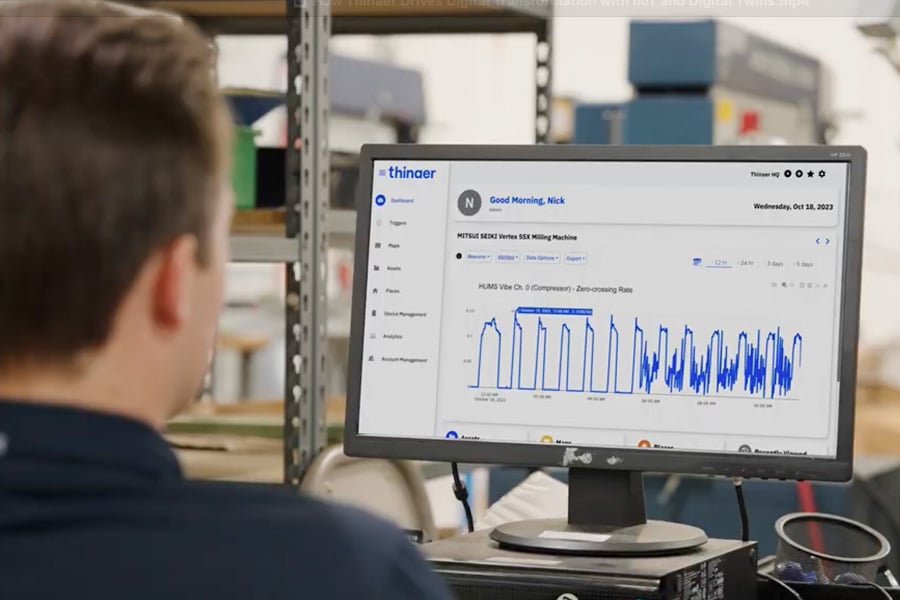
With Sonar supplying the visibility layer and Thinaer’s open APIs streaming structured telemetry outward, organizations can feed any GenAI platform, internal or commercial, without being locked to a specific vendor. The model is interchangeable. The live telemetry is the value.
- This is how a true digital thread is created.
- A CNC vibration spike correlated with a temperature shift
- A tool leaving its geofence mid-operation
- A pallet stalled between steps in a shipyard
- A mobile infusion pump idle for six hours in a hospital wing
These signals rarely appear in traditional systems, yet they unlock predictive maintenance, anomaly detection, mission readiness, and high-consequence quality control. And all of it flows from one source: structured, real-time telemetry delivered through Sonar.
From Visibility to Evolution
The evolution of Industry 4.0 is not about replacing human expertise; it is about augmenting it with flawless situational awareness. In healthcare, this means nurses spending less time searching for infusion pumps and more time with patients. In shipbuilding, it means knowing the exact status of thousands of kits and parts moving through a yard. In defense, it means ensuring asset readiness with absolute certainty.
We are currently witnessing a shift where operational resilience is defined by data integrity. The organizations that succeed in this new era will be those that solve the connection problem first. They will treat their physical operations as a data-rich environment, ensuring that every asset, person, and process contributes to the enterprise’s collective intelligence.
There is ample reason for optimism. The technology to bridge the IT/OT divide is mature, secure, and scalable. By focusing on establishing ground truth through live telemetry, industrial leaders can finally unlock the compounding value of AI, moving from reactive management to predictive, intelligent evolution.
Next Step: Are you ready to assess your own operational visibility? Would you like me to outline a “Live Data Action Plan” based on the specific blind spots in your current manufacturing or defense operations?