



The models are here. The data isn’t. A recent AWS post on Archetype AI’s Newton shows how far industrial AI has come. Newton is a physical world model that spots anomalies in sensor streams without task-specific training. It also rests on one assumption: that the physical AI data it needs already flows from your facility.
In most plants, shipyards and hangars, much of that data doesn’t exist yet. Tools, carts, work in progress (WIP) and older equipment often produce no signal at all. This post covers what physical AI data means on an industrial floor and what world model AI does with it. It also shows how to check whether your operation gives a model enough to see.
What Physical AI Data Means Outside the Robotics Lab
Physical AI data is the record of what happens in the physical world: where things are, how they move, what condition they’re in and how their surroundings change. AI systems use it to learn how the world behaves and to act on what is happening right now.
Most writing on the topic covers training data. That means robot demonstrations, simulation output and labeled datasets that teach a model how objects behave. NVIDIA’s Physical AI Data Factory is a good example of this side, built for robotics and autonomous vehicle development.
Operational data is the other half. It comes live from real facilities: the location of a torque wrench, the humidity in a paint booth, whether a machining center sat idle all shift. Industrial AI runs on this kind of data, and it’s the kind most facilities have the least of.
Simulation output
Labeled datasets
Environmental conditions
Machine utilization (on, off, idle)
Physical AI differs from AI in general mainly in its input. Most AI works with text, images and code. Physical AI works with signals from the real world and acts in it. Our guide to what physical AI is covers the rest.
What World Model AI Actually Does
A world model is an AI model trained on sensor signals instead of text. It learns how physical systems normally behave. As a result, it can flag the moment something drifts from that pattern.
Two traits make the newest world models useful in industrial settings. First, they’re multimodal, so one model can read vibration, temperature, electrical current and video together. Second, they’re zero-shot. According to the AWS post, Newton detects anomalies and diagnoses conditions in environments it has never encountered, with no training for that task.
In the Capture, Learn, Act framework, world models belong to the Learn layer. They interpret data. Something has to capture it first.
Zero-Shot Training Moves the Bottleneck to Coverage
For years, training was the hard part of industrial AI. Teams needed labeled failure data, custom models and data scientists to build them. Plenty of projects stalled at that step.
Zero-shot models remove most of that work. Once training stops being the constraint, what a model can do depends on which parts of your operation produce a signal at all.
The AWS architecture assumes most of them do. In its design, sensor and video data streams from programmable logic controllers (PLCs) and gateways through existing industrial infrastructure. That fits an instrumented production line well. However, it leaves out everything in the building that was never wired to a PLC.
The shift matters most in defense and aerospace. Many of the hardest assets to track sit in spaces that standard networks don’t reach. A model that needs no training can go live quickly there. Even so, the data feeding it still has to come from inside the security boundary.
The Parts of the Floor a World Model Can’t See
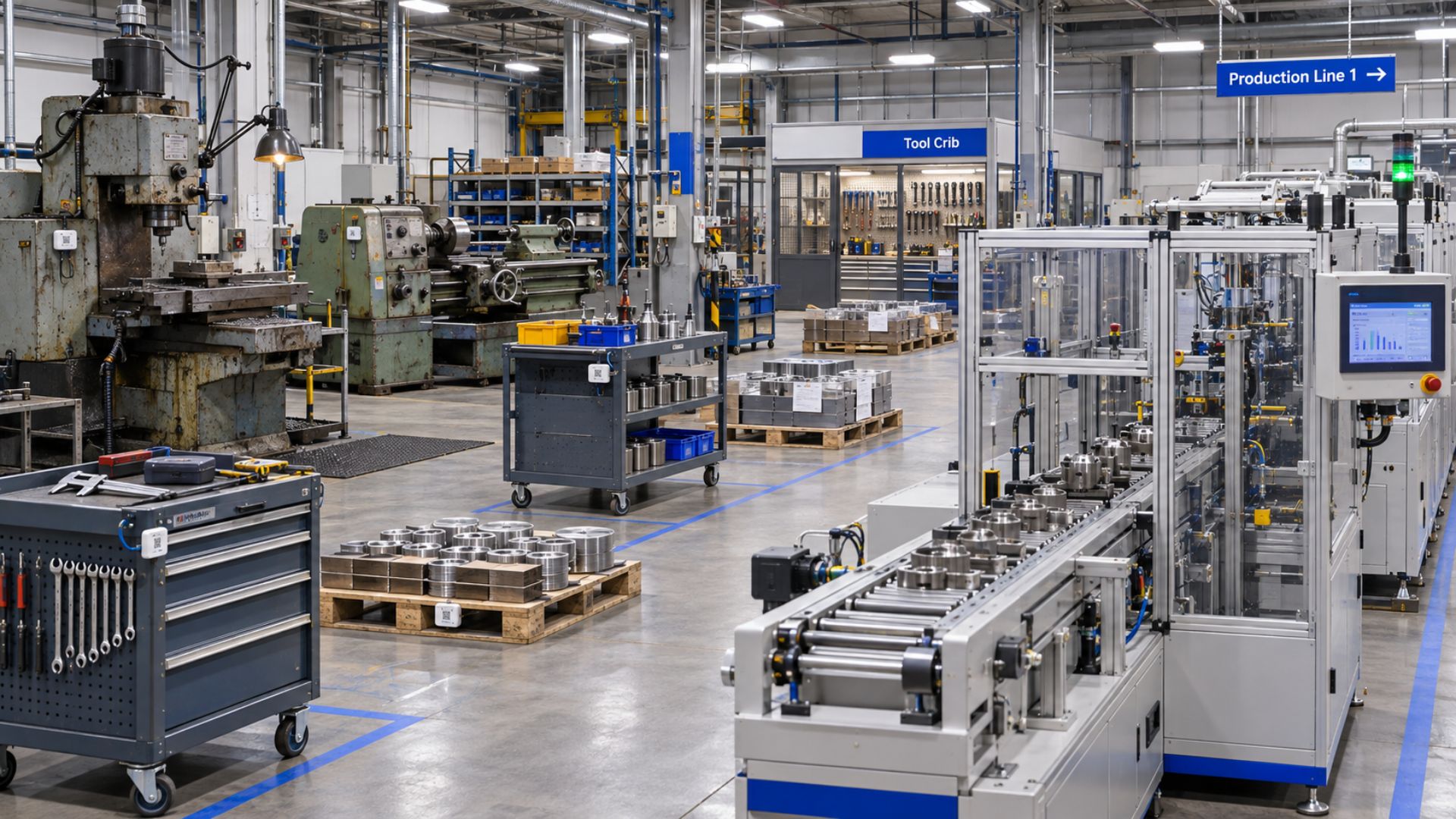
Walk any plant floor and you’ll find activity that never reaches a controller. For example:
- Tools and calibrated equipment that move between stations, cribs and job sites.
- WIP, carts and fixtures, whose location tells you where a job is stuck.
- Older machines with no network connection. Many have run for decades, and replacing them isn’t necessary to make them AI-ready.
- Temperature, humidity and pressure in rooms that hold sensitive materials.
- Steel hulls, shielded rooms and other spaces where standard radio frequency (RF) coverage fails.
- Classified bays, where most platforms aren’t allowed to deploy at all.
A world model can generalize across the sensors it has. It can’t generalize to the parts of the floor that never produce a signal.
Those gaps also limit what an anomaly means. Say a model flags a spindle motor running hot. Without location and utilization data, a technician still has to work out which machine it is. Then they need to find where it sits and how long it has run hot.
Gaps also hide from the model itself. A model built to spot deviations treats silence as normal. If a cart of WIP sits untracked in a corner for days, nothing drifts, because nothing was measured. Nobody gets an alert. The first sign is a late order or a missing tool.
Where Capture Ends and the Model Begins
World models and capture layers do different jobs. Thinaer captures the data AI runs on. The models themselves come from the AI partners and platforms our customers choose.
Some signals also sit outside what Thinaer captures. High-frequency vibration waveforms and acoustic emission come from specialized sensors, including the ones behind the fault detection the AWS post describes. Thinaer’s data complements those sensors.
What Thinaer adds is the context around them. That includes location, movement, environmental conditions and machine utilization, captured across 40+ sensor types with whatever mix of radios the environment calls for. Multimodal models also improve as they get more kinds of signal, and PLC data rarely carries location or room conditions. An anomaly becomes useful the moment it’s tied to a specific asset in a specific zone.
The data stays yours. It feeds Thinaer Sonar for immediate visibility, then flows through open APIs to any cloud and any model. That includes world models running at the edge or inside your own environment.
A Coverage Check Before You Deploy a World Model
Before you connect a world model to your operation, map what it will actually see. These four checks cover most of it:
- What share of your critical assets produces a signal today, and how many sit outside PLC reach? The answer sets the ceiling on what any model can see.
- Which zones go dark because of building materials, RF limits or security rules? Losses and delays often add up in exactly these areas.
- Who owns the data once it leaves the sensor, and can you move it to a different model later? Portability matters because new models keep arriving.
- Does the data stay inside your security boundary and your identity and access management (IAM) controls? For defense programs, that answer decides whether a project can start.
If the answers show large gaps, start with coverage, since a model can only learn from the floor it can see.
Your Environment Decides What the Model Learns
Every facility mixes steel, concrete, interference, legacy equipment and security rules in its own way. That’s why Thinaer carries every major sensing technology and backhaul option, and lets the environment decide the mix.
Today that approach runs across 150,000+ sensors, 33 locations and 12 million+ square feet. It includes ordnance environments under HERO ZERO certification and deployments approved by the Defense Information Systems Agency (DISA).
World model AI can already work on your operation, provided it gets physical AI data from the whole floor. See how Sonar turns that data into a live view of your operations. Physical AI starts here.