


Industrial foundation models are showing up in plants and engineering departments. The companies building them are clear about what the models can do. However, they say much less about what the models need first: operational data from the specific site they serve.
We have already covered how unstructured data becomes AI-ready data and what AI cannot fix when it cannot see. This post picks up with a trained model that now needs data to work on. It covers what an industrial foundation model is, how it differs from a large language model (LLM), and why the model was never the hard part.
What an Industrial Foundation Model Is
A foundation model learns from a broad body of data once, then adapts to many tasks. LLMs learned from text and code, while industrial foundation models learn from the data industry produces. Two current examples show how much that data can vary.
The first is time-series data: timestamped readings, such as a temperature reading every few seconds across a process. SUPCON unveiled its first Time-series Pre-trained Transformer (TPT) in June 2024 and presented TPT2 at Hannover Messe 2026. The launch announcement framed TPT as one pretrained model plus one software layer, replacing a separate model for each application. It named chlor-alkali, thermal power, and petrochemical plants as application areas. According to IoT Analytics’ report from the show (published June 22, 2026), TPT2 trained on data from more than 1,000 chemical and petrochemical plants. It can run in closed-loop process control, where the model writes optimization parameters directly to plant equipment.
In contrast, Siemens took a different route. Its Industrial Foundation Model is a generative AI tuned for engineering and manufacturing data. That includes 3D computer-aided design (CAD) models, bills of materials, and machining toolpaths. Siemens describes uses in machine-tool programming and production planning. Neither company’s announcement gives independently verified performance numbers.
How It Differs From an LLM
General-purpose LLMs train mostly on public text and code. Plant operations, in contrast, run on proprietary records tied to time and to specific equipment. For example, IoT Analytics lists historian records (the time-stamped process data plants already store), controller logs, and vibration readings. It says that gap is why some vendors now train their own models.
The practical result is a model with a different job. LLMs draft and summarize what people wrote down. Time-series industrial models predict and adjust what a process does next, and Siemens’ model works earlier in the cycle, on design and planning. In practice, production models need a steady stream of readings from the floor, while engineering models need organized design files and company standards.
A person reads an LLM’s wrong answer and can correct it. A model that writes parameters to equipment acts on its inputs directly, so the quality of those inputs matters more.
However, IoT Analytics does not expect domain-specific models to win everywhere. Its view is that they will succeed in areas such as robotics and CAD design, while general frontier LLMs stay ahead in areas like code generation. Either way, a model needs data from the plant it serves.
No public dataset records how a specific plant behaved during its last shift. Whatever a model learned from other sites, the plant it works in still has to supply its own current data.
Why the Model Is Only Half the Answer
Whether the data exists at all comes before any question of whether a model can use it. Our post on how unstructured data becomes AI-ready data covers the second question.
IoT Analytics sees the same gap across the industry. Its Hannover Messe 2026 report describes a central tension. Vendors have started to charge for autonomous AI decisions on the shop floor. Many manufacturers do not yet have a trusted, contextualized data foundation to support those decisions.
In its outlook, the analysts say it will take years for the average manufacturer to add data acquisition tools and reorganize existing silos. On whether AI-ready data foundations will become the bottleneck, their verdict is “So yes, it will be the bottleneck.”
Meanwhile, the same report finds industrial DataOps vendors growing quickly. Their software organizes data from plant systems, and demand comes from manufacturers who want AI-ready, contextualized data. The report lists that demand as one of 12 key industrial technology trends from the show. Industrial software vendors also argue, according to the report, that reliable AI agents need structured engineering and operations context.
Where the Missing Data Comes From
A model trained on more than 1,000 plants still needs current data from the plant where it runs. A model that writes parameters to equipment acts on whatever it is told about the plant right now. As a result, gaps in that picture become gaps in its decisions.
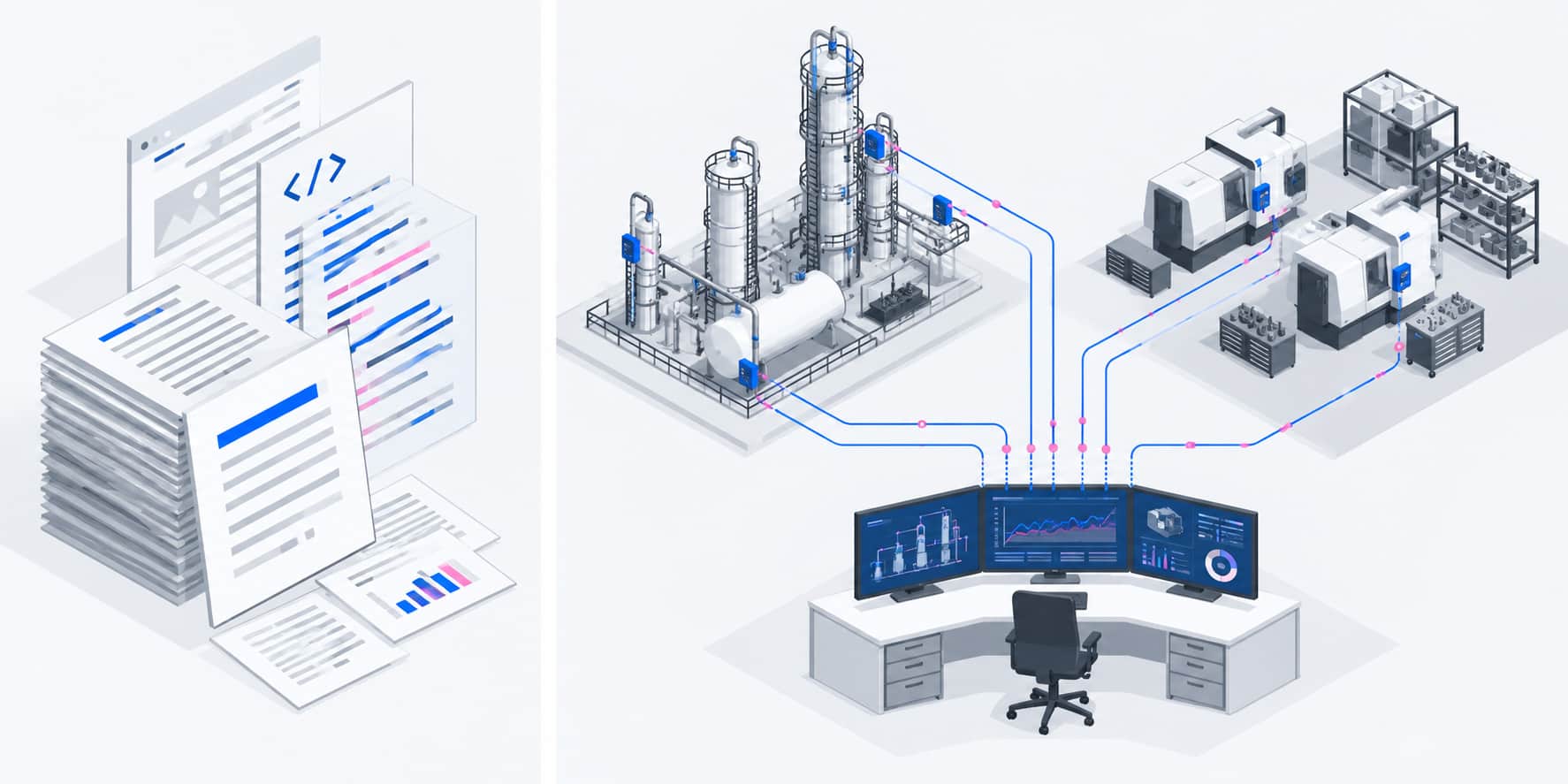
Some of the data already sits in control systems and historians. Thinaer works alongside those systems and does not replace them. High-frequency waveform data from specialized sensors also stays with the systems built to record it.
Some of the data exists nowhere until someone captures it. That includes where assets are, how they move, what the environment is doing, and which machines sit idle. Engineering data such as CAD models already exists in digital form. Data about what happens on the floor, however, exists only if someone records it.
In the Capture, Learn, Act framework, industrial foundation models belong to the Learn layer. Thinaer is the capture layer in front of them. The models belong to SUPCON, Siemens, and their peers. Thinaer captures operational data from the physical environment, including classified facilities where standard platforms cannot operate. It carries more than 40 sensor types, and the environment decides which ones a site uses. It delivers that data through Sonar and open interfaces, so the customer can point it at any model on any cloud.
Four Questions to Ask Before You Deploy One
These questions test a plant’s data readiness before the first pilot of an industrial foundation model.
- What does the model need from my site on day one, and what does it need continuously after that?
- Which of that data do I already record, and at what interval?
- Which of it comes from places no system records today, such as storage areas, shared tooling, or secure areas?
- Who owns the data and the outputs, and can I point a different model at the same data later?
Questions one and two usually go quickly, because control systems and historians have answers. Question three, however, takes longer. Those places often have no system recording what happens in them. A capture layer covers that gap.
Question four protects the plant’s options. A plant that owns its data can change models without recapturing anything.
What Each New Environment Adds
Each new environment adds to a body of structured data for AI that every model, analytics tool, and digital twin the customer runs can use. Thinaer has deployed more than 150,000 sensors across 33 locations. The same deployment that gives operators day-one visibility in Sonar also builds that dataset. Operators use Sonar from the first day, so the dataset grows during normal operations instead of waiting on a separate data project. A leading defense OEM has documented multi-million dollar ROI from its deployment.
When a new model release arrives, the data it needs is already flowing. A customer who switches models, or runs two at once, keeps the same data, because the customer owns it.
Capture Comes Before the Model
Any industrial foundation model still depends on what a plant records about itself. SUPCON and Siemens have shown the models exist, and IoT Analytics expects the data foundation to be the bottleneck. Physical AI starts with capturing it.
See how Thinaer captures the operational data industrial foundation models need.